
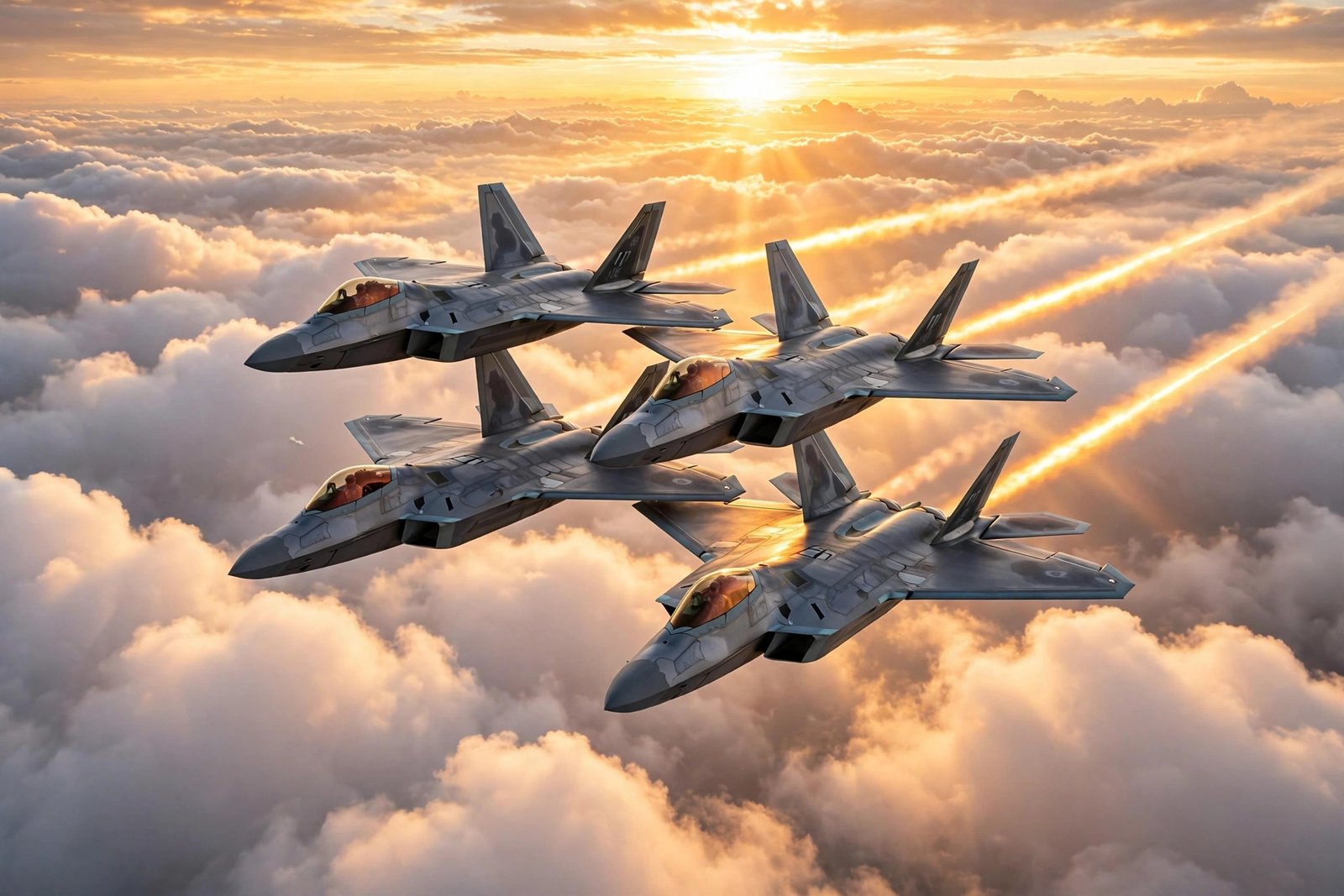
Look up on a clear day almost anywhere in the United States and there is a good chance an American military aircraft is somewhere overhead. It might be a fighter jet climbing out of a base in Nevada, a tanker refueling another plane high above the Atlantic, or a giant transport carrying troops and supplies toward the other side of the world. That constant presence is no accident. It is the work of the United States Air Force, the branch of the American military that owns the sky, and it has spent nearly eighty years building a force no other country can match.
The U.S. Air Force is the youngest of the American military services, but it is also the largest air force on the planet. Its aircraft range from stealth fighters that are almost invisible to radar to bombers that first flew when Dwight Eisenhower was president and are still flying today. This is the story of how America came to rule the skies, what the Air Force actually has in its arsenal, and where it is headed next.
Born in 1947: How the Air Force Became Its Own Service
For the first forty years of military aviation, American airmen flew as part of the Army. The story began in 1907, when the Army created an Aeronautical Division inside the Signal Corps, and it grew through two world wars. During World War II, the Army Air Forces became a huge fighting organization in its own right, with thousands of aircraft and more than two million people in uniform. Yet it was still, legally and organizationally, part of the Army.
Everything changed after the war. President Harry S. Truman signed the National Security Act of 1947, which created the Department of the Air Force, and the new service officially became a separate branch on September 18, 1947, when the first Secretary of the Air Force, W. Stuart Symington, was sworn into office. The Air Force’s own fact sheet describes that moment as the end of a forty-year association with the Army and the start of a new era in which airpower became firmly established as a major element of the nation’s defense.
The timing mattered. The world was entering the Cold War, and the airplane had just proved in World War II that it could decide the fate of nations. The new service took on three jobs that still define it today: winning control of the air, striking targets anywhere on Earth, and moving people and cargo across the globe at a speed no ship or truck could match. Over the decades that followed, the Air Force added new missions, including the nuclear deterrent, space operations, and cyber defense.
By the Numbers: The World’s Largest Air Force
Size is the simplest way to understand the Air Force, and the numbers are striking. According to the 2026 edition of the Air and Space Forces Magazine almanac, the Total Aircraft Inventory stood at 4,865 aircraft as of September 30, 2025, counting the active-duty force, the Air National Guard, and the Air Force Reserve together. Add in a small number of specialized aircraft the main table does not carry, and the fleet sits close to 5,000 aircraft. No other air force in the world comes close to that total.
The people behind the machines are just as impressive. The same almanac records 319,119 active-duty personnel as of September 30, 2025, including officers, enlisted airmen, and Air Force Academy cadets. Congress authorized an active-duty end strength of 321,500 airmen for fiscal year 2026. Beyond the active force, the Air National Guard counts about 105,000 to 106,000 members and the Air Force Reserve roughly 67,500 to 95,000 depending on how the count is drawn, supported by around 183,000 civilian employees. Altogether, the total force numbers more than 678,000 people.
That force is organized into major commands that each own a piece of the mission. Air Combat Command flies the fighters and bombers based in the United States. Air Mobility Command runs the tankers and transports. Air Force Global Strike Command owns the bombers and the intercontinental ballistic missiles. Pacific Air Forces and United States Air Forces in Europe and Africa cover their regions of the world, while Air Force Special Operations Command, Air Education and Training Command, and Air Force Materiel Command handle special missions, training, and the vast work of buying and maintaining aircraft.
One honest note belongs here too. The fleet is aging: the same almanac puts the average age of Air Force aircraft at 31.75 years, the oldest fleet in the service’s history, and the service has been retiring older aircraft faster than it buys new ones.
The Fighters: F-22, F-35, F-15 and F-16
If the Air Force has a public face, it is the fighter jet. Fighters win control of the air, and without control of the air, nothing else the military does is possible. The Air Force flies two fifth-generation stealth fighters, a term that means the jets are designed to be hard for enemy radar to see, packed with advanced sensors, and able to share information across a network in real time.
The F-22 Raptor is the Air Force’s air dominance fighter. Its primary job, as the Air Force fact sheet puts it, is air dominance in a multi-role fighter, combining stealth, supercruise, maneuverability, and integrated avionics. Supercruise means the jet can fly faster than the speed of sound without using fuel-hungry afterburners, and its top speed is in the Mach 2 class. The F-22 entered service in December 2005, and production was capped at 195 aircraft, with the Air Force’s fact sheet listing a total force of 183 as of August 2022. It has never been exported. The United States is the only country that flies it, and American law has barred its sale abroad since the program began.
The F-35 Lightning II is the workhorse of the future. It is a multirole stealth fighter built to strike ground targets, gather intelligence, and share sensor data with other aircraft and ships. The Air Force’s F-35A is the conventional takeoff version, while the Marine Corps and Navy fly their own variants. The Air Force has more than 300 F-35s in service and plans to buy 1,763 of the A-model in total. More than 1,100 F-35s have been delivered worldwide, and the jet is flown by the United States and many allied nations, which makes it the backbone of Western airpower for decades to come.
Behind the stealth jets stands the older generation that still does much of the daily work. The F-15 Eagle family, including the newer F-15EX, remains a powerful air-to-air and strike fighter, and the F-16 Fighting Falcon is the most numerous fighter in the fleet, with more than 800 in service. Together, the mix of stealth and proven fourth-generation fighters gives the Air Force depth that no rival can match.
The Bombers: B-52, B-1, B-2 and the B-21 Raider
Bombers are the Air Force’s long arm. They can take off from the United States, fly across oceans, and strike targets on the other side of the world, with or without refueling. The Air Force currently flies three strategic bombers, and a fourth is in testing.
The B-52 Stratofortress is the legend of the fleet. It entered service in 1955, which means it has been flying for more than seventy years, and it is still the most numerous bomber in service, with 76 aircraft. The B-52 is a long-range heavy bomber that can carry both nuclear and conventional weapons, and the Air Force is modernizing it into a new B-52J configuration with new engines, a change meant to keep it flying well into the 2050s.
The B-1B Lancer is the only supersonic bomber in the fleet, with 44 to 45 aircraft in service. Its variable-sweep wings let it fly fast at low altitude, and it can carry a very large load of conventional weapons over intercontinental distances without refueling. The B-2 Spirit is the opposite idea: a flying-wing stealth bomber, designed to slip past enemy air defenses unseen. Only 20 were built, and 19 remain in service, all based at Whiteman Air Force Base in Missouri. It is the world’s most technologically advanced strategic bomber, and the only one of its kind.
The future is the B-21 Raider, built by Northrop Grumman. The Air Force intends to acquire at least 100 B-21s, and the aircraft is now in flight testing, with only a small number of test aircraft flying so far. The B-21 is described as the first sixth-generation aircraft in the world, and it will eventually replace both the B-1 and the B-2. The Air Force Global Strike Command fact sheet says the B-21 will bring an initial capability around 2028, and Ellsworth Air Force Base in South Dakota is set to become its first operational home, followed by Whiteman and Dyess Air Force Base in Texas. Until the Raider is fully fielded, the older bombers carry the mission.
The Nuclear Mission: Air Force Global Strike Command
One command carries the heaviest responsibility in the Air Force. Air Force Global Strike Command, activated on August 7, 2009, and headquartered at Barksdale Air Force Base in Louisiana, is responsible for the nation’s three intercontinental ballistic missile wings, the Air Force’s entire bomber force, and the B-21 Raider program. Its fact sheet counts more than 33,700 airmen and civilians in the command.
The command’s job is deterrence, the idea that a potential enemy will not attack because the response would be overwhelming. The Air Force provides two of the three legs of America’s nuclear triad: the bombers, and the land-based intercontinental ballistic missiles, or ICBMs. The third leg, submarine-launched missiles, belongs to the Navy. The ICBM force consists of Minuteman III missiles based in underground silos in the northern plains.
Deterrence is a quiet mission. The bombers train constantly, the missile crews sit alert around the clock, and the goal is that none of it is ever used. The command also flies Bomber Task Force deployments, sending bombers to train with allies in Europe, the Middle East, and the Indo-Pacific. Those flights are visible on purpose: they show friends that America is present, and they remind rivals that American airpower can reach anywhere.
Around the World: Bases, Tankers and Airlift
Fighters and bombers get the attention, but the Air Force could not do its job without the aircraft that rarely make headlines. Air refueling tankers, led by the KC-135 Stratotanker and the newer KC-46 Pegasus, extend the reach of every other aircraft, letting fighters cross oceans and bombers stay on station for hours.
Transport aircraft are the other half of the equation. The C-17 Globemaster III and the C-5M Super Galaxy move tanks, helicopters, and troops across continents, while the C-130 Hercules handles shorter flights into rough airfields. The same aircraft that carry soldiers into a crisis also carry food, medicine, and rescue teams after earthquakes and hurricanes, and the Air Force’s airlift fleet is often the first American help to arrive after a disaster anywhere in the world.
The Air Force operates from roughly 77 installations in the United States and many more overseas, with major hubs in Europe, the Middle East, and the Pacific. Bases in Japan, South Korea, Germany, and the United Kingdom put American aircraft within hours of the world’s flashpoints.
What Comes Next
The Air Force of the next decade will look different from the one that flies today. The F-47, a sixth-generation fighter chosen to eventually replace the F-22, is in development. The B-21 Raider is moving toward service. The Sentinel missile will replace the Minuteman III. And the service is investing heavily in uncrewed aircraft, known as collaborative combat aircraft, that will fly alongside crewed fighters as loyal wingmen, extending their sensors and weapons without putting more pilots at risk.
The challenges are real: the fleet is the oldest it has ever been, and the budget is stretched across three giant modernization programs at once. Yet the underlying advantage has not changed. No other country operates a fleet of nearly 5,000 aircraft, a global network of bases, and a tanker and transport force that can put airpower anywhere on Earth within a day. That combination is what it means to rule the skies.
Related reading
Want to go deeper into American air and sea power? Read the story of the F-35 Lightning II, explore how the U.S. Space Force works, and see how Navy aircraft carriers project power at sea.
Frequently Asked Questions
When did the U.S. Air Force become a separate service?
The Air Force became a separate military service on September 18, 1947, when the first Secretary of the Air Force, W. Stuart Symington, was sworn into office under the National Security Act of 1947. Before that, American military aviation was part of the Army, tracing its roots back to 1907.
How many aircraft does the U.S. Air Force have?
The 2026 almanac from Air and Space Forces Magazine lists a Total Aircraft Inventory of 4,865 aircraft as of September 30, 2025, across the active force, the Air National Guard, and the Air Force Reserve. Counting a small number of specialized aircraft not carried in that table, the fleet is close to 5,000 aircraft, making it the largest air force in the world.
What is the difference between the F-22 and the F-35?
The F-22 Raptor is a dedicated air dominance fighter built to win control of the sky, with supercruise speed and extreme maneuverability, and only the United States flies it. The F-35 Lightning II is a multirole stealth fighter built to strike ground targets, gather intelligence, and share data across a network, and it is flown by the United States and many allies.
What bombers does the Air Force fly?
The Air Force flies three strategic bombers today: the B-52 Stratofortress, with 76 in service; the supersonic B-1B Lancer, with 44 to 45 in service; and the stealth B-2 Spirit, with 19 in service. The B-21 Raider, a sixth-generation stealth bomber now in testing, will eventually replace the B-1 and B-2.
What does Air Force Global Strike Command do?
Air Force Global Strike Command, headquartered at Barksdale Air Force Base in Louisiana, is responsible for the nation’s intercontinental ballistic missile wings, the Air Force’s entire bomber force, and the B-21 Raider program. Its mission is nuclear deterrence and global strike, with more than 33,700 airmen and civilians in the command.