
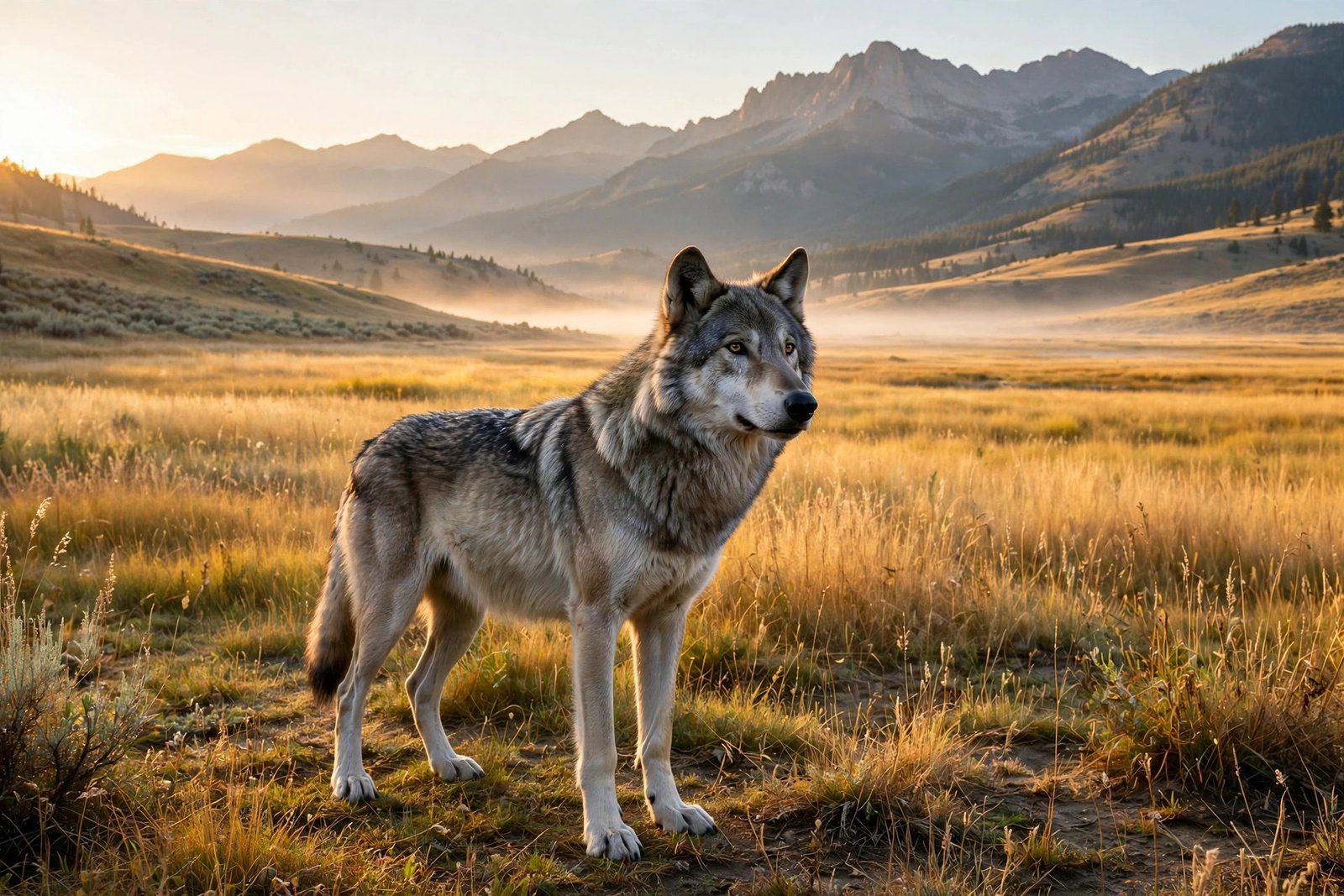
On a cold January morning in 1995, a small group of gray wolves stepped out of acclimation pens in Yellowstone National Park and into a landscape that had not heard their howl in nearly seventy years. Fourteen wolves from Alberta, Canada, had been brought to the park in the first release. Seventeen more from British Columbia followed in 1996, and ten wolves from northwest Montana were added in 1997, bringing the total number of founders to 41. What happened next became one of the most famous wildlife stories in American history.
The return of the wolf to Yellowstone changed the park in ways scientists are still studying. Elk behavior shifted. Willows and aspen grew taller in some places. Beavers returned to streams they had abandoned. And millions of visitors began coming to the Lamar Valley at dawn, hoping to see a wolf through a spotting scope. But the story is more complicated than the headlines suggest. The science behind the famous “trophic cascade” is still debated, the wolf population has risen and fallen, and the politics of wolf management outside the park remain heated. This is the honest story of the gray wolf comeback, from the last wolf killed in 1926 to the 84 wolves counted in the park at the end of 2025.
How Yellowstone Lost Its Wolves
Gray wolves were once common across the American West, including Yellowstone. When the park was established in 1872, wolves were part of its wildlife, along with elk, bison, grizzly bears, and mountain lions. But in the early 20th century, the federal government ran a predator-control campaign that treated wolves as a threat to livestock and game. Park rangers and government hunters killed wolves inside Yellowstone, and the last known pack in the park was killed in 1926. For roughly the next seventy years, Yellowstone had no wolves at all.
The effects of that absence built up slowly. Without wolves, elk numbers grew, and elk spent more time browsing along streams and valley bottoms. Young willows and aspen were eaten before they could grow tall. Beavers, which depend on willow for food and dam building, declined. The park’s riverside habitats thinned out. At the time, few people connected these changes to the missing wolves. It was only later, when ecologists began to study the park as a whole system, that the wolf’s role as a top predator became clear.
The legal groundwork for the wolves’ return was laid in 1973, when the U.S. Fish and Wildlife Service listed the northern Rocky Mountain gray wolf as endangered and designated the Greater Yellowstone Ecosystem as one of three recovery areas. From 1991 to 1994, the National Park Service, the U.S. Fish and Wildlife Service, and state governments developed a reintroduction plan and an environmental impact statement. In 1995, the Secretary of the Interior approved the plan, and the wolves came home.
The Reintroduction: 41 Wolves, Three Winters
The reintroduction was careful and deliberate. In January 1995, 14 gray wolves captured in Alberta, Canada, were brought to Yellowstone and held in acclimation pens for about ten weeks before their release. They formed the Crystal Creek, Rose Creek, and Soda Butte packs, the first breeding packs in the park in nearly seventy years. In 1996, 17 more wolves from British Columbia were released. In 1997, ten wolves from Montana, pups from a pack in the state’s northwest corner that had been broken up after going after livestock, were added. In total, 41 wild wolves were released in Yellowstone between 1995 and 1997.
The released wolves were listed as “nonessential experimental” under the Endangered Species Act, a special status that gave wildlife managers flexibility to deal with wolves that left the park and caused problems for ranchers. A parallel release in central Idaho brought the total number of wolves released in the Northern Rockies in 1995 and 1996 to 66, which is why that larger figure sometimes appears in news reports. The Yellowstone number is 31 for the first two years, and 41 when the 1997 Montana wolves are included.
The wolves did what wild animals do: they bred, they formed packs, and they spread. By 2001, there were 132 wolves in Yellowstone and 216 wolves within the Greater Yellowstone Area, according to the Yellowstone Wolf Project’s annual reports. The population kept growing, and by the mid-2000s it reached a peak of about 175 wolves in the park. The reintroduction, by the plain measure of survival and spread, had worked.
What the Wolves Changed
Within a few years of the wolves’ return, researchers began reporting striking changes. Elk, the wolves’ main prey, became more cautious. They spent less time standing in open valleys and along stream banks, and more time moving and staying alert. In places where elk browsing eased, young willows and aspen grew taller. In some streams, beavers returned to build dams, ponds reappeared, and songbirds came back to the thickets. This chain of effects, wolves affecting elk, elk affecting plants, and plants affecting beavers and other wildlife, is called a trophic cascade.
A series of papers by researchers William Ripple and Robert Beschta and their colleagues documented these patterns. Their 2001 study in Biological Conservation reported that wolf reintroduction had started a trophic cascade among wolves, elk, and aspen on Yellowstone’s northern range, and their 2012 follow-up covered the first fifteen years after the wolves’ return. The story caught the public imagination. A popular video and countless articles told a simple, satisfying tale: wolves changed the rivers.
But the tidy version of the story was always too simple. Elk numbers did decline in parts of the Greater Yellowstone Ecosystem after the wolves returned, but the decline was not uniform, and it was not driven only by wolf predation. Drought, hunting outside the park, a growing grizzly bear population, and other factors also shaped elk numbers. A 2010 landscape-scale study by Matthew Kauffman and colleagues concluded that aspen recruitment did not increase across the northern range in the straightforward way early trophic-cascade proponents had predicted, and that hydrology, fire suppression, and climate history were also strong controls on plant recovery.
The Trophic Cascade Debate: What the Science Actually Says
The debate over Yellowstone’s trophic cascade is still live, and it is worth understanding honestly. In 2025, a high-profile study reported a dramatic willow rebound after wolf recovery, including a claim that willow crown volume had risen by about 1,500 percent. A peer-reviewed rebuttal in Global Ecology and Conservation then argued that conclusion was invalid, pointing to problems in the study’s methods, including comparisons across unmatched plots and sampling bias. The critics’ reanalysis found no evidence for a dramatic, park-wide surge in willow.
The honest summary, from the current back-and-forth, is that a trophic cascade did occur, but its strength was overstated. Willow recovery is more modest, more patchy, and driven as much by hydrology, beaver activity, and local site conditions as by wolves alone. Wolves reshaped elk behavior and helped some plant communities recover, but “wolves changed the rivers” is a story the science no longer fully supports in its strongest form.
That does not make the reintroduction a failure. Far from it. The wolves restored a missing predator to a major ecosystem, gave scientists one of the best-studied natural experiments in ecology, and created a thriving wolf population that visitors can watch in the wild. The cascade debate is what good science looks like: a bold idea, tested, argued over, and refined. The wolves are real. The changes are real. The argument is about how big the changes were, and why.
Where the Wolves Stand Today
Yellowstone’s wolf population has risen and fallen since the reintroduction, driven by prey, disease, and conflict between packs. The Yellowstone Wolf Project counts the park’s wolves each year, and the numbers tell a story of natural fluctuation. At the end of 2024, the park counted 108 wolves in nine packs. At the end of 2025, the count was 84 wolves in seven packs and one new group, down from the 108 the year before. Only 17 pups survived the year, the fewest since 1996, which the park’s annual report attributed to a mix of causes that may include disease. Canine distemper has killed pups in the park in past summers.
The 2025 decline was within the natural fluctuation of the population, according to the Wolf Project’s lead biologist Dan Stahler. Over the past twelve years, the population has generally held at around 100 to 110 wolves, and the 2025 count, while lower, is not a sign of collapse. The largest pack at the end of 2025 was Wapiti Lake, with 18 wolves. The Junction Butte pack, the one most associated with the Lamar Valley, finished the year at 15 wolves. Wolves killed 153 animals that park staff found in 2025, including 72 elk.
The legal status of wolves has changed more than once. Wolves in the Northern Rockies were delisted in Montana and Idaho in 2011 by an act of Congress, and in Wyoming in 2017. In February 2024, the U.S. Fish and Wildlife Service found that listing wolves in the western states was not warranted. In August 2025, a federal judge in Missoula vacated most of that finding and sent it back to the agency. Wolves that leave Yellowstone can be legally hunted in the surrounding states, which is one of the reasons a well-known wolf can vanish from the Lamar Valley between one season and the next. The politics of wolf management remain contested, and the wolves themselves live in the middle of it.
Wolf Watching in the Lamar Valley
For visitors, the best place to see Yellowstone’s wolves is the Lamar Valley, a wide, open valley in the park’s northeast corner that is often called America’s Serengeti. Wolves are most active at dawn and dusk, and the valley’s open meadows make them easier to spot than in the park’s dense forests. The Junction Butte pack is the one most often seen in the Lamar Valley and nearby Slough Creek, while the Wapiti Lake pack is associated with Hayden Valley.
Wolf watching is a social activity in Yellowstone. Regular watchers gather at roadside pullouts with spotting scopes, and they are usually happy to share a look and tell you what pack is in view. The park’s Wolf Project uses radio collars and field observation to track the packs, and many individual wolves are known by number, such as 907F of the Junction Butte pack. Bring binoculars or a spotting scope, dress warmly, and arrive before sunrise for the best chance. Wolves are wild animals, and sightings are never guaranteed, which is part of what makes them special.
Why the Wolf Comeback Still Matters
Thirty years after the first fourteen wolves stepped out of their pens, the Yellowstone wolf story is no longer just a conservation success. It is a lesson in how ecosystems work, how science corrects itself, and how a single decision can echo for decades. The wolves brought back a missing piece of Yellowstone, and the park is wilder and more complete because of it. They also brought back an argument, about predators, livestock, hunting, and the role of people in wild places, that is still being settled in courtrooms and statehouses across the West.
Related reading
For more American wildlife comeback stories, read The Whooping Crane Comeback Guide, The Bald Eagle Comeback: A Conservation Success, and The American Bison Comeback: Return of the Herds.
Frequently Asked Questions
When were wolves reintroduced to Yellowstone?
Wolves were reintroduced to Yellowstone National Park in January 1995, when 14 gray wolves from Alberta, Canada, were released after about ten weeks in acclimation pens. Seventeen more from British Columbia followed in 1996, and ten from Montana were added in 1997, for a total of 41 founders.
How many wolves are in Yellowstone now?
At the end of 2025, the Yellowstone Wolf Project counted 84 wolves in seven packs and one new group, down from 108 wolves in nine packs at the end of 2024. The population has generally held at around 100 to 110 wolves over the past twelve years, and the 2025 dip is considered natural fluctuation, possibly linked to disease.
What is a trophic cascade?
A trophic cascade is a chain of effects in a food web: a top predator affects its prey, the prey affects plants, and the plants affect other species. In Yellowstone, wolves changed elk behavior, which helped willows and aspen grow in some places, which helped beavers return. Scientists still debate how strong and how widespread the cascade was.
Where is the best place to see wolves in Yellowstone?
The Lamar Valley in the park’s northeast corner is the best-known wolf-watching area, especially at dawn and dusk. The Junction Butte pack is the one most often seen there. Bring binoculars or a spotting scope, arrive early, and stay at least 100 yards from any wolf you see.
Are Yellowstone wolves still protected?
Wolves in the Northern Rockies were delisted in Montana and Idaho in 2011 and in Wyoming in 2017, so they are managed by the states, not the federal government. In February 2024, the U.S. Fish and Wildlife Service found that relisting was not warranted, but in August 2025 a federal judge vacated most of that finding and sent it back to the agency. Wolves inside the park are protected by the National Park Service.