
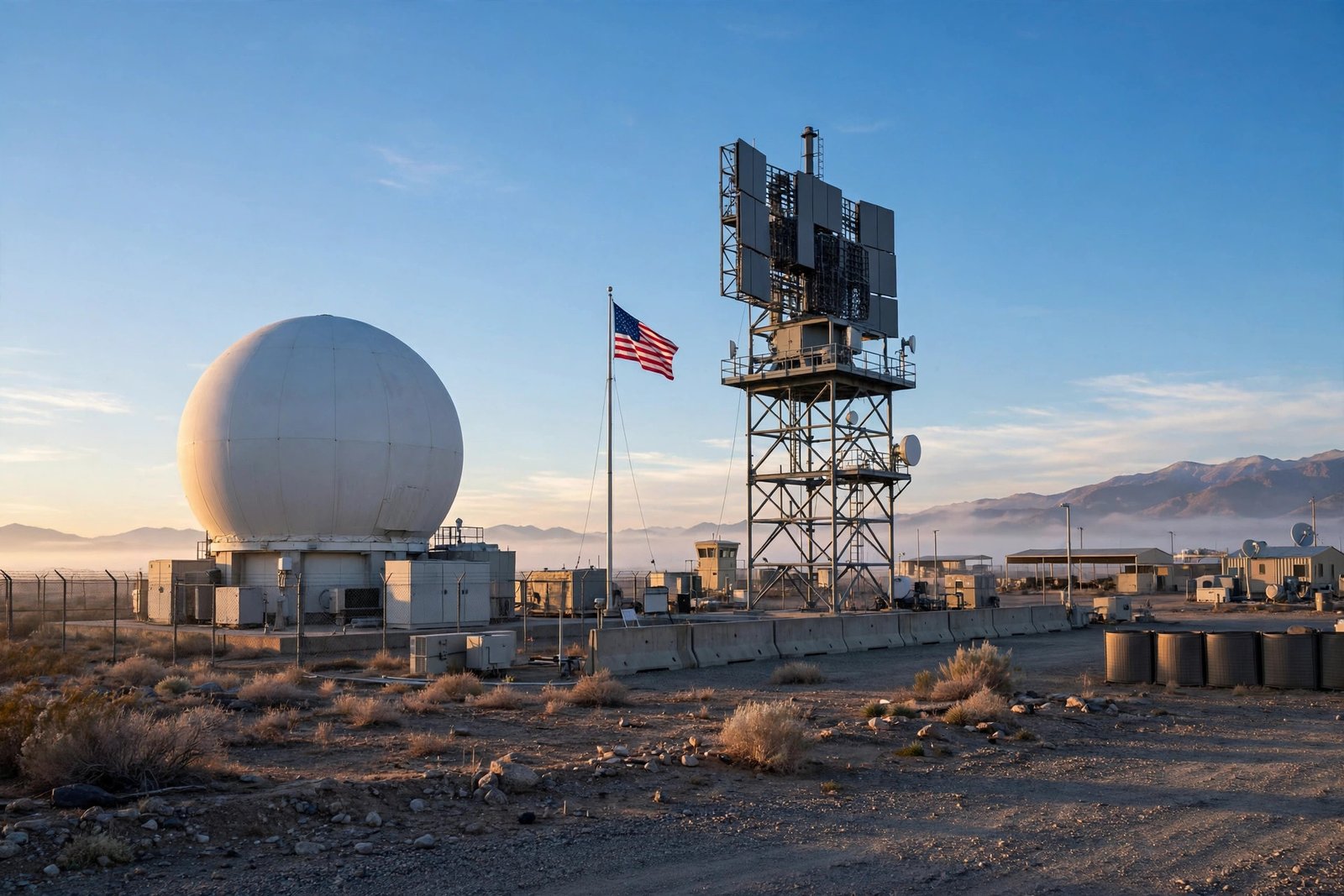
America has spent decades protected by oceans, distance, and a missile defense system built for a simpler era. Golden Dome is the plan to change that. Announced in 2025, it is the most ambitious homeland missile defense project the United States has attempted since President Ronald Reagan proposed the Strategic Defense Initiative in the 1980s, and it aims to do something no American system has ever tried: shield the entire country from ballistic, hypersonic, and cruise missiles, with sensors and interceptors in space as well as on the ground.
The idea sounds simple enough. Missiles come in, the shield knocks them down. The reality is far more complicated, and far more expensive. The White House put the price at about $175 billion and promised the system within three years. The Congressional Budget Office, the nonpartisan scorekeeper for Congress, has estimated the true cost could reach $1.2 trillion over 20 years. Between those two numbers sits one of the biggest debates in American defense policy. Here is what Golden Dome actually is, how it is supposed to work, who is building it, and why so many experts are skeptical.
What Is Golden Dome?
Golden Dome is a planned multi-layer missile defense system designed to protect the American homeland. Unlike the missile defenses the United States operates today, which are built mainly to stop a limited attack from a smaller adversary, Golden Dome is meant to defend against attacks from any direction, including from peer adversaries with large and advanced arsenals. Its targets are ballistic missiles, hypersonic weapons that travel at more than five times the speed of sound, and cruise missiles that fly low and slow enough to slip under traditional radar coverage.
The Pentagon describes Golden Dome as a system of systems, not a single weapon. It stitches together things the military already has, like ground-based interceptors in Alaska and California, with things that do not exist yet, like satellites carrying sensors and interceptors in orbit. The goal is a shield that can spot a launch anywhere on Earth, track the missile through its flight, and destroy it before it reaches American soil.
The idea began with an executive order. On January 27, 2025, President Donald Trump signed Executive Order 14186, titled The Iron Dome for America, directing the secretary of defense to deliver a plan for a next-generation missile defense shield within 60 days. The order called ballistic, hypersonic, and cruise missiles the most catastrophic threat facing the United States, and it ordered the Pentagon to build a shield that would deter attacks and defend American citizens and critical infrastructure. The name was later changed to Golden Dome, but the mission in the order stayed the same.
The May 2025 Announcement
Golden Dome moved from paper to public plan on May 20, 2025, when President Trump announced the system from the Oval Office. Standing beside the announcement, the president said the shield would be completed within three years, before the end of his term, at a cost of about $175 billion. It was a striking promise: a nationwide missile shield, including weapons in space, built on a timeline shorter than most single Pentagon programs take just to finish testing.
Few technical details were released that day. There was no public list of how many satellites would be needed, how many interceptors would be built, or where the ground sites would go. What was clear was the ambition. The president said the system should be fully operational before the end of his term, and the administration presented Golden Dome as the centerpiece of its defense agenda. The announcement immediately drew comparisons to Reagan era Star Wars plans, and just as quickly drew skepticism from defense analysts who noted that no country has ever built anything like it.
The funding followed quickly. Congress included roughly $25 billion for Golden Dome in the reconciliation bill passed in July 2025, giving the program its first large tranche of money. The Congressional Research Service later put the figure for integrated air and missile defense in that law at $24.4 billion, available through September 2029. That money got the program started, but it was only a fraction of even the administration’s own $175 billion estimate, and the question of where the rest would come from has hung over the program ever since.
How the Shield Is Supposed to Work
To understand Golden Dome, it helps to understand how a missile flies. A ballistic missile passes through three phases: the boost phase, when its rockets are burning just after launch; the midcourse phase, when it coasts through space toward its target; and the terminal phase, when it plunges back toward Earth. Each phase offers a different chance to stop it, and each chance requires different tools. Golden Dome is designed to attack the problem in every phase at once.
According to a Pentagon briefing presented to defense contractors in Huntsville, Alabama, and first reported by Reuters in August 2025, Golden Dome will have four layers: one based in space and three on land. The space layer is the most novel part. Satellites equipped with sensors would watch for the heat of a missile launch anywhere on the globe, track the missile as it climbs, and hand that tracking data to interceptors. Some of those interceptors would also be based in space, positioned to strike an enemy missile during its boost phase, when it is slowest, brightest, and most vulnerable.
The ground layers build on systems the United States already operates. The Ground-Based Midcourse Defense system, with more than 44 interceptors spread between Alaska and California, is the only American system designed to stop an intercontinental ballistic missile in flight. The Terminal High Altitude Area Defense system, known as THAAD, and the Navy’s Aegis ballistic missile defense ships would handle threats in their final approach, along with Patriot missile batteries for lower-altitude defense. The Reuters report on the Pentagon slides said the plan included 11 short-range batteries located across the continental United States, Alaska, and Hawaii.
Connecting all of this is the hardest part. Sensors in space, radars on the ground, ships at sea, and interceptor batteries on land must all share targeting data in seconds, through a command-and-control network that the Pentagon has described as using artificial intelligence to sort threats and assign interceptors. Historically, American missile defense systems have struggled to talk to each other. Golden Dome’s success depends on solving that problem at a scale nobody has attempted.
The Man in Charge: Gen. Michael Guetlein
Running Golden Dome is Space Force Gen. Michael Guetlein, a career space officer who was nominated to lead the program in May 2025 and confirmed by the Senate on July 17, 2025. He took charge of the effort on July 21, 2025, and on his second day on the job he told an audience at the Space Foundation that he had been given 60 days to deliver an objective architecture for the shield, and that he believed the technology, including space-based interceptors, already existed to protect America.
Guetlein has been blunt about both the promise and the pressure. He has said space-based interceptors can be ready by 2028 from a technical standpoint, and he has described the program’s priority as defending against what he has called a coercive decapitation or rogue nation attack against the homeland. In September 2026, he said the architecture was being prioritized against that kind of attack, with initial capability still targeted for mid-2028. He has also been candid about the funding problem. In August 2026, he warned that a stopgap spending bill does not help Golden Dome, because the program has no regular budget line to fall back on.
Under Guetlein, the program has moved quickly by Pentagon standards. The first operational site broke ground at Joint Expeditionary Base Fort Story in Virginia, and in June 2026 the program completed what Guetlein called its most complex test yet at White Sands Missile Range in New Mexico. By mid-August 2026, he said about 90 percent of the first funding tranche had already been obligated. His office reports to the Deputy Secretary of Defense.
The Price Tag: $175 Billion, $185 Billion, or $1.2 Trillion?
No part of Golden Dome is debated more than its cost, and the estimates depend heavily on who is doing the counting and what they are counting. The administration’s original figure, announced in May 2025, was about $175 billion. In March 2026, Guetlein said the official estimate had risen by $10 billion, to $185 billion, because the program had been asked to procure additional space capabilities. That figure covers the objective architecture through delivery in about 2035, according to his testimony.
The Congressional Budget Office sees a much larger bill. In a May 2026 illustrative estimate, the CBO put the cost of developing, deploying, and operating the system at $1.2 trillion over 20 years. The CBO separately estimated that the space-based interceptor portion alone could cost $542 billion. The gap between the two estimates is not a rounding error. It reflects different assumptions about how many satellites and interceptors are needed, how long they last in orbit, and how much it costs to replace them.
Other analysts have gone higher still. The American Enterprise Institute has estimated costs as high as $3.6 trillion depending on the architecture. Guetlein has dismissed outside estimates, saying they do not price the system he is actually building. What is certain is that the funding path is already strained. For fiscal 2027, the Pentagon requested $17.5 billion for Golden Dome, but only $398 million of that sat in the regular base budget, with the rest depending on funding outside the normal appropriations process.
Why Critics Say the Timeline Is Too Ambitious
The three-year timeline has drawn the sharpest criticism. Building a space-based interceptor constellation means launching hundreds, possibly thousands, of satellites, and keeping enough of them in the right orbits at all times to cover likely launch sites. Because satellites move fast and the Earth turns beneath them, only a small fraction of the constellation is ever in position to act on a given threat. Critics argue that this makes space-based interceptors far less efficient than ground-based defenses, which sit and wait where they are needed.
Then there is the physics. Hypersonic glide vehicles do not follow the predictable arc of a traditional ballistic missile, which makes them much harder for midcourse interceptors to catch. Cruise missiles fly low, under the radar horizon, and can be launched from ships close to American shores. Defending against all three threat types at once, across roughly 3.8 million square miles, is a fundamentally different problem from defending a small country against short-range rockets, which is what Israel’s Iron Dome was built to do.
The comparison to Iron Dome is where the debate gets most pointed. Israel’s system defends a country roughly the size of New Jersey against rockets fired from a few dozen miles away, and it has a long combat record. Golden Dome would defend the entire United States against weapons launched from continents away. Supporters say the name is only a brand, and that the technology has advanced enough to make the bigger shield possible. Skeptics say borrowing the name invites the public to expect Iron Dome results at a scale where the physics and the economics work very differently. Both sides agree on one thing: no nation has ever built a system like Golden Dome, so there is no track record to point to.
What Happens Next
Golden Dome now faces a series of tests. The program must prove its sensors and interceptors can work together in realistic tests, not just on briefing slides. It must also survive the budget process. The stopgap spending bill that funded the government from October 1, 2026, gave Golden Dome effectively nothing, because the program was funded outside the normal appropriations process and has no budget line to continue under a stopgap.
There are also diplomatic questions that have barely been debated in public. Putting interceptors in orbit would make Golden Dome the first American space weapons system, and other nations have warned that space-based weapons could accelerate an arms race in orbit. Supporters argue that the deterrent value outweighs that risk, and that adversaries are already developing the missiles Golden Dome is meant to stop.
For now, Golden Dome remains a promise in motion: an executive order, a presidential announcement, a general with a deadline, a first tranche of funding mostly spent, and a cost estimate that keeps climbing. Whether it becomes the shield its supporters describe or a cautionary tale about ambition outrunning physics will be decided in the test ranges, in Congress, and in orbit, over the next several years. Americans will be watching, because the stakes are the safety of the homeland itself.
Related reading
Want to understand the forces behind Golden Dome? Read how the U.S. Air Force projects American power around the world, explore America’s existing missile defense system, and meet the U.S. Space Force, the service building the shield’s orbital layer.
Frequently Asked Questions
What is Golden Dome?
Golden Dome is a planned multi-layer missile defense system meant to protect the United States from ballistic, hypersonic, and cruise missiles. It combines space-based sensors and interceptors with ground-based systems like the Ground-Based Midcourse Defense network, THAAD, and Aegis, all linked by a shared command-and-control network.
When was Golden Dome announced?
President Donald Trump signed Executive Order 14186, titled The Iron Dome for America, on January 27, 2025. He formally announced the Golden Dome plan on May 20, 2025, saying it would be completed within three years at a cost of about $175 billion.
How much will Golden Dome cost?
Estimates vary widely. The White House said about $175 billion in May 2025, and Gen. Michael Guetlein later revised the Pentagon estimate to $185 billion. The Congressional Budget Office estimated $1.2 trillion to develop, deploy, and operate the system over 20 years.
Who is in charge of Golden Dome?
Space Force Gen. Michael Guetlein leads the program as head of the Office of Golden Dome for America. He was nominated in May 2025, confirmed by the Senate on July 17, 2025, and took charge on July 21, 2025. He reports to the Deputy Secretary of Defense.
Is Golden Dome the same as Israel’s Iron Dome?
No. Israel’s Iron Dome is a short-range system that defends a small country against rockets fired from nearby. Golden Dome is a far larger concept meant to shield the entire United States against ballistic, hypersonic, and cruise missiles launched from continents away, including with interceptors based in space.
Sources: The White House, Executive Order 14186; SpacePolicyOnline, Guetlein on the Golden Dome architecture; Reuters, Pentagon Golden Dome four-layer plan; The Space Review, Golden Dome dilemma; Golden Dome overview and cost estimates; The Strategic Perspective, Golden Dome vs. Iron Dome; AlphaBriefing, Golden Dome funding and budget line.