
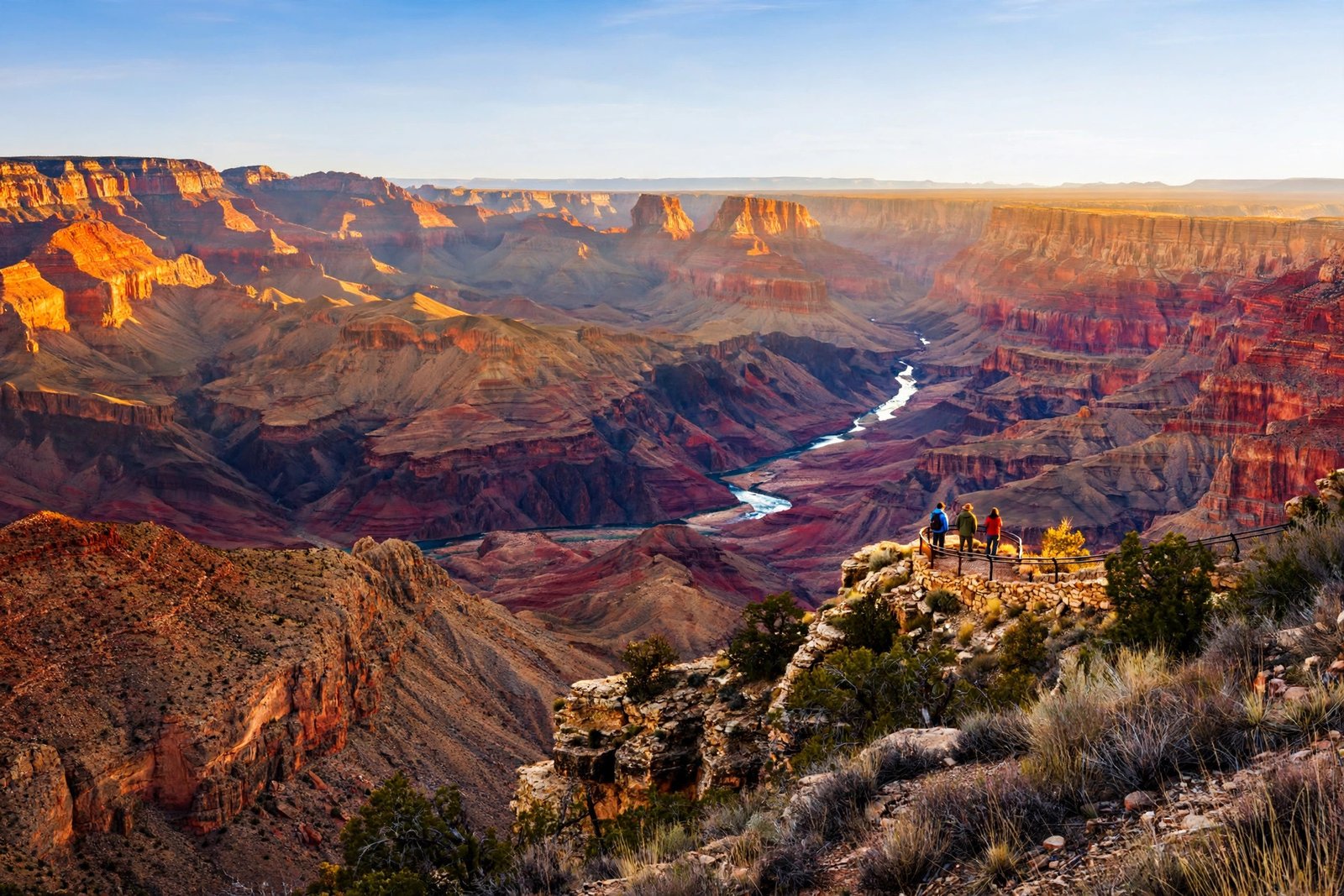
It is the most famous hole in the ground on Earth, and it still surprises people. The Grand Canyon is so big that the first look over the rim can feel unreal, like a painting that forgot to stay flat. But behind the postcard views is a place full of strange, wonderful facts — about rocks nearly two billion years old, a river that carved a canyon in a geological blink, a president who had to fight to protect it, and wildlife found nowhere else on the planet. Here are 25 things you probably did not know about America’s most iconic natural wonder.
The Sheer Scale
Fact 1: The Grand Canyon is 277 miles long. Measured along the Colorado River, it begins at Lees Ferry (mile 0) and ends at the Grand Wash Cliffs (mile 277), winding across northwestern Arizona. Fact 2: It is up to 18 miles wide, rim to rim, though in places it narrows to just a few hundred yards across. At Grand Canyon Village, the width is about 10 miles. Fact 3: It is over a mile deep. At its deepest, the canyon drops about 6,000 vertical feet — 6,093 feet, to be exact — from rim to river. Near Grand Canyon Village, the drop is a vertical mile of about 5,000 feet, and the trail down covers about 7 miles of switchbacks.
Fact 4: The national park that protects it is enormous. According to the National Park Service, Grand Canyon National Park covers 1,218,375.54 acres, or 1,904 square miles — bigger than the entire state of Rhode Island. Fact 5: And the canyon does not stop at the park boundary. The canyon and its rims are also contained within Kaibab National Forest, Grand Canyon-Parashant National Monument, and the Hualapai, Havasupai and Navajo Nation lands, which is why the same canyon can feel very different depending on where you stand.
A Canyon Carved by Time
Fact 6: The oldest rocks exposed in the canyon are close to 2,000 million years old. The dark Vishnu Schist at the bottom of the Inner Gorge is nearly half the age of the Earth itself. Fact 7: The pale Kaibab Limestone that caps the rim is far younger — about 270 million years old — and it is the layer that forms the flat, walkable surface visitors stand on. Between the two, the canyon walls display a layered record of nearly two billion years of Earth’s history.
Fact 8: Yet the canyon itself is young. While its rocks are ancient, the canyon as an erosional feature has formed only in the past five or six million years. Fact 9: The Colorado River established its course through the area about 5 to 6 million years ago, and since then the river and its tributaries have cut downward through layer after layer of rock while the Colorado Plateau was uplifted around them. Geologists still debate the details of how the canyon was incised, but the broad story — a young canyon cut through ancient rock — is settled science.
From Forest Reserve to National Park
Fact 10: The Grand Canyon first received federal protection in 1893, when it was set aside as a Forest Reserve. Fact 11: President Theodore Roosevelt, who called the canyon “the one great sight which every American should see,” later designated it a National Monument in 1908, protecting it from mining and development claims. Fact 12: It did not achieve National Park status until 1919, three years after the creation of the National Park Service — and only after years of political fighting with mining and railroad interests.
Fact 13: In 1979 the canyon was designated a UNESCO World Heritage site, recognizing it as a place of outstanding value to all of humanity. Fact 14: The park’s popularity has exploded since its early days. In 1919, its first year as a national park, it received 44,173 visitors. Today, the National Park Service says it receives close to five million visitors each year — more than a hundred times as many.
South Rim vs North Rim
Most visitors see the Grand Canyon from the South Rim, and for good reason: it is open all year, it has the lodges, the visitor centers and the classic viewpoints, and it is the easiest to reach. But the two rims are very different places.
Fact 15: The South Rim sits at about 7,000 feet above sea level. Fact 16: The North Rim, at approximately 8,200 feet, is some 1,200 feet higher — and it feels it, with cooler temperatures and a forested, alpine character. Fact 17: The North Rim sees only about a tenth of the park’s visitors, which makes it the choice for travelers who want quiet trails and elbow room. Fact 18: The North Rim is seasonal — in a normal year open roughly from mid-May to mid-October — while the South Rim is open 24 hours a day, 365 days a year. Note for 2026: the North Rim was closed for the 2025 season after the Dragon Bravo Fire and reopened in 2026 for limited day use only, with no services, until its gate closes on November 30, 2026. The two rims are only about 10 miles apart as the crow flies, but the drive between them is roughly 215 miles and takes about four hours.
There is also a third option many visitors never hear about: the West Rim, on Hualapai land, home to the glass-bottomed Skywalk. It is a different experience — narrower canyon views and a tribal enterprise rather than a national park — and it is not connected to the South or North Rim by road inside the park.
The Best Viewpoints
Fact 19: The Desert View Watchtower, at the eastern end of the South Rim, was built in 1932 and designed by the architect Mary Colter, who modeled it on ancient Ancestral Puebloan towers and decorated its interior with Hopi murals. Climb to the top for a 270-degree panorama and the best view of the Colorado River bending below.
Fact 20: Hermit Road, the seven-mile scenic drive west of Grand Canyon Village, is closed to private cars from March through November — you ride the free red shuttle, walk or cycle it instead. Its nine viewpoints include Hopi Point, the classic sunset spot, and Mohave and Pima Points, which are quieter at golden hour. Fact 21: Mather Point, a short walk from the Grand Canyon Visitor Center, is where most visitors get their first look, and it is one of the best sunrise spots in the park. From there, the paved Rim Trail runs 13 miles along the edge in total, passing Yavapai Point and its geology museum, with its glass-walled viewing room, on the way to the historic Village.
Life in the Canyon
Fact 22: The California condor, the largest flying land bird in North America, soars over the canyon today because of one of the great wildlife comebacks in American history. Condors were reintroduced to the region after the species nearly vanished, and now they are a regular sight riding the thermals above the South Rim. Look for a bird with a wingspan of nearly 10 feet and numbered tags on its wings.
Fact 23: The Kaibab squirrel lives nowhere on Earth except the Kaibab Plateau on the North Rim. This white-tailed, tassel-eared squirrel evolved in isolation on the forested plateau, separated from its relatives on the South Rim by the canyon itself — a living example of how the canyon shapes evolution. Elk, mule deer and bighorn sheep are also common sights, and the park’s elevation range, from river to rim, creates stacked layers of habitat, from desert scrub at the bottom to ponderosa pine forest on top.
Below the Rim
Fact 24: The canyon is not just for looking at — thousands of hikers go down every year, and the two main corridor trails are the Bright Angel Trail from the Village and the South Kaibab Trail from near Yaki Point. Both descend to the Colorado River and to Phantom Ranch, the lodge at the canyon’s bottom, where a night’s stay must be booked far in advance. The descent is the easy part: the climb back up, gaining a vertical mile in desert heat, is what earns the canyon its reputation. Rangers warn every year that the hike from rim to river and back in a single day is one of the most grueling day hikes in the national park system, and summer temperatures at the bottom regularly top 100 degrees Fahrenheit.
River trips are the other way in. Multi-day rafting journeys run the full 277 miles from Lees Ferry to the Grand Wash Cliffs, passing rapids, side canyons and waterfalls that cannot be reached any other way. Permits are limited and demand is high, so most river travelers book with commercial outfitters months or years ahead.
What Most Visitors Get Wrong
Fact 25: For all its fame, the Grand Canyon is not the deepest canyon in the world. That distinction belongs to others — the Kali Gandaki Gorge in Nepal is much deeper, and both the Barranca del Cobre in Mexico and Hells Canyon in Idaho are deeper too. What makes the Grand Canyon unmatched, in the National Park Service’s own words, is the incomparable vistas it offers and the thick sequence of ancient rocks, beautifully preserved and exposed, that record much of the early geologic history of the North American continent. No other place on Earth compares for the scale and completeness of that record.
Visitors get a few other things wrong, too. The canyon is not a single viewpoint but a 277-mile landscape of side canyons, buttes, temples and hidden waterfalls. It is not empty desert: more than 1,700 plant species and hundreds of animal species live in the park. And it is not silent — listen at dawn and you will hear canyon wrens, ravens and the wind moving through a mile of open air.
Planning Your Visit
Spring (April to May) and fall (September to October) are the ideal seasons for the South Rim: mild days, clear skies and thinner crowds. Summer is busy, with afternoon thunderstorms in July and August, and winter brings snow on the rim and empty trails for those who dress for it. The entrance fee is $35 per private vehicle for a seven-day pass, and the America the Beautiful annual pass works here too. Since January 2026, non-U.S. residents pay an additional surcharge, so check current fees on nps.gov before you go.
Book lodging well ahead — the lodges inside the park, including the historic El Tovar and Bright Angel Lodge, sell out months in advance, and the gateway town of Tusayan, just outside the south entrance, fills up too. Arrive early, ride the free shuttles instead of driving between viewpoints, and give yourself at least two days: one for the Village viewpoints and a short hike below the rim, and one for the Desert View Drive and a Hermit Road sunset. The canyon rewards patience. The longer you look, the more it shows you.
Related reading
- Grand Canyon North Rim: A Hidden Gem Guide
- America’s 63 National Parks: The Complete Guide
- California Condor Comeback: 607 Birds and Counting
Frequently Asked Questions
How long is the Grand Canyon?
The Grand Canyon is 277 miles long, measured along the Colorado River from Lees Ferry to the Grand Wash Cliffs. It is up to 18 miles wide and over a mile deep, with the deepest point reaching about 6,000 feet from rim to river.
When did the Grand Canyon become a national park?
Grand Canyon became a national park in 1919, after first being protected as a Forest Reserve in 1893 and designated a National Monument by President Theodore Roosevelt in 1908. It was named a UNESCO World Heritage site in 1979.
Which is better, the South Rim or the North Rim?
The South Rim is open year-round and has the classic viewpoints, lodges and shuttle system, so it suits first-time visitors. The North Rim is about 1,200 feet higher, far quieter — roughly a tenth of the visitors — and in a normal year open only from mid-May to mid-October (check current conditions before visiting — the North Rim operated with limited day use only in 2026 after the Dragon Bravo Fire). Many travelers who return choose the North Rim for its solitude.
How many people visit the Grand Canyon each year?
The National Park Service says the park receives close to five million visitors each year, a huge increase from the 44,173 visitors it welcomed in its first year as a national park, 1919.
Can you hike to the bottom of the Grand Canyon?
Yes, on the Bright Angel Trail or the South Kaibab Trail, both of which descend to the Colorado River and Phantom Ranch. The round trip is extremely demanding — a vertical mile back up in desert heat — and rangers advise against attempting rim-to-river-and-back in a single day, especially in summer.