
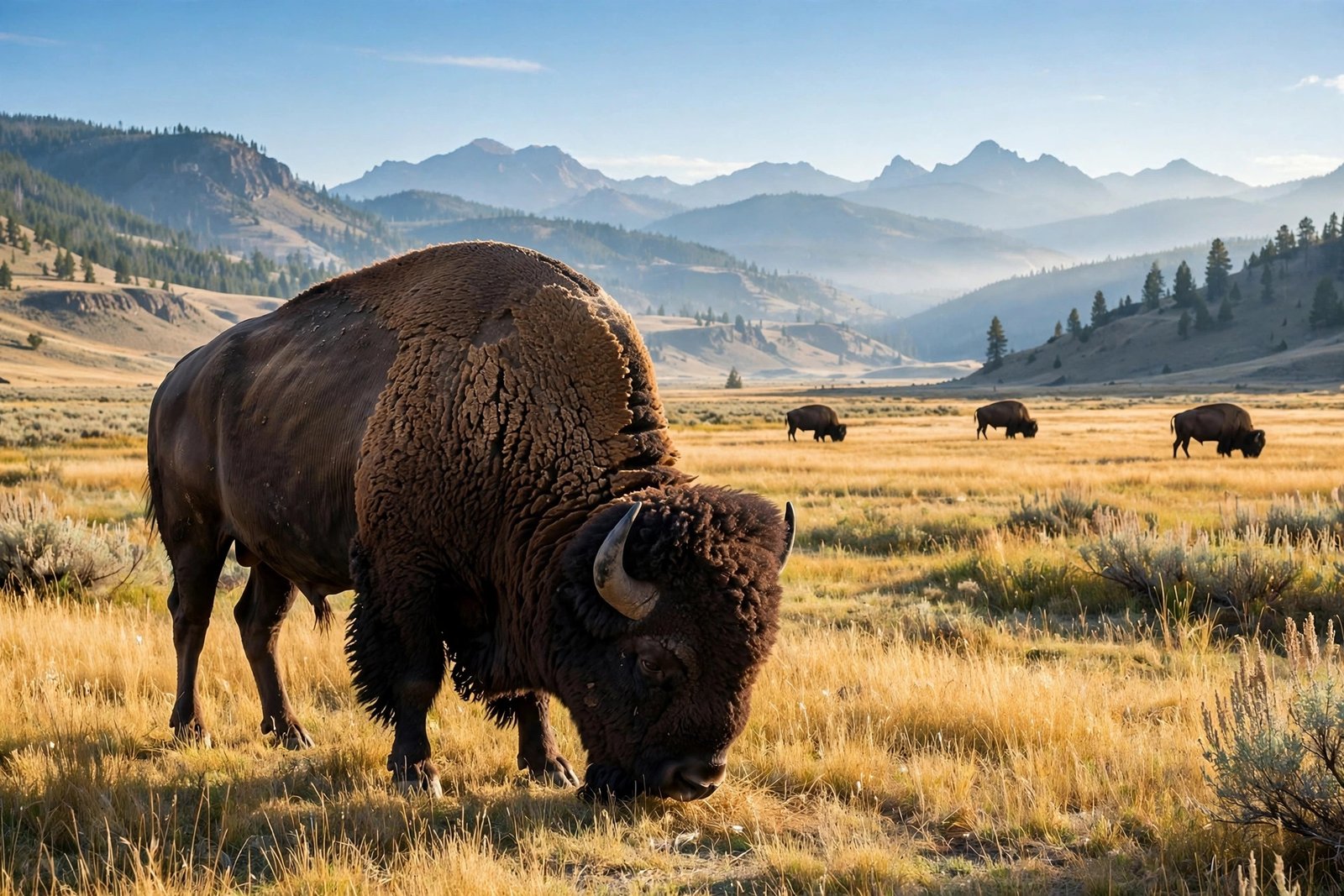
There is a moment every Yellowstone visitor remembers: the road ahead fills with a slow-moving river of dark brown shapes, calves trotting close to their mothers while a bull the size of a small car watches from the sagebrush. American bison are the beating heart of Yellowstone National Park. This herd is the largest bison population on public land in the United States, the only one that has lived continuously in the same place since prehistoric times, and the direct descendant of a remnant so small it could have vanished in a single bad winter.
Why Yellowstone’s Bison Matter So Much
Yellowstone is the only place in the United States where bison have lived continuously since prehistoric times, according to the National Park Service. That single fact makes this herd irreplaceable. Most other bison herds in North America were rebuilt from animals raised on ranches or moved in from elsewhere. Yellowstone’s animals are the real thing: wild, free-ranging, and shaped by the same landscape their ancestors roamed for thousands of years.
The herd is also the nation’s largest bison population on public land, and it has become the source population for restoration efforts across the country. Yellowstone’s bison carry genetic lines found nowhere else, and when tribes and conservation groups start new herds, Yellowstone animals are often the ones they want. In 2016, the bison’s importance was recognized at the national level when the American bison was designated the national mammal of the United States. The animal that once defined the Great Plains, and nearly disappeared from it, became an official symbol of the country, and Yellowstone is where that symbol still lives wild.
From Millions to 23: The Near-Extinction Story
Before the mid-1800s, an estimated 30 to 60 million bison may have roamed North America, according to the National Park Service. They were possibly the most numerous large land animal on Earth, and they shaped the entire ecology of the Great Plains. That abundance collapsed with shocking speed. Commercial hunting for hides and meat, westward expansion, the coming of the railroads, and deliberate government policies aimed at breaking Indigenous food systems drove the slaughter. By the 1890s, fewer than 1,000 bison remained on the entire continent, according to the Smithsonian’s National Zoo.
Even inside Yellowstone, the animals were nearly wiped out. Poachers cut the herd from as many as 1,000 animals in 1872 to about two dozen by 1902. Only about 23 wild bison were known to have survived the poaching in Yellowstone. The rescue began that same year, when the U.S. Army, which then administered the park, brought 21 bison from two private herds to join the wild survivors. A small ranching operation raised bison in the Lamar Valley for decades, and it was phased out by 1952, leaving the animals to live wild again. From those two dozen survivors and the 21 newcomers, the herd grew into the thousands we see today. The park’s most recent official estimate put the population at nearly 5,300 animals in 2025, split between the northern and central breeding herds.
The Two Herds: Northern and Central
Yellowstone’s bison are traditionally described as two herds, defined by where they gather to breed. The northern range herd ranges from the park’s north entrance near Gardiner, Montana, through the Blacktail Plateau and into the Lamar Valley, and older estimates put it at roughly 2,300 animals. The central interior herd, once estimated at roughly 1,400 animals, ranges from the Madison River valley into the Hayden Valley and the Upper and Lower Geyser Basins. Together, the two groups account for the park’s total population, which fluctuates with births, winter deaths, and management removals.
The line between the two herds has blurred in recent years. A genetic study published in the Journal of Heredity in 2025 found that Yellowstone’s bison are now a single interbreeding population of roughly 4,000 to 6,000 animals. Researchers from Texas A&M University found that increasing numbers of central-herd bison have been traveling to the northern range, mixing with the northern herd, and staying to breed and raise calves there. The study’s authors recommended that the animals be managed as one genetically healthy herd, which is good news for the species: a single large, interbreeding population is far more resilient than two small isolated ones.
Where to See Bison in Yellowstone
Lamar Valley is the classic bison destination. The wide, open valley floor holds big herds for much of the year, and the road runs right through it, with pullouts where you can stop and watch from your car. Early morning and evening are the best times, when the light is low, the animals are active, and the valley often fills with elk, pronghorn, and wolves as well. Bring binoculars or a spotting scope. Much of the best viewing is across the valley, and a scope turns distant dark shapes into grazing cows, sparring bulls, and wobbly-legged calves.
Hayden Valley is the central herd’s home and the second great viewing area. The valley stretches along the Yellowstone River between Canyon and Fishing Bridge, and bison graze its wet meadows through the summer. Bison are not confined to the two famous valleys. They also graze the Madison River valley, the Firehole River meadows near Old Faithful, the Pelican Valley, and the grasslands around Mammoth Hot Springs. In winter, many animals move to lower elevations, and the northern range around Gardiner becomes one of the best places in the park to see them. Bison migrate up to 70 miles between summer and winter ranges, and individual animals travel about 1,000 miles over the course of a year, more than any other hoofed animal in the Greater Yellowstone Ecosystem.
The Rut: Summer’s Thunder
The breeding season, known as the rut, runs through July and August, and it is the most dramatic time to watch bison. Herds swell as bulls join the cows, with group sizes averaging about 200 in summer and reaching a maximum of about 1,000 during the rut, according to the National Park Service. Mature bulls bellow, wallow in the dust, and fight each other for the right to mate, clashing head to head with a sound you can feel in your chest from a hundred yards away.
Calves arrive the following spring after a gestation of nine to nine and a half months. Newborns are reddish-tan, earning them the nickname red dogs, and they begin turning brown after about two and a half months. Spring in the Lamar Valley, with dozens of red dogs bouncing around their mothers, is one of the great wildlife sights in America. It is also the time to be most careful: a cow with a new calf is at her most protective, and she will charge anything she sees as a threat.
What Bison Are Really Like
Bison are the largest land-dwelling mammal in North America. Males weigh up to 2,000 pounds, females around 1,000 pounds, and both stand on a frame built for power, with a huge shoulder hump and heavy forequarters. They look slow and placid when they graze, and that appearance fools people every year. Bison can run 35 miles per hour, three times faster than a human, and they can jump over objects about five feet high. They are also strong swimmers with excellent hearing, vision, and sense of smell.
Their diet is almost entirely grass. More than 90 percent of what Yellowstone bison eat is grasses, sedges, and other grass-like plants, and they typically forage nine to eleven hours a day. Their big shoulder and neck muscles let them swing their heads from side to side to clear snow from foraging patches in winter, a trick other hoofed animals cannot match. That ability is one reason bison survive Yellowstone winters that drop to minus 44 degrees Fahrenheit in the central plateau. Wolves and grizzly bears are the only large predators of adult bison, and even they usually take calves or weakened animals rather than healthy adults.
Staying Safe: The 25-Yard Rule
Bison have injured more people in Yellowstone than any other animal. That is the park’s own warning, repeated in every visitor center, and it surprises people who think of bison as gentle giants. They are not aggressive by nature, but they are wild, unpredictable, and enormously powerful, and they will defend their space when they feel threatened. A review by the Centers for Disease Control and Prevention found that bison have injured more visitors on foot in Yellowstone than any other wildlife species since 1980, and that the encounters happened because visitors got too close.
The rule is simple and it is federal law: stay at least 25 yards away from bison and all other large animals, including elk, moose, deer, bighorn sheep, and coyotes, and at least 100 yards from bears and wolves. Twenty-five yards is about two school-bus lengths, and a charging bison can cover it in about three seconds. If an animal is near a trail, boardwalk, parking lot, or campsite, give it space, move away, or turn around and go the other way. Never approach a bison for a photograph, never try to feed one, and never, ever touch a calf. In 2016 and again in 2023, visitors who handled bison calves caused the animals to be rejected by their herds, and both calves had to be euthanized because they were too young to survive alone. In the summer of 2024, two visitors were gored in separate incidents, an 83-year-old woman near the Storm Point Trail at Yellowstone Lake and a 30-year-old man near Old Faithful, both after getting too close. Education campaigns have helped enormously: the park went from 10 to 13 bison injuries a year in the early 1980s to fewer than one a year by 2010 to 2014.
The Brucellosis Debate
Not every part of the bison story is a simple success. Some Yellowstone bison carry brucellosis, a bacterial disease that can be transmitted to cattle through contact with infected birth tissues. The disease came from domestic cattle long ago, but it now lives in the wild bison and elk populations, and it sits at the center of one of the most complex wildlife debates in the American West.
Ranchers outside the park worry, understandably, that bison wandering out of Yellowstone in winter could expose their cattle. Montana’s livestock industry has spent decades keeping the state free of brucellosis, and a single transmission could cost ranchers dearly. Conservationists and tribes argue, with equal force, that wild bison have a right to roam beyond the park’s borders. The compromise is the Interagency Bison Management Plan, under which the National Park Service works with federal, state, and tribal agencies to manage bison that leave the park. The plan sets population targets, and when the herd grows beyond them, animals are removed through hunting outside the park, transfer to tribal herds, and shipment to slaughter. The winter of 2022-23 saw the largest removal on record, with more than 1,500 animals taken out of the population, drawing criticism from conservation groups who questioned whether a hunt of that size was necessary.
Conservation Significance: Why This Herd Shapes the Future
Yellowstone’s herd matters far beyond the park’s borders because it is the genetic wellspring for bison restoration everywhere. Unlike most herds, Yellowstone’s bison are largely free of cattle genes, the result of crossbreeding that happened on many ranches in the early 1900s. Their DNA is as close to the original wild bison as anything left on the continent, and conservation herds across North America trace their ancestry back to Yellowstone animals.
The numbers tell the scale of the recovery. From 30 to 60 million animals before the mid-1800s, the species fell below 1,000 by the 1890s. Today, roughly 30,000 bison live in conservation herds in North America, and about 500,000 are raised as commercial livestock, according to the Smithsonian’s National Zoo. A century ago, 23 animals stood between the American bison and extinction in the wild. Today, thousands of their descendants roam the valleys of Yellowstone, and their calves are rebuilding herds from Montana to the Great Plains. For a visitor standing in the Lamar Valley at dawn, watching a herd move through the mist, that is not just a wildlife sighting. It is a glimpse of what conservation, given time and stubborn protection, can actually do.
Related reading
Keep exploring America’s wild places and wildlife with these stories from Famus News: Grizzly Bears in Yellowstone: A Wildlife Guide, The Gray Wolf Comeback in Yellowstone, and America’s 63 National Parks: A Complete Guide.
Frequently Asked Questions
How many bison live in Yellowstone National Park?
The population fluctuates with births, winter losses, and management removals. The most recent official estimate put the herd at nearly 5,300 animals in 2025, split between the northern and central breeding herds.
Where is the best place to see bison in Yellowstone?
Lamar Valley in the park’s northeast is the classic viewing spot for the northern herd, and Hayden Valley along the Yellowstone River is the central herd’s home. Early morning and evening are the best times.
How close can you get to a bison in Yellowstone?
Stay at least 25 yards away from bison at all times, about two school-bus lengths. Stay at least 100 yards from bears and wolves. Bison can run 35 miles per hour and cover 25 yards in about three seconds.
When is bison rut season in Yellowstone?
The rut runs through July and August. Herds swell to hundreds of animals, with groups reaching about 1,000 at the peak, and mature bulls bellow, wallow, and fight for the right to mate. Calves are born the following spring.
Are Yellowstone bison dangerous?
Yes. Bison have injured more visitors in Yellowstone than any other animal, and every documented injury involved someone getting too close. They are wild, unpredictable, and enormously strong. Keep your distance and watch from your car or through binoculars.
Why are Yellowstone bison so important for conservation?
Yellowstone is the only place in the United States where bison have lived continuously since prehistoric times, and the herd is the nation’s largest on public land. The animals are largely free of cattle genes, making them the source population for bison restoration efforts and tribal herds across North America.