
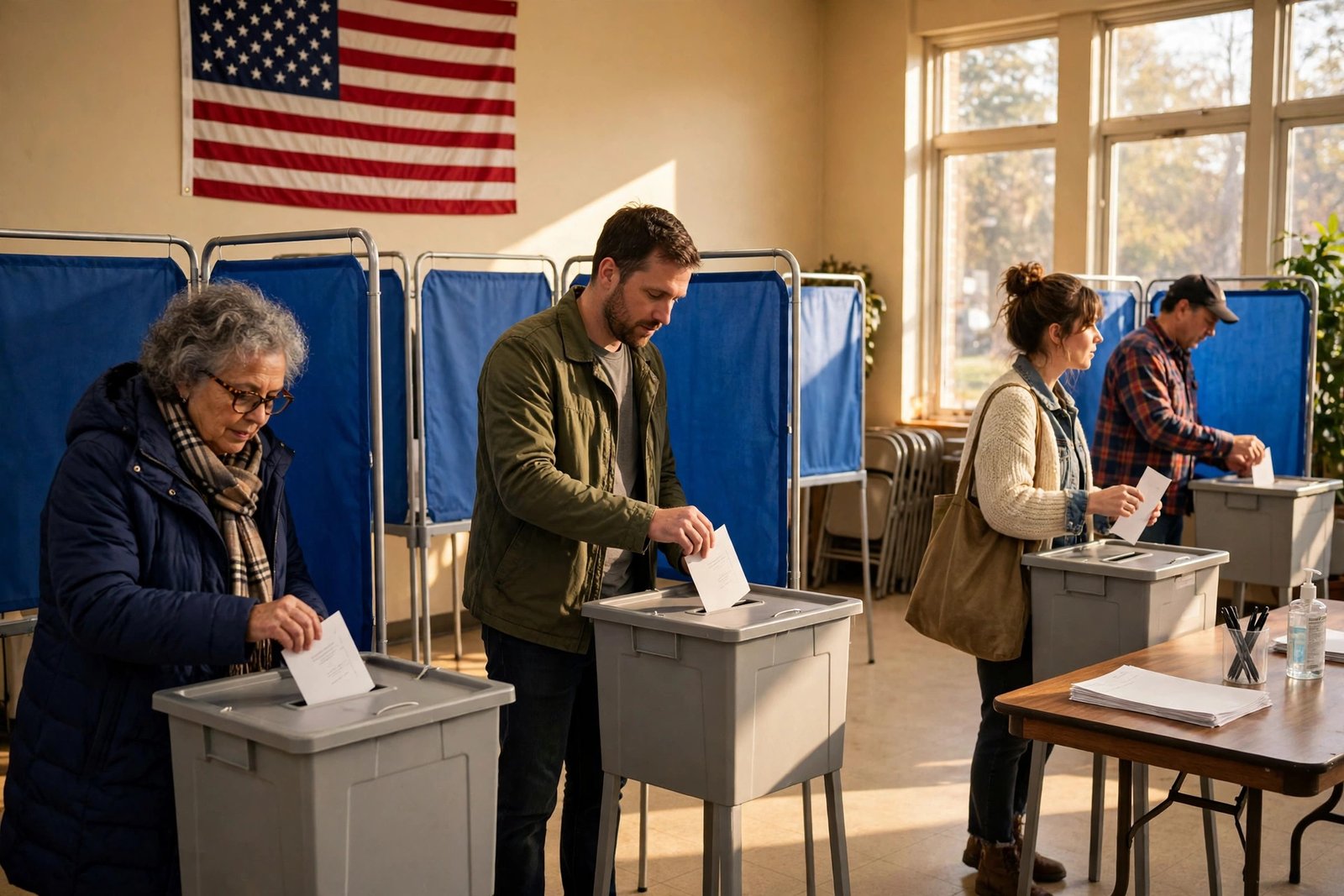
Every two years, Americans head to the polls on the same curious day: the Tuesday after the first Monday in November. It is such a familiar rhythm that most voters never stop to ask why. Why Tuesday, a workday, instead of a Saturday or Sunday, when most people are free? Why November, when the days are growing short and cold? The answer is older than the light bulb, older than the automobile, and older than the telegraph in most American homes. It comes from a law passed by Congress in 1845, written for a country of farmers, horse-drawn wagons, and county-seat courthouses. That law has survived for more than 180 years, and it still decides the date of every federal election in the United States.
America Before 1845: A Patchwork of Election Days
When the United States held its first presidential election, there was no national Election Day at all. The Constitution gave the states the power to decide how and when to choose presidential electors, and the states used that freedom in very different ways. Some held a popular vote. Others let their state legislatures pick the electors directly. And the dates were just as varied. According to the Congressional Research Service, the first federal elections for the House and Senate were held between November 24, 1788, and June 22, 1789, a span of nearly seven months. Presidential electors cast their ballots on February 4, 1789, and Congress counted the votes on April 6, 1789. It was a slow, scattered process, and nobody in the young republic seemed to think that was strange.
For decades after that first election, the pattern continued. Each state chose its presidential electors on a different day, often weeks apart. In the early 1800s, more than half of the states held their presidential elections in early November, but that was custom, not law. A voter in Virginia might cast a ballot in October, while a voter in New York voted in November and a voter in South Carolina did not vote at all, because the state legislature made the choice for him. The system worked, after a fashion, because news traveled slowly. A result in one state took days or weeks to reach another, carried by horseback, by stagecoach, and eventually by the early railroads.
The 1792 Law and the 34-Day Window
The first attempt to bring order to this chaos came in 1792, when the Second Congress passed a law setting the framework for presidential elections. Under that law, presidential electors would meet and cast their votes on the first Wednesday in December. The states were required to choose their electors within the 34 days leading up to that meeting. Within that window, each state picked any day it liked.
The 34-day window created exactly the problems Congress later tried to fix. As the Congressional Research Service has noted, the long period during which elections could be held prolonged excitement and provided time for intrigue. In the election of 1844, for example, voting stretched from November 1 to December 4. That was the last straw for many in Congress. When members of the House debated a bill in 1844 to set a uniform presidential Election Day, they declared that the goal was to guard against frauds in the elections of President and Vice President. A single day, they argued, would make the vote fairer and harder to manipulate. ThoughtCo’s account of the 1845 law traces the same chain of events, from the telegraph’s arrival to the final vote in Congress.
The 1845 Law: One Day for the Whole Country
On January 23, 1845, the 28th Congress passed a short law with a long title: An Act to establish a uniform time for holding elections for electors of President and Vice President in all the States of the Union. Signed by President John Tyler, it declared that presidential electors would be appointed in each state on the Tuesday next after the first Monday in the month of November. The law applied only to presidential elections at first. It did not touch elections for the House or the Senate, and it did not tell states when to hold their own state and local contests. But it was a turning point. For the first time, the whole country would choose its president on the same day.
The first presidential election held under the new law took place on November 7, 1848. Whig candidate Zachary Taylor defeated Democrat Lewis Cass, with former President Martin Van Buren running as the Free Soil candidate. From that day forward, every presidential election in American history has been held on the Tuesday after the first Monday in November. The rule is now written into federal law in several places. Title 3 of the United States Code sets the date for appointing presidential electors, and later laws set the same day for House and Senate elections. The wording has barely changed in nearly two centuries: the Tuesday next after the first Monday in November.
- 1792: Congress sets a 34-day window for states to choose presidential electors.
- 1845: The uniform Tuesday rule becomes federal law.
- 1848: The first nationwide Election Day is held on November 7.
- 1872: House elections are aligned to the same Tuesday in November.
Why November? The Harvest Calendar
To understand why Congress chose November, picture the United States in the 1840s. It was still a largely agrarian society, and farmers made up a majority of the labor force. The farming year shaped everything, from planting in the spring to the long, exhausting harvest in the fall. The Farmers’ Almanac walks through the same harvest-season logic. Holding an election in the middle of planting season or during the harvest would have pulled farmers away from the work that fed their families. November offered a practical alternative. By then, in most of the country, the main harvest was finished. The crops were in, the barns were full, and farmers finally had time to spare.
Why Tuesday? Horses, the Sabbath, and Market Day
If November was the month, Tuesday was the day, and the reasons are just as rooted in 19th-century life. In the 1840s, most Americans were devout Christians who set aside Sunday as a day of rest and worship. Asking voters to begin a long journey on Sunday, the Sabbath, would have been unthinkable. That ruled out Sunday as a travel day, and it also ruled out Monday as an election day, because a farmer who lived far from the county seat would have needed to travel on Sunday to arrive in time to vote on Monday.
Wednesday was out for a different reason. In many farming communities, Wednesday was market day, when farmers brought their crops and goods into town to sell or trade. It was one of the busiest days of the week, and asking farmers to vote on market day would have meant asking them to give up a day of business. That also ruled out Thursday as an election day, since a voter traveling on Wednesday, market day, would have been pulled away from the market. By the same logic, a Friday election would have interfered with the end of the working week, and Saturday was a day many people used to prepare for Sunday worship. Tuesday, by elimination, was the day that fit. A farmer could travel to town on Monday, after a Sunday of rest, vote on Tuesday, and be home in time for Wednesday’s market.
The travel itself mattered enormously. In an era before automobiles, a journey of twenty miles could take an entire day on horseback or in a horse-drawn wagon, especially on rough dirt roads. Polling places were not on every corner. The system Congress designed gave that farmer a Monday to travel, a Tuesday to vote, and a Wednesday to do business. As Britannica notes, historians commonly cite this combination of travel, religious observance, and market schedules as the explanation for Tuesday, though the surviving record does not prove that any single consideration decided the matter. What is clear is that Tuesday was the day that clashed least with the weekly rhythm of rural American life.
Why “After the First Monday”? The November 1 Problem
The strangest part of the rule is its wording: the Tuesday after the first Monday in November. Why not simply say the first Tuesday in November? The answer is that the first Tuesday in November sometimes falls on November 1, and Congress wanted to avoid that date. November 1 is All Saints’ Day, a holy day observed by many Christians, and in the 1840s it was considered an unfavorable day for an election. There was also a practical business reason. Merchants in the 1800s typically used the first day of the month to settle their books from the previous month, tallying accounts and closing out October’s business. Scheduling a national election on the same day would have interfered with that work.
The phrase “after the first Monday” is a neat piece of legal drafting. If November 1 falls on a Monday, the first Monday is November 1, and the Tuesday after it is November 2. If November 1 falls on any other day, the first Monday comes later in the week, and the Tuesday after it lands between November 3 and November 8. Either way, the election can never fall on November 1. Because of the wording, Election Day always falls between November 2 and November 8.
How the Rule Spread to Congress and the States
The 1845 law covered only presidential elections, and for nearly thirty years, elections for the House of Representatives continued on varied dates. Some states held their congressional elections on the same day as the presidential vote, but others did not. That changed in 1872, when the 42nd Congress passed a law aligning House elections with presidential elections, scheduling them for the Tuesday after the first Monday in November starting in 1876. Senate elections followed later, after the 17th Amendment made senators directly elected by the people. Today, the same Tuesday in November governs the general election for the president, the House, and the Senate in even-numbered years.
State and local elections followed a similar path, though more gradually. There is no federal law telling a state when to hold its governor’s race or its mayoral election, and states are free to set their own dates. But most states found it convenient to hold their elections on the same day as the federal vote. Sharing a date means sharing polling places, sharing election workers, and sharing the cost of running an election. Over time, the Tuesday in November became the default for American elections at every level, from the White House down to the school board.
The Modern Debate: Should America Vote on the Weekend?
Today, the reasons behind the 1845 law no longer apply. America is no longer a farming nation. Most voters drive to the polls, or vote early, or vote by mail. Sunday is no longer a universal day of rest, and Wednesday is no longer market day in most towns. Yet the Tuesday rule remains, and it has become one of the most debated features of American elections. Critics argue that holding elections on a workday suppresses turnout, especially for people who work long hours, hold multiple jobs, or cannot easily take time off. When the Census Bureau has surveyed people about why they do not vote, a large share say they were too busy or their schedules did not allow them to get to the polls. As NPR has reported, members of Congress from both parties have proposed moving the vote to a weekend or making Election Day a holiday. Supporters of change point out that many other democracies vote on weekends or make Election Day a public holiday, and they ask why the United States still clings to a schedule designed for horse-drawn wagons.
There is also a quieter argument for keeping the tradition. A single, predictable day gives the country a shared civic moment. Americans know when Election Day is, they can count on it, and the whole nation votes together. That shared rhythm is part of what makes the day feel important. For all its quirks, the Tuesday after the first Monday in November has one great virtue: everybody knows when it is. And that, in the end, may be why a law written for farmers in 1845 still stands. It was designed to be predictable, and predictability is exactly what an election needs.
Related reading
If you enjoyed this look at an American tradition, explore more stories from Famus News: Why Are US Dollar Bills Green? The History Behind the Color, The First Thanksgiving at Plymouth in 1621, and The Siege of Yorktown in 1781.
FAQ
When was Election Day set to the Tuesday after the first Monday in November?
Congress set the date on January 23, 1845, when it passed a law establishing a uniform time for choosing presidential electors. The first presidential election held under the new law took place on November 7, 1848. The same date now governs federal elections.
Why did Congress choose November for elections?
November came after the autumn harvest but before the worst winter weather, which mattered in a largely farming society. Farmers had finished their harvest and had time to travel to the polls, and the roads were still passable. November also left enough time for presidential electors to meet in December, as an earlier 1792 law required.
Why Tuesday instead of another day of the week?
Tuesday fit the weekly rhythm of rural life in the 1840s. Sunday was observed as a day of worship and rest, so voters could not travel that day. Monday gave them a day to travel to the county seat, Tuesday was the day to vote, and Wednesday was market day, when farmers sold their goods in town.
Why does the law say the Tuesday “after the first Monday” instead of the first Tuesday?
The wording keeps Election Day from ever falling on November 1, which is All Saints’ Day, a holy day for many Christians. It also avoided clashing with merchants, who traditionally used the first day of the month to settle their books from the previous month. Because of the wording, Election Day always falls between November 2 and November 8.
Does the Tuesday rule apply to state and local elections too?
Federal law sets the date only for federal offices: the president, the House, and the Senate. States are free to set their own dates for state and local contests, but most choose to hold them on the same Tuesday in November, because sharing polling places and election workers saves money and boosts turnout.