
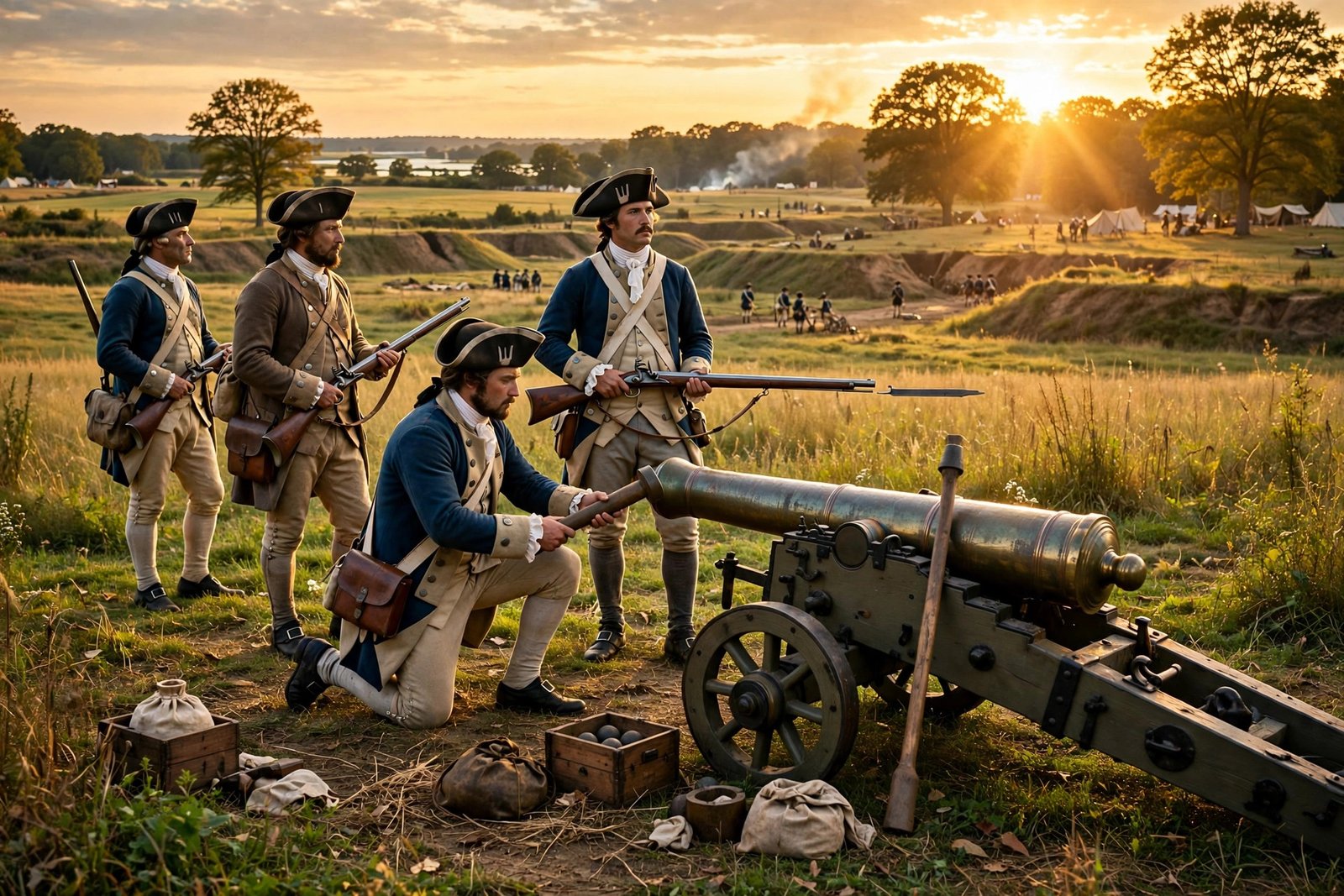
In the autumn of 1781, a small tobacco port on a Virginia peninsula became the stage for one of the most decisive moments in American history. Over three weeks in September and October, a combined French and American army trapped the British army of Lord Cornwallis at Yorktown, Virginia, and forced its surrender. The victory did not formally end the Revolutionary War — that would take two more years of diplomacy — but it broke Britain’s will to keep fighting and made American independence all but certain.
The War Moves South
By 1780, the Revolutionary War had dragged on for five years, and the British had changed their strategy. After failing to crush the rebellion in the North, they turned to the South, betting that large numbers of Loyalists there would rally to the king’s cause. The plan worked at first: British forces captured Savannah in 1778 and Charleston in 1780.
But the American resistance in the South refused to collapse. Under General Nathanael Greene, Continental forces and local militia fought a grinding campaign of maneuver and ambush. American victories at Kings Mountain in October 1780 and Cowpens in January 1781 bloodied the British army, and at Guilford Courthouse on March 15, 1781, Greene fought Lord Cornwallis to a costly standstill that left Cornwallis’s army too battered to hold the ground it had gained.
Short of supplies and far from his bases, Cornwallis made a fateful decision. Instead of returning to the coast of South Carolina, he marched his army north into Virginia. On May 20, 1781, he joined forces with troops under Benedict Arnold at Petersburg, taking command of a combined force of more than 7,000 men. His movements were shadowed by a much smaller American force under the young Marquis de Lafayette, who had orders to harass Cornwallis but avoid a pitched battle he could not win.
Cornwallis spent the summer raiding across Virginia, but his orders from his superior, General Henry Clinton in New York, were muddled. Clinton first told him to send troops back to New York, then ordered him to build a defensible deep-water port on the Chesapeake Bay where the Royal Navy could resupply him. Cornwallis chose Yorktown, a small town on the York River, and in late July 1781 he began fortifying it, with a smaller force across the river at Gloucester Point. He did not know that his choice of ground would become a trap.
Washington’s Gamble: The March to Virginia
Far to the north, George Washington faced a problem of his own. His Continental Army, camped around New York, had been staring at Clinton’s British garrison for years without the strength to attack it. In the summer of 1781, Washington’s French ally, Lieutenant General Comte de Rochambeau, arrived at his headquarters with 4,000 French troops, and the two generals began planning a joint attack on New York City.
Then, on August 14, 1781, word arrived that changed everything. Admiral François Joseph Paul, Comte de Grasse, was sailing north from the West Indies with a powerful French fleet, and he intended to bring it to the Chesapeake Bay, not to New York. Rochambeau urged Washington to seize the opportunity: if the allied armies could reach Virginia while de Grasse’s ships sealed off the Chesapeake, Cornwallis would be caught between an army on land and a fleet at sea, with no way out and no hope of rescue.
Washington agreed, and the gamble began. Starting on August 19, the combined French and American force of roughly 7,000 men slipped away from New York, leaving a small screen of troops behind to keep Clinton guessing. The march south covered some 450 miles through New Jersey, Pennsylvania, Maryland, and Virginia. French Admiral de Barras slipped out of Newport, Rhode Island, carrying the heavy siege guns the allied army would need.
De Grasse, meanwhile, had sailed from the Caribbean on August 5 with 37 ships, including 28 ships of the line, after raising funds and loading some 3,000 French soldiers at Santo Domingo. He reached the mouth of the Chesapeake at the end of August and landed his troops at Jamestown, where they joined Lafayette’s force at Williamsburg.
The Battle of the Chesapeake: The Door Slams Shut
On September 5, 1781, the trap’s sea door slammed shut. British Admiral Sir Thomas Graves sailed south from New York with 19 ships of the line, hoping to reach the Chesapeake first and rescue Cornwallis. Instead he found de Grasse’s fleet already anchored in the bay. De Grasse put to sea with 24 ships of the line, and the two fleets fought a sharp engagement off the Virginia Capes that lasted about two and a half hours.
The battle was not a crushing victory for either side, but strategically it was decisive. Graves’s ships were too damaged to fight again, and he sailed back to New York. De Grasse returned to the Chesapeake, now joined by de Barras’s squadron, and took full control of the bay. Cornwallis was sealed off by sea: no reinforcements could reach him, and no evacuation was possible.
The significance of the naval battle is hard to overstate. As the National Park Service puts it, before the Battle of the Chesapeake, the creation of the United States was possible; after it, it was certain. On September 14, Washington arrived at Lafayette’s headquarters in Williamsburg. Three days later, he went aboard de Grasse’s flagship, the Ville de Paris, to thank the admiral in person and persuade him to keep his fleet in Virginia waters past his planned departure date. De Grasse agreed.
The Trap Closes: September 28, 1781
On September 28, 1781, the allied army marched out of Williamsburg and invested Yorktown. The force that ringed the town numbered roughly 17,000 men — about 8,800 Americans and some 7,800 French — against Cornwallis’s roughly 8,000 British and Hessian soldiers. On the far side of the York River, French troops under the Marquis de Choisy bottled up the British garrison at Gloucester Point, cutting off Cornwallis’s last land escape route.
Cornwallis’s position was strong on paper: his engineers had built a ring of earthworks, redoubts, and gun batteries around the town, and he expected the Royal Navy to come to his rescue. But his men were already running low on food, and his outer defenses were too extensive for his small army to hold everywhere. Washington’s plan was classic siege warfare: dig trenches closer and closer to the enemy lines, bring up heavy artillery, and pound the defenses until they collapsed or the garrison surrendered.
The Bombardment Begins
The siege began on the night of October 6, when allied soldiers dug the first siege trench — called a parallel because it ran parallel to the British lines — about 600 yards from the British defenses. On October 9, the allied artillery opened fire. Washington himself is said to have fired the first gun of the bombardment. For days, French and American cannon and mortars hammered Yorktown, smashing houses, silencing British guns, and driving Cornwallis’s men into their earthworks.
On October 11, the allies began a second parallel, even closer to the British lines. But two British redoubts — small, strongly built earthwork forts known as Redoubt No. 9 and Redoubt No. 10 — stood directly in the path of the new trench, and their guns swept the ground where the allied soldiers were digging. The siege could not move forward until those two forts were taken.
The Night of the Bayonets: Redoubts 9 and 10
The assault on the redoubts, on the night of October 14, 1781, is one of the most famous episodes of the Revolutionary War. After two days of artillery fire to soften the defenses, Washington ordered a simultaneous night attack on both forts. To keep the element of surprise, the assault troops were ordered to attack with unloaded muskets and fixed bayonets — no gunfire to give them away. The password for the night was “Rochambeau,” which the American troops cheerfully translated as “Rush on boys!”
At about 7 p.m., six signal guns fired, and the attacks began. On the right, Lieutenant Colonel Alexander Hamilton led some 400 American light infantrymen against Redoubt No. 10. His men hacked through the wooden abatis with axes, climbed the parapet, and overwhelmed the roughly 70 British and Hessian defenders in about ten minutes of fierce hand-to-hand fighting. At the same time, French troops under the Vicomte de Deux-Ponts stormed Redoubt No. 9.
By morning, both redoubts were in allied hands, and the second parallel was completed within days. Allied artillery could now fire into Yorktown at point-blank range. Cornwallis’s defenses were collapsing, his men were exhausted and sick, and his supplies were nearly gone.
Cornwallis’s Last Gamble
On the night of October 16, Cornwallis made one final, desperate attempt to escape. Under cover of darkness, he tried to ferry his troops across the York River to Gloucester Point, hoping to break through the French lines there and march north to safety. But a sudden storm scattered his boats, and the attempt had to be abandoned. By dawn, his men were back in Yorktown, and there was nowhere left to run.
Later that day, October 17, a British drummer appeared on the parapet beating a parley, and a white flag went up over the British lines. Cornwallis asked for a ceasefire to discuss surrender terms. Washington, wary of delay while a British relief fleet might still arrive, gave him just two hours to agree to his terms.
The negotiations took place at the Moore House, a farmhouse east of Yorktown. On October 19, 1781, Cornwallis signed the Articles of Capitulation, surrendering his entire army. The terms were honorable: his men would march out with their colors cased and lay down their arms, and they would be held as prisoners until exchanged or released. Cornwallis himself, pleading illness, did not attend the ceremony. He sent his second-in-command, Brigadier General Charles O’Hara, in his place.
The Surrender: October 19, 1781
The surrender ceremony on the afternoon of October 19 was a moment of high drama. The British army marched out of Yorktown between two lines of allied soldiers — the French in their white uniforms on one side, the Americans in their worn blue and buff on the other — and laid down their arms in a field. O’Hara tried to hand Cornwallis’s sword to Rochambeau, who directed him to Washington. Washington, in turn, directed him to his own second-in-command, General Benjamin Lincoln, who accepted the sword.
According to tradition, the British band played a tune called “The World Turned Upside Down” as the defeated army marched out — a fitting title for a day when a ragtag collection of American farmers and soldiers, backed by the army and navy of France, had defeated the most powerful military force on earth. About 8,000 British soldiers became prisoners, along with some 240 cannon, and the allied victory was complete.
The news raced up and down the coast. In Philadelphia, crowds celebrated in the streets. In London, when Prime Minister Lord North heard the news, he is reported to have cried, “Oh God! It is all over!” Whether or not he said those exact words, the sentiment was right: the British government had lost the will to continue a war that had already cost so much blood and money.
Why Yorktown Ended the War
Yorktown was the last major land battle of the Revolutionary War. There were still British garrisons in New York, Charleston, and Savannah, and fighting continued in scattered places for more than a year. But after Yorktown, no British government could justify sending another great army across the Atlantic to reconquer America. Peace negotiations opened in Paris, and on September 3, 1783, Britain signed the Treaty of Paris, formally recognizing the independence of the United States of America.
Yorktown also settled a question that had hung over the war from its beginning: whether the new nation could win a conventional military victory against a European great power. The answer, delivered on the fields outside a small Virginia port, was yes — but only with help. French money, French soldiers, French ships, and French guns were essential to the victory. The Franco-American alliance, forged in 1778, had paid off at exactly the right moment, and the victory at Yorktown was a shared one.
Visiting Yorktown Today
Today, the Yorktown battlefield is preserved as part of Colonial National Historical Park, and visitors can walk the siege lines, the reconstructed redoubts, and the field where the British laid down their arms. The Moore House, where the surrender terms were signed, still stands, and the York River still flows past the spot where de Grasse’s fleet sealed the bay.
Standing on the ground where it happened, it is easy to see why Yorktown has become a symbol of American independence. It was not the biggest battle of the war, and it was not the bloodiest. But it was the one that decided everything: in three weeks in the fall of 1781, an alliance, a march, a naval battle, and a night assault with bayonets combined to end a war and give birth to a nation.
Related reading
- Boston Tea Party 1773: The Protest That Sparked a Revolution
- Valley Forge Winter 1777: How Washington’s Army Survived
- Battle of Gettysburg 1863: The Turning Point of the Civil War
Frequently Asked Questions
When was the Siege of Yorktown?
The siege ran from September 28 to October 19, 1781. The allied Franco-American army invested Yorktown on September 28, the bombardment began on October 9, and Lord Cornwallis surrendered his army on October 19, 1781.
Who won the Siege of Yorktown?
The allied American and French forces won. General George Washington commanded the American troops, Lieutenant General Comte de Rochambeau commanded the French army, and Admiral Comte de Grasse commanded the French fleet that blockaded the Chesapeake Bay. The British army under Lieutenant General Charles Cornwallis surrendered.
Why was the Battle of the Chesapeake important?
The Battle of the Chesapeake, fought on September 5, 1781, gave the French fleet control of the Chesapeake Bay. It prevented the Royal Navy from reinforcing or evacuating Cornwallis’s army at Yorktown, sealing the trap that forced the British surrender.
How many soldiers surrendered at Yorktown?
About 8,000 British soldiers surrendered, along with roughly 240 cannon. The allied army that besieged them numbered about 17,000 French and American troops.
Did the Revolutionary War end at Yorktown?
Yorktown was the last major land battle of the war, and it ended major combat operations, but the war did not formally end until the Treaty of Paris was signed on September 3, 1783, when Britain formally recognized American independence.