
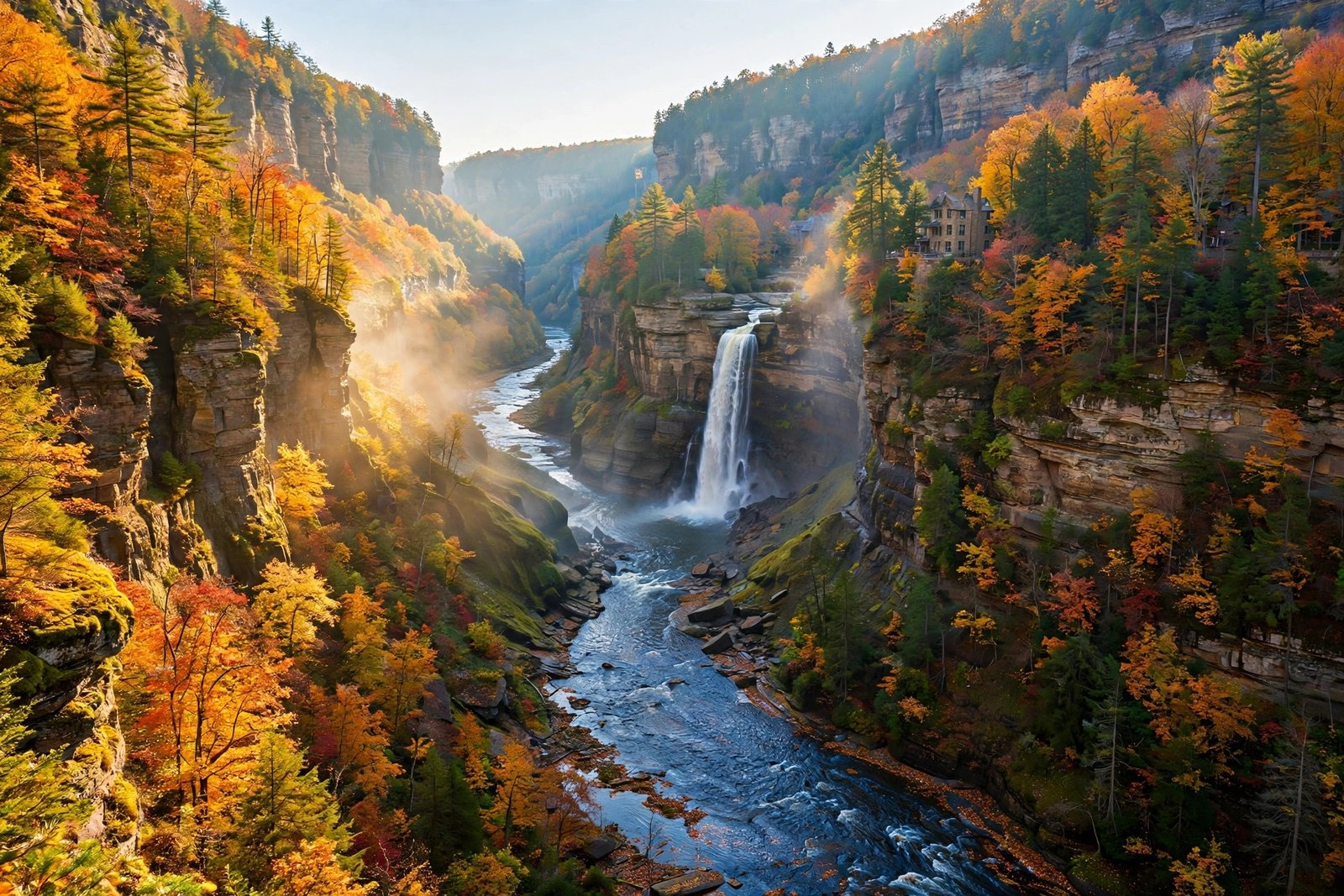
There is a place in western New York where a river has spent thousands of years carving a canyon so deep and so dramatic that early visitors reached for the most famous comparison they knew. They called it the Grand Canyon of the East. The place is Letchworth State Park, and if you have never heard of it, you are not alone. Here, the Genesee River tumbles over three major waterfalls, winds through a gorge with cliffs rising as high as 600 feet, and passes through more than 14,000 acres of forest, meadow, and history. It is, by many measures, one of the most beautiful state parks in America, and it was named the best state park in the nation in 2015. This guide covers everything you need to plan a visit: the waterfalls, the trails, the viewpoints, the seasons, and the practical details that turn a good day trip into a great one.
The Grand Canyon of the East
Letchworth State Park covers 14,427 acres in Livingston and Wyoming counties, following the course of the Genesee River for roughly 17 miles as it flows north through a deep gorge. The nickname Grand Canyon of the East comes from the scale of that gorge. In places the rock walls rise up to 600 feet above the river, and the canyon narrows to about 400 feet across above the Middle Falls. The rock itself tells an old story. The gorge exposes layers of Devonian-era shale, siltstone, and sandstone laid down roughly 380 million years ago, when this part of New York lay beneath a warm inland sea. The river was forced into its present course by the last continental glacier, which diverted it from its old valley and set it to cutting a new one through the rock. The result is a landscape that feels far bigger than a state park in upstate New York has any right to be. The state parks agency describes Letchworth as a masterpiece of gorge scenery, and the state environmental agency counts it among the most scenically magnificent areas in the eastern United States. The park is open year-round, from 6 a.m. to 11 p.m. daily, though individual facilities keep their own seasons. That matters when you plan, because the pool, the museum, the inn, and the campground do not all run on the same calendar.
The Three Great Waterfalls
The Genesee River creates three major waterfalls as it cuts through the gorge, and each one has its own character. The Middle Falls is the tallest and the most photographed, dropping 107 feet in a wide curtain that many consider the most impressive waterfall in New York State. The Upper Falls drops 70 feet and sits just below the Genesee Arch Bridge, a 963-foot steel arch railroad bridge that carries Norfolk Southern trains across the gorge. Watching a train cross the bridge above the falls is one of those small, unexpected moments that visitors remember long after they leave. The Lower Falls also drops about 70 feet, in a more secluded stretch of the gorge, and it is reached by a stone footbridge that crosses the river just below the falls. Beyond the three big falls, the park holds as many as 50 waterfalls on tributaries that flow into the gorge. The most famous of these is Inspiration Falls, a ribbon waterfall on a tributary creek near the Inspiration Point Overlook. It has a total drop of about 350 feet, which makes it one of the tallest waterfalls in New York, but it is seasonal and often appears as little more than a stain on the cliff after dry spells. Catch it after heavy rain or spring snowmelt and it is unforgettable. The three main falls, by contrast, run all year, and each season gives them a different mood.
The Man Who Saved the Gorge
Letchworth State Park exists because one man decided the gorge was worth saving. William Pryor Letchworth was a Buffalo industrialist and philanthropist who bought his first 190 acres along the gorge in 1859, specifically to protect the Middle Falls and the surrounding forest from industrial development. Over the following decades he expanded his holdings, built his estate, the Glen Iris, on the gorge rim, and opened his grounds to the public. In 1906 he donated his estate to New York State, and the gift became the foundation of the park that bears his name. The Glen Iris Inn still stands on the site of his home, and it remains the heart of the park. The inn operates seasonally, generally from May through October, and serves breakfast, lunch, and dinner in a dining room that looks out over the Middle Falls. Reservations are recommended, especially on autumn weekends. The park also preserves the Letchworth museum, which sits near the inn and covers the history of the estate, the gorge, and the Seneca people who lived in this valley long before Letchworth arrived. The Seneca called the gorge home for centuries, and the Gardeau Tract, nearly 18,000 acres secured by the Seneca leader Mary Jemison, lies just south of the park. The museum is a good place to start learning it.
Hiking the Gorge Trail and Beyond
The park has about 66 miles of hiking trails, and there is a walk here for almost every ability. The most famous is the Gorge Trail, which runs along the west rim of the gorge past all three waterfalls. The full trail is about seven miles each way, but most visitors walk it in sections, using the park road and the parking areas to hop between the falls. The stretch from the Upper Falls down to the Lower Falls is the classic walk, and it delivers the park’s best views in a single outing. If you want a longer challenge, the Letchworth Trail runs about 24 miles and is a real backpacking route rather than a day hike. Shorter trails lead to quieter corners of the park: the Autism Nature Trail, a one-mile accessible loop with eight sensory stations near the Humphrey Nature Center, is designed for visitors of all abilities and is a gentle introduction to the park’s forests and meadows. The Humphrey Nature Center itself is open daily from 10 a.m. to 5 p.m. and has exhibits on the plants, animals, geology, and river ecology of the park. A few practical notes for hikers: pets are not allowed on the Gorge Trail, some gorge trails can flood in early spring when water levels are high, and Trail 7 from Middle Falls to the Genesee Arch Bridge is permanently closed, so do not plan to continue past that point. The park is a carry-in, carry-out park, so bring a bag for your trash. The park also offers horseback riding, biking, fishing, and whitewater rafting on the Genesee.
The Best Viewpoints
Part of the pleasure of Letchworth is that the views come to you. The park road runs along the gorge rim, and a string of overlooks lets you see the canyon from a dozen different angles without a long hike. Inspiration Point is the classic first stop, with a broad view down the gorge and the seasonal Inspiration Falls on the cliff nearby. The Great Bend Overlook, near the northern end of the park, shows the river making a sweeping curve beneath high cliffs, and it is one of the best places in the park to watch the sun set. The Archery Field Overlook, reached from the Castile entrance, gives a wide view of the gorge and the valley beyond. For photographers, the Middle Falls is the star. The view from the Glen Iris Inn side, with the falls framed by the gorge walls, is the image on most postcards, and the light is best in the morning. In autumn, when the hardwood forest turns, the whole gorge becomes a wall of color, and the overlooks fill up early. The Mount Morris Dam, operated by the U.S. Army Corps of Engineers, stands at the northern end of the park.
Seasons: When to Visit
There is no bad season at Letchworth, but each one changes the park completely. Spring brings high water, when the falls run at their fullest and the gorge trails can be muddy or flooded in places. Summer is the classic season. The weather is warm, the pool is open from late June through Labor Day, the Glen Iris Inn and the museum are in full operation, and the campground is busy. It is also the busiest time, especially on weekends, so arrive early or visit on a weekday. Autumn is the park’s most famous season. The fall color in the gorge is genuinely spectacular, and the park draws visitors from across the Northeast. The color usually peaks in mid-October, and the weekends around the peak can be crowded, with traffic backing up at the entrances. If you can, visit on a weekday in October, or come early in the morning. Winter transforms the park again. The falls freeze into curtains of ice, the gorge goes quiet, and the trails become routes for cross-country skiing and snowshoeing. Some entrances and trails close for the winter, and the Portageville entrance is closed in the cold months, but the park itself stays open year-round. A winter visit is the best way to have Letchworth almost to yourself, and the frozen falls are worth the cold.
Where to Stay: Camping and Cabins
If one day is not enough, Letchworth makes it easy to stay. The Highbanks Camping Area has 270 tent and trailer campsites with electric hookups, and it can accommodate RVs up to 50 feet. The campground season generally runs from mid-May to mid-October, and sites book up well in advance for summer weekends and the fall color season, so reserve early through the state parks reservation system. The park also rents cabins, which run on a longer season, generally from early May into late November, and offer a comfortable middle ground between camping and the inn. The Glen Iris Inn itself offers hotel-style rooms in the historic house, and staying there means waking up to the sound of the Middle Falls. Wherever you stay, plan on at least a full day in the park. Four hours will let you drive through and stop at the major points, but the park rewards a slower pace: a morning at the falls, an afternoon hike, and an evening at an overlook as the light changes.
Practical Visitor Information
A little planning goes a long way at Letchworth. The park’s address is 1 Letchworth State Park, Castile, NY 14427, and the main phone number is 585-493-3600. There are seven entrances, and which one you use matters. The Portageville entrance in the south gives access to the Glen Iris Inn, the museum, the Middle and Upper Falls, and the Genesee Arch Bridge. The Castile entrance, on the southwest side, is the main entrance and is closest to the visitor center, the Lower Falls, the Humphrey Nature Center, and the cabins. The Mount Morris entrance in the north serves the swimming pool and the Highbanks Recreation Area, while the Perry entrance on the west leads to the Highbanks Camping Area. The vehicle entrance fee is $10 per vehicle, collected at the Mount Morris, Perry, Portageville, and Castile entrances during the fee season, which in 2026 runs from May 8 through October 25, from 9 a.m. to 5 p.m. Arrive before 9 a.m. and there is no charge. In winter and early spring the collection stations may not be staffed and entry is free. The fee does not cover swimming, and the museum and nature center suggest a small donation. Before you go, check the official park page for current hours, closures, and fee dates, because seasons and schedules can change from year to year. Bring water, good walking shoes, and a layer for the gorge, which can be cooler than the rim.
Related reading
If you enjoyed this guide, you may also like Watkins Glen State Park, another New York gorge filled with waterfalls, the Bisti Badlands of New Mexico, a desert landscape that feels like another planet, and Devils Tower in Wyoming, America’s first national monument.
Frequently Asked Questions
Where is Letchworth State Park? Letchworth State Park is in western New York, in Livingston and Wyoming counties, with its main address at 1 Letchworth State Park, Castile, NY 14427. It sits roughly between Rochester and Buffalo, about an hour south of Rochester.
Why is Letchworth called the Grand Canyon of the East? The nickname comes from the Genesee River gorge, which runs about 17 miles through the park with cliffs rising as high as 600 feet. The scale of the canyon, the three major waterfalls, and the layered rock walls reminded early visitors of the Grand Canyon.
How many waterfalls are in Letchworth State Park? There are three major waterfalls on the Genesee River: the Upper Falls at 70 feet, the Middle Falls at 107 feet, and the Lower Falls at 70 feet. The park also has as many as 50 smaller waterfalls on tributaries that flow into the gorge, including the seasonal Inspiration Falls.
How much does it cost to enter Letchworth State Park? The vehicle entrance fee is $10 per vehicle, collected during the fee season from 9 a.m. to 5 p.m. Arriving before 9 a.m. is free, and entry is often free in winter and early spring when the collection stations are not staffed. Check the official park page for the current fee dates before your visit.
What is the best time of year to visit Letchworth? Autumn is the most famous season, when the fall color fills the gorge, usually peaking in mid-October. Summer offers the full range of facilities, including the pool and the Glen Iris Inn, while spring brings the fullest waterfalls and winter brings frozen falls and quiet trails. Each season has its own rewards.