
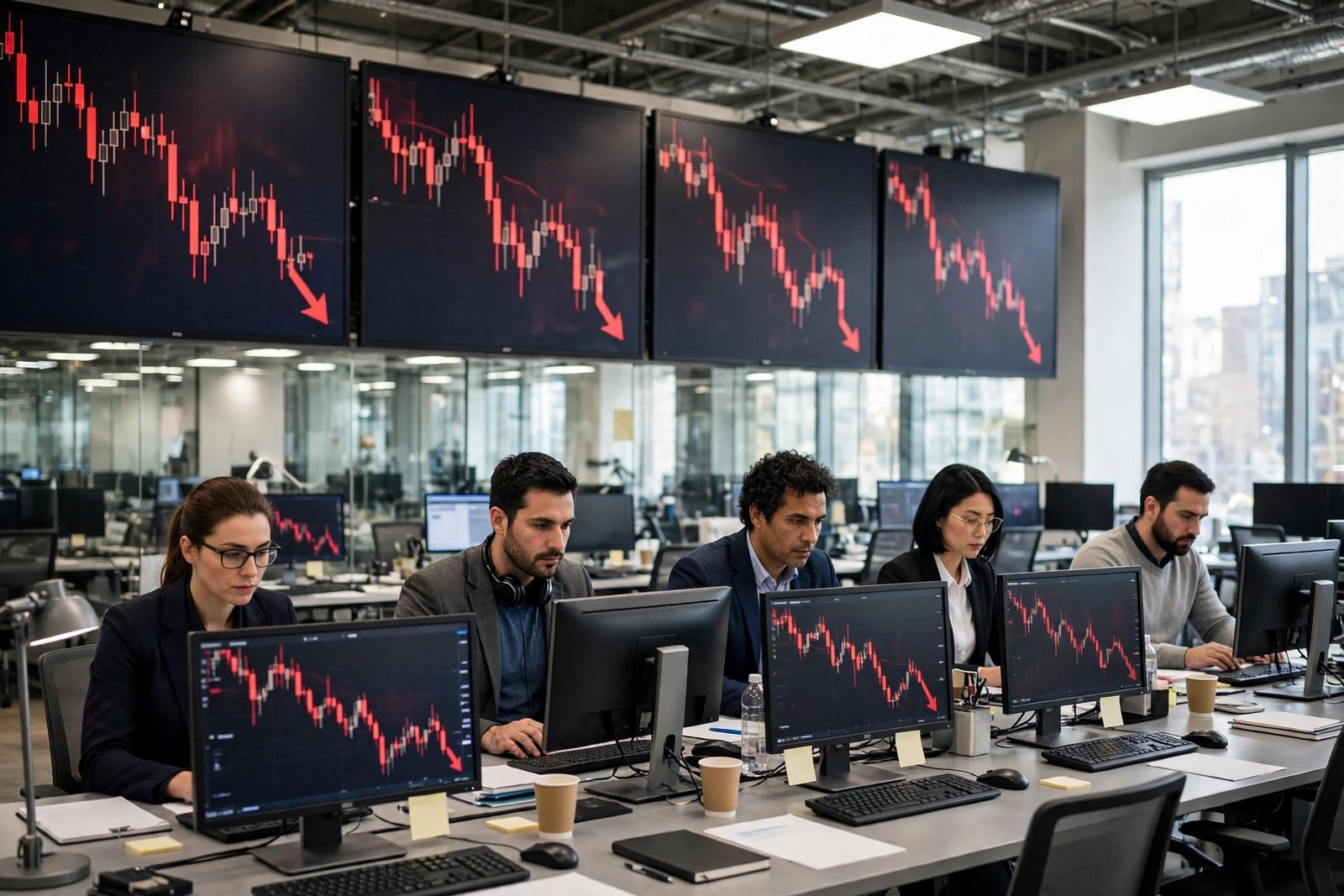
Friday, November 20, 2026, was a brutal day on Wall Street — and Nvidia was at the center of it. Shares of the world’s most important artificial intelligence chipmaker plunged 14% in a single session, closing at $125.53, after Reuters reported that the U.S. Securities and Exchange Commission is examining the company’s accounting practices. The drop capped Nvidia’s worst week since the 2008 financial crisis and turned a six-week slide into a full-blown rout.
For a company that was, until recently, the most valuable in the world, the fall has been staggering. Nvidia has now lost nearly half its value since early October, wiping out trillions of dollars in market value. The SEC report was the latest blow in a pile-up of troubles: a chief executive’s resignation, a state attorney general’s subpoena, a Justice Department review of a major acquisition, and growing doubts on Wall Street about the artificial intelligence boom itself.
Here is what happened, what the SEC is reportedly looking at, and what investors are watching next.
Friday’s Rout in Numbers
The scale of Friday’s sell-off is hard to overstate. Nvidia shares fell 14.01% — a drop of $20.45 — to close at $125.53 on the Nasdaq, according to market data. The single-day decline erased roughly $491 billion in market value, taking Nvidia from about $3.52 trillion to about $3.03 trillion, according to the Motley Fool.
For the week, Nvidia lost about 23%, its worst weekly slide since October 2008 — eighteen years ago, during the depths of the financial crisis. Friday was the stock’s seventh straight daily fall and its seventh straight weekly drop, the longest weekly losing streak since 2008.
The longer view is even more dramatic. Nvidia closed at a record $239.24 on October 6. At Friday’s price, the stock is down about 48% from that high, and the company has lost about $2.5 trillion in value in just six weeks, according to the Motley Fool. The chipmaker has slipped behind Apple, Microsoft, and Alphabet in market value, losing its position as the third-most valuable American company. There was a small sign of life after the close: in after-hours trading on Friday, Nvidia shares bounced to $130.01, up about 3.6% from the regular-session close, according to Finnhub market data.
What the SEC Is Reportedly Investigating
The spark for Friday’s plunge was a Reuters report, published in the afternoon, that the SEC is probing Nvidia’s accounting practices. Citing two people briefed on the matter, Reuters reported that the agency’s enforcement staff are scrutinizing potential accounting issues at the company.
The Reuters report followed a Wall Street Journal report on Tuesday, November 17, that the SEC was investigating Nvidia — but the Journal could not establish the focus of the investigation. Reuters filled in that gap, while also noting what it could not determine: the news agency said it could not immediately establish when the SEC opened its inquiry or exactly which accounting practices are under review.
Both the SEC and Nvidia have stayed quiet. The SEC declined to comment, and Nvidia did not immediately respond to requests for comment, according to multiple reports. That silence is normal at this stage — regulators rarely discuss ongoing inquiries — but it leaves investors guessing about how serious the matter is.
One point the reporting has stressed repeatedly: an investigation is not evidence of wrongdoing, and many SEC inquiries close without resulting in enforcement action. That distinction matters, even as the market has reacted as though the worst is coming.
So what might the SEC be looking at? Reuters could not say, but reporting and analysis since Friday have pointed to several open questions. One is how Nvidia reports where its sales come from: the company breaks out revenue by where customers are headquartered, rather than where they are billed, and the Financial Times has reported that roughly $104 billion of 2025 revenue was booked through Nvidia’s Singapore unit. Another is receivables, which have been running at about 64 days of sales. A third is the possibility that the probe relates to how Nvidia reports geographic revenue at a time when the Commerce Department has tightened chip export rules to Southeast Asia — rules that could make the question of where Nvidia’s chips ultimately end up a sensitive one. None of these areas has been confirmed as the focus of the inquiry, and investors should treat them as open questions, not findings.
How the Story Unfolded: From CEO Resignation to Probe
The SEC report did not arrive out of nowhere. It landed on a company already in turmoil. Nvidia co-founder Jensen Huang stepped down as chief executive earlier in November, following revelations about his personal relationships, including with a woman U.S. authorities suspect of spying for China — an allegation Beijing has denied. Nvidia has said it is probing the former chief executive and any potential compromise of company secrets or national security.
The legal pressure has been building from several directions at once. On Thursday, November 19, California Attorney General Rob Bonta served an investigative subpoena on Nvidia. His office is investigating whether Nvidia or Huang’s actions resulted in China obtaining advanced chips or confidential information — and whether Nvidia misled investors and the public about that risk. Huang is set to appear before Congress on December 1 for questioning about potential national-security breaches and his reported relationship with a suspected Chinese intelligence operative, according to Barron’s.
The Justice Department is also reviewing Nvidia’s planned $12.9 billion purchase of Hugging Face, the open-source AI platform, as part of a wider antitrust inquiry into the company’s acquisitions and practices, according to Reuters.
Remarkably, Nvidia’s business itself has not faltered. The company reported strong quarterly earnings earlier in the week, with record revenue and a stronger sales forecast — and the stock fell anyway. That disconnect between the company’s financial performance and its share price is one of the strangest features of this sell-off: the numbers are strong, but investors are selling regardless.
The Wider Chip Sell-Off
Nvidia was the biggest loser on Friday, but it was far from alone. The sell-off swept across the entire semiconductor industry and much of the technology sector. Advanced Micro Devices sank 13.3%, Micron Technology slid 13.9%, and Broadcom fell 12.2%, according to the Associated Press. The PHLX Semiconductor Index, which tracks major chip stocks, sank 10.7%.
The damage spread well beyond chips. The Nasdaq Composite plunged 5.3%, losing 1,261.47 points to close at 22,617.73 — its worst week since 2020 — and the index is now negative for 2026. The S&P 500 fell 3.7%, closing at 6,910.39 in its worst weekly loss in more than 18 months, and both the S&P 500 and the Dow Jones Industrial Average slipped into correction territory, meaning they are down more than 10% from their recent highs. The Dow dropped 949.73 points, or 1.9%, to 48,147.33.
Even Anthropic, the AI company that had made a blockbuster stock market debut just the day before, fell 8.5% on Friday to close at $88.91, giving back more than half of its first-day gain. The sell-off went global, too: Japan’s Nikkei fell about 5% and South Korea’s Kospi lost more than 5% on Friday.
Why Markets Reacted So Strongly
Why did one report about an SEC inquiry knock 14% off the world’s leading AI chipmaker in a single day? The short answer is that it hit a market that was already nervous, and a company that was already under strain.
First, the AI trade itself is under scrutiny. Investors have been questioning whether the trillions of dollars being poured into artificial intelligence — the data centers, the chips, the power plants — will generate enough returns to justify the spending. Nvidia sits at the center of that bet: it supplies the chips that power the AI buildout, and it has also invested widely in AI companies. When confidence in the AI boom wobbles, Nvidia is the first stock to feel it.
Second, the leadership vacuum matters. Jensen Huang was not just Nvidia’s chief executive; he was the public face of the AI revolution and the architect of the company’s dominance. His sudden departure, under a cloud of scandal, left investors without the leader they trusted most — and the stock has shed more than a quarter of its value since he stepped down.
Third, the SEC probe adds a new kind of risk. Investors can model slower growth or tougher competition, but an accounting investigation is harder to price: its scope is unknown, its timeline is measured in months or years, and its worst-case outcomes — restatements, fines, or findings of misconduct — strike at the credibility of the numbers investors rely on. As one Motley Fool analysis put it, the probe could hang over the company for at least several months.
Finally, there is the simple mechanics of a crowded trade unwinding. Nvidia had become one of the largest holdings in index funds and portfolios around the world. When a stock that big starts falling, the selling feeds on itself, as funds rebalance and traders rush for the exits at the same time.
What Investors Are Watching Next
The story is far from over, and several dates and documents will shape what happens next. The first is Nvidia’s next quarterly filing, its 10-Q, which investors will comb for any disclosure about the SEC inquiry or changes in how the company reports its revenue. Companies facing regulatory scrutiny often address the matter in their filings before they say anything in public.
The second is December 1, when Jensen Huang is scheduled to appear before Congress. His testimony could shed light on the China questions that have dogged the company — or deepen them.
The third is any word from Nvidia itself. The company has not yet responded substantively to the Reuters report, and investors will be watching for a statement, an earnings call, or a filing that addresses the accounting questions head-on. Silence, in this environment, tends to make the market more nervous, not less.
Beyond Nvidia, the broader question is whether the AI sell-off has further to run. The Nasdaq is now down for the year, the S&P 500 is in correction territory, and the fear gauge on Wall Street — the VIX — jumped 41% on Friday to 40. For now, the market’s message is clear: after years in which AI could seemingly do no wrong, investors want proof — proof that the spending pays off, proof that the numbers are sound, and proof that the companies at the center of the boom can survive the scrutiny now coming their way.
Related Reading
More on the tech world, markets, and the companies shaping America’s future:
- Nvidia CEO Jensen Huang Resigns in 2026
- Anthropic IPO 2026: Reports and Valuation
- Silicon Valley: The Heart of World Tech Power
Frequently Asked Questions
How much did Nvidia stock fall on November 20, 2026?
Nvidia shares fell 14.01%, or $20.45, to close at $125.53 on the Nasdaq. The drop erased roughly $491 billion in market value in a single session. For the week, the stock lost about 23%, its worst weekly decline since October 2008.
What is the SEC reportedly investigating?
Reuters reported on November 20, citing two people briefed on the matter, that SEC enforcement staff are examining potential accounting issues at Nvidia. The Wall Street Journal had reported on November 17 that the SEC was investigating the company but could not establish the focus. Reuters said it could not determine when the inquiry began or which accounting practices are under review, and the SEC has declined to comment.
Does an SEC investigation mean Nvidia did something wrong?
No. An investigation is not evidence of wrongdoing, and many SEC inquiries close without resulting in enforcement action. Reuters made that point explicitly in its reporting. Investors should wait for confirmed findings before drawing conclusions about the company’s accounting.
Why did other chip stocks fall too?
The sell-off spread across the semiconductor sector: AMD fell 13.3%, Micron fell 13.9%, and Broadcom fell 12.2% on Friday, while the PHLX Semiconductor Index sank 10.7%. Investors were questioning AI valuations broadly, and chipmakers — the biggest beneficiaries of the AI data-center buildout — bore the brunt of the selling.
What should investors watch next?
Nvidia’s next quarterly filing, its 10-Q, may include disclosures about the inquiry. Jensen Huang is scheduled to appear before Congress on December 1. Investors will also watch for any statement from Nvidia addressing the accounting questions, and for signs of whether the broader AI sell-off is stabilizing or deepening.