
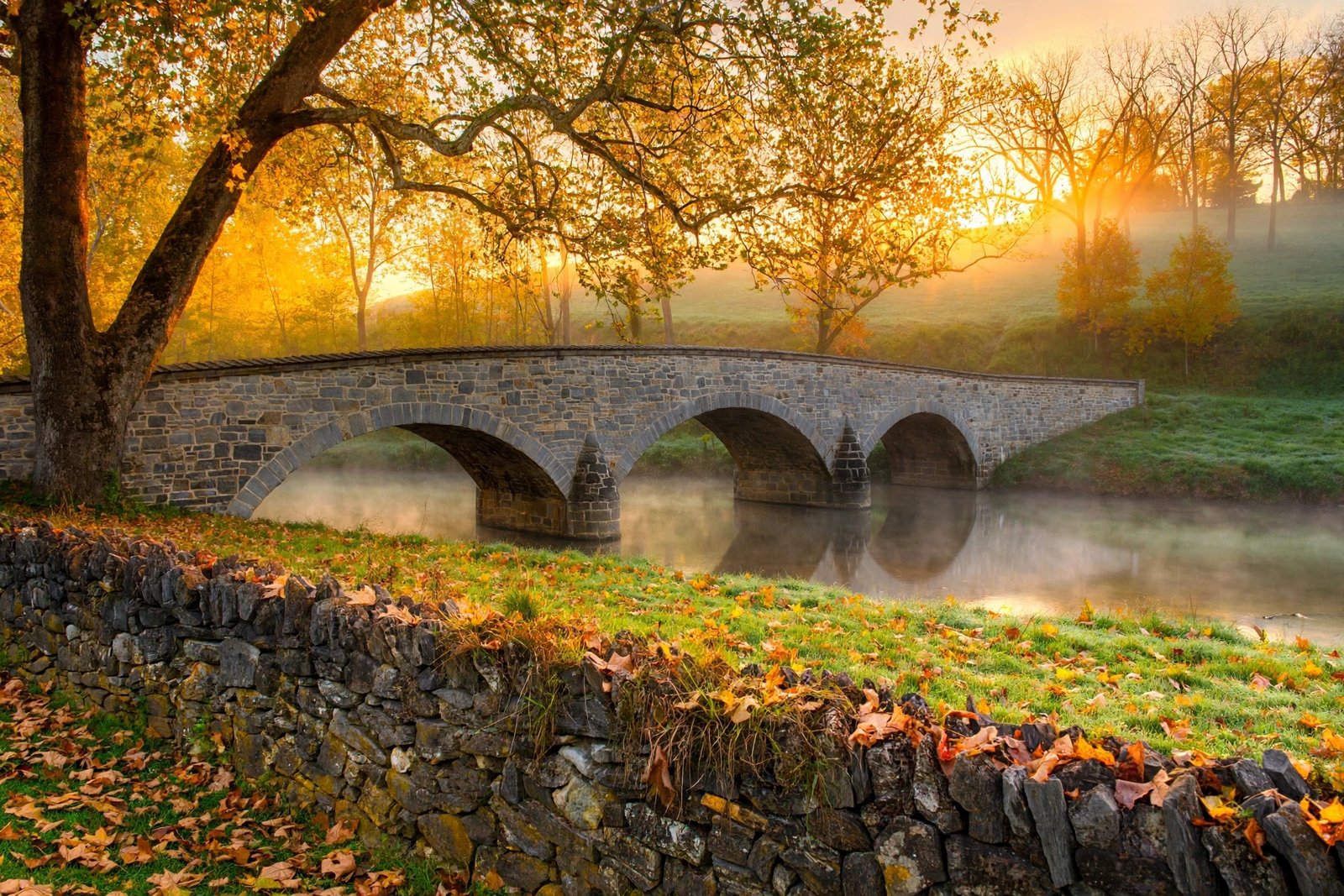
On the morning of September 17, 1862, in the rolling farmland outside the small Maryland town of Sharpsburg, two great armies met in a fight that would become the bloodiest single day in American history. By sunset, nearly 23,000 men lay dead, wounded, or missing along the banks of Antietam Creek. No other day in the nation’s history, before or since, has claimed so many American lives in combat. The Battle of Antietam was a tactical draw, yet it changed the Civil War forever, giving President Abraham Lincoln the opening he needed to issue the Emancipation Proclamation and turn a war to save the Union into a war to end slavery.
Why Lee Marched North: The Maryland Campaign
By the late summer of 1862, the Confederate Army of Northern Virginia was riding high. Under General Robert E. Lee, it had defeated Union forces at the Second Battle of Manassas in late August, driving the Army of the Potomac back toward Washington. Lee saw an opportunity. Rather than rest on his victory, he decided to carry the war into Northern territory for the first time, crossing the Potomac River into Maryland in early September.
Lee had several reasons for the invasion. A victory on Union soil could win Maryland, a slave state that had stayed in the Union, to the Confederate cause. It could also impress Britain and France, whose recognition of the Confederacy would bring badly needed supplies and legitimacy. And it could relieve war-torn Virginia, letting his army live off Maryland’s farms while Virginia’s farmers harvested their crops in peace.
But the invasion was a gamble. Lee’s army numbered roughly 40,000 men, and it was stretched thin. On September 9, at his headquarters near Frederick, Maryland, Lee issued Special Orders No. 191, a plan that divided his army into four parts. Most of the force, under General Thomas “Stonewall” Jackson, would march to capture the Union garrison at Harpers Ferry, while another column under General James Longstreet held the mountain passes.
Meanwhile, the Union Army of the Potomac, now under Major General George B. McClellan, was moving out of Washington in pursuit. McClellan commanded about 87,000 men, more than twice Lee’s strength, though only part of that force would reach the battlefield in time to fight. The stage was set for a meeting engagement neither side had fully planned.
The Lost Order That Changed Everything
On September 13, 1862, in a field outside Frederick, Maryland, two Union soldiers from the 27th Indiana Infantry, Corporal Barton W. Mitchell and First Sergeant John M. Bloss, made one of the greatest intelligence discoveries of the Civil War. Resting in tall grass where Confederate troops had camped, they found an envelope wrapped around three cigars. Inside was a copy of Lee’s Special Orders No. 191, the document laying out the positions and routes of Lee’s scattered divisions. The story of the Lost Order, as the American Battlefield Trust tells it, remains one of the war’s great tales.
The “Lost Order” told McClellan everything: Lee’s army was divided, its pieces miles apart, and Harpers Ferry was its target. It was the kind of gift a general dreams of. McClellan is reported to have boasted that with the order in hand, he now knew how to beat Lee. Yet he waited about eighteen hours before acting, and his advance remained cautious. That delay proved costly. On September 14, Union troops forced the mountain passes at South Mountain after a day of hard fighting, but on September 15, Jackson captured Harpers Ferry along with roughly 12,000 Union soldiers, the largest surrender of American troops in the war up to that point.
Lee, warned that his plans had been discovered, hurried to concentrate what forces he had near Sharpsburg, with the Potomac River at his back and Antietam Creek in front. The creek was deep and swift, crossable only at three stone bridges. McClellan spent September 15 and 16 getting his army into position. By the evening of September 16, about 65,000 Union troops faced roughly 40,000 Confederates across the creek. McClellan planned to attack both Confederate flanks and then strike the center. In practice, his attacks would come one after another, never together, allowing Lee to shift his outnumbered men from crisis to crisis all day long.
Dawn in the Cornfield
The battle began at first light on September 17. Major General Joseph Hooker’s I Corps crossed Antietam Creek and advanced south down the Hagerstown Turnpike toward the little whitewashed Dunker Church, the meeting house of the German Baptist Brethren. In front of them lay a 30-acre cornfield on the farm of David R. Miller, its tall stalks standing higher than a man’s head.
What followed was some of the most savage close-quarters fighting of the war. Union and Confederate brigades charged back and forth across the cornfield for about three hours, the field changing hands again and again. Artillery fired from several directions at once, cutting the corn down as if with a scythe. One Union general later wrote that every stalk of corn in the northern part of the field had been cut as closely as if with a knife, and the dead lay in rows precisely as they had stood in their ranks moments before.
Hooker’s corps was badly mauled, and Hooker himself was wounded. Major General Joseph Mansfield’s XII Corps came up in support, but Mansfield was killed shortly after arriving. Then a division under John Sedgwick pushed into the West Woods and was struck from three sides, losing more than 2,000 men in a short time. Despite the Union’s great numerical advantage, Jackson’s men held their ground near the Dunker Church. By 9 a.m., the morning phase alone had produced roughly 8,000 to 10,000 casualties, and the battle was only getting started.
Bloody Lane: The Sunken Road
By late morning, the fighting shifted to the center of the line. There, Confederate troops under Major Generals D. H. Hill and Richard Anderson held a farm lane worn below the surrounding fields by years of wagon traffic. The sunken road formed a natural trench, and for about three hours Union divisions hurled themselves against it.
The assaults were led in part by the famed Irish Brigade, whose green flags were visible above the smoke as they advanced. Then a misunderstood Confederate order caused part of the defending line to pull back, and Union soldiers gained positions from which they could fire down the length of the lane. The defense collapsed. The road, choked with the dead, became known as Bloody Lane, a name it carries to this day.
It was a breakthrough that could have split Lee’s army in two. But once again, McClellan declined to commit his reserves to exploit the opening. The Union troops who had broken through were exhausted and unsupported, and they pulled back rather than pressing on toward Sharpsburg. Another chance for a decisive victory slipped away.
Burnside Bridge and the Afternoon Fight
The final phase of the battle belonged to Major General Ambrose Burnside and his IX Corps on the southern end of the field. Burnside had been ordered to cross Antietam Creek and roll up the Confederate right flank. But the crossing point was a narrow stone bridge, and a small force of Georgia sharpshooters on the bluffs above held it against repeated attacks for hours.
Burnside’s men made several aborted attempts to force the bridge before finally pushing across in the early afternoon. Once over, they advanced toward Sharpsburg itself and threatened Lee’s escape route to the Potomac. For a moment, it looked as if the Union might finally crush the Confederate army.
Then came the dramatic turn of the day. At about 4 p.m., Major General A. P. Hill’s Light Division arrived from Harpers Ferry after a forced march of 17 miles. Hill’s men slammed into Burnside’s exposed flank and drove the Union troops back toward the creek, saving the day for the Army of Northern Virginia. As darkness fell, both armies were spent. About 23,000 men from both sides had been killed, wounded, or missing, making September 17, 1862, the bloodiest day in American history. There was no fighting the next day, and that night Lee withdrew his battered army across the Potomac into Virginia.
The Butcher’s Bill: Antietam’s Casualties
The numbers from Antietam are staggering, and they remain the reason the battle holds its grim record. The National Park Service estimates total casualties at about 22,700, with roughly 12,400 Union and 10,300 Confederate soldiers killed, wounded, or missing. Other tallies put the total slightly higher, near 22,726. Union losses included 2,108 killed, 9,549 wounded, and 753 captured or missing. Confederate losses included 1,546 killed, 7,752 wounded, and 1,018 captured or missing.
To put that in perspective, more Americans died at Antietam in a single day than on D-Day in World War II, and nearly eight times as many as fell on the beaches of Tarawa. The Confederate army lost almost a quarter of its strength in twelve hours. It was slaughter on a scale the American public had never imagined, and the photographs of the dead taken by Alexander Gardner in the days after the battle shocked the nation when they were exhibited in New York. For the first time, Americans could see the true face of war.
Why Antietam Was a Turning Point
Tactically, Antietam was a draw. Lee’s army escaped to fight another day, and McClellan failed to destroy it when he had the chance. But strategically, the battle was a Union victory that mattered enormously. Lee’s invasion of the North had been turned back. The Confederacy’s hopes for foreign recognition faded, as Britain and France saw that the rebellion could not win on Northern soil. And in the North, the outcome gave Lincoln the political footing he desperately needed.
Lincoln had been waiting for a military success before taking a step he had been considering for months: declaring emancipation. His cabinet had advised him not to issue such a proclamation from a position of weakness, after a string of Union defeats. Antietam, imperfect as it was, gave him the victory he needed. Five days after the battle, on September 22, 1862, Lincoln issued the Preliminary Emancipation Proclamation, declaring that on January 1, 1863, all enslaved people in states still in rebellion would be “then, thenceforward, and forever free.”
The proclamation changed the character of the war. It was no longer only a fight to preserve the Union. It was now also a fight against slavery, and that moral purpose helped keep Britain and France from aiding the Confederacy. It also opened the way for Black men to enlist in the Union Army, adding some 180,000 soldiers to the Northern cause by war’s end. Historians count Antietam among the great turning points of the Civil War precisely because of what followed it, not only because of what happened on the field.
From Antietam to Emancipation
The Emancipation Proclamation that Lincoln signed on January 1, 1863, was a military measure, and it was limited. It applied only to states in rebellion, leaving slavery untouched in the loyal border states of Maryland, Kentucky, Missouri, and Delaware. But its importance cannot be overstated. It made the destruction of slavery an official war aim, and it made any negotiated peace that preserved slavery impossible.
The road from Antietam to emancipation was not straight, and the war would grind on for two and a half more bloody years, through Gettysburg, Vicksburg, and Appomattox. But the link between the battle and the proclamation is direct and undisputed. Without Antietam, Lincoln might have waited months longer, and the political moment might have passed. As the National Park Service puts it, when the sun set over the bloody fields of Antietam, the Civil War became a different war. You can read the proclamation itself, and the history behind it, at the National Archives.
Visiting Antietam Today
Antietam National Battlefield, established by Congress on August 30, 1890, is today one of the best-preserved Civil War sites in the country. The park covers roughly 3,000 acres near Sharpsburg, Maryland, and visitors can walk the Cornfield, stand on Bloody Lane, and cross Burnside Bridge, all much as they were in 1862. More than 300 tablets mark the positions of individual regiments and the phases of the battle. The American Battlefield Trust’s Antietam battle page is a good place to start planning a visit and learning the ground before you go.
The American Battlefield Trust and its partners have preserved hundreds of additional acres around the park, including the Wilson farm between the Cornfield and the Dunker Church.
It was the bloodiest day in American history, and it was the day the war to save the Union became the war to end slavery.
Related reading
- Battle of Gettysburg: The Turning Point of the Civil War
- The Gettysburg Address: Lincoln’s 272 Words That Redefined America
- Battle of the Bulge: Hitler’s Last Gamble in the Ardennes
Frequently Asked Questions
How many people died at the Battle of Antietam?
About 22,700 soldiers were killed, wounded, or missing at Antietam, according to National Park Service estimates. Roughly 3,654 were killed outright: 2,108 Union soldiers and 1,546 Confederates. The total makes September 17, 1862, the bloodiest single day in American history.
Who won the Battle of Antietam?
The battle was a tactical draw, but a strategic Union victory. Lee’s invasion of Maryland was turned back and his army retreated to Virginia. The result gave President Lincoln the opening to issue the preliminary Emancipation Proclamation five days later.
What was Special Order 191?
Special Order 191 was General Robert E. Lee’s plan, issued on September 9, 1862, to divide his army and capture the Union garrison at Harpers Ferry. A copy was found by Union soldiers wrapped around three cigars near Frederick, Maryland, on September 13, revealing Lee’s plans to General McClellan.
Why is the road at Antietam called Bloody Lane?
Bloody Lane was a sunken farm road worn below the surrounding fields by years of wagon traffic. Confederate troops used it as a natural trench during the midday fighting on September 17, 1862. After Union troops broke the position, the road was so choked with the dead that it earned the name Bloody Lane.
How did Antietam lead to the Emancipation Proclamation?
President Lincoln had drafted an emancipation proclamation but was waiting for a Union victory before issuing it. Antietam gave him that victory. Five days after the battle, on September 22, 1862, he issued the preliminary proclamation, promising freedom for enslaved people in rebellious states effective January 1, 1863.