
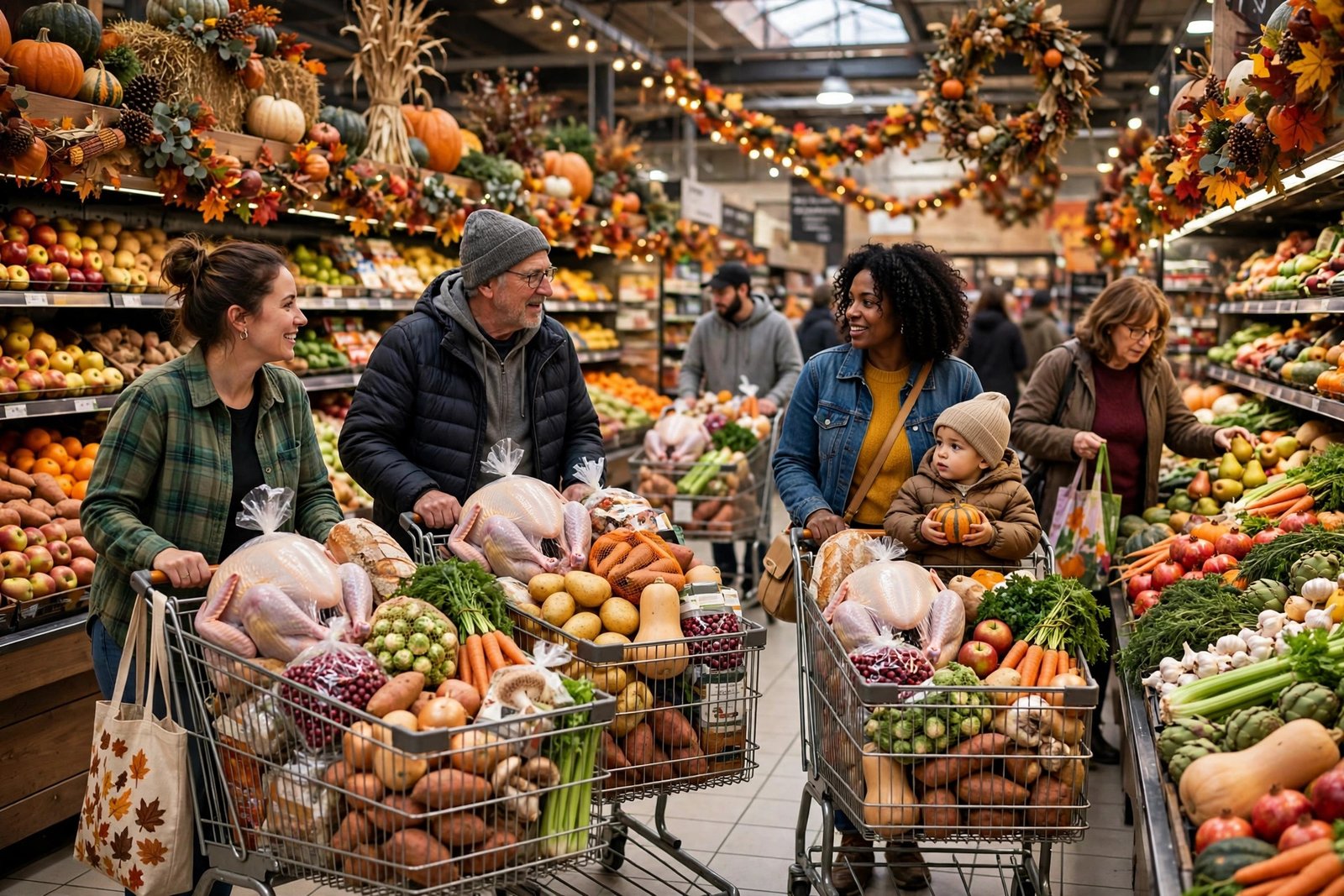
Thanksgiving is America’s biggest homecoming, and in 2026 it is also one of the biggest economic events of the year. The holiday touches almost every part of the American economy at once: the food on the table, the roads and airports that carry families home, and the shopping season that follows the meal. Taken together, the forecasts for Thanksgiving 2026 describe a holiday that costs more than last year, draws more than 81 million travelers, and opens a retail season expected to pass one trillion dollars for the first time.
None of these numbers are final results yet. Every figure in this article is a forecast or a survey finding released in the weeks before Thanksgiving, from the American Farm Bureau Federation, AAA, the National Retail Federation, and Adobe. They tell a consistent story: Americans are spending more, traveling almost as much as last year, and shopping earlier than ever.
The Dinner Table: A $58.63 Meal for Ten
Start with the meal itself, because that is where most families feel the holiday first. According to the American Farm Bureau Federation’s 41st annual Thanksgiving dinner survey, the classic Thanksgiving dinner for ten people costs $58.63 in 2026, or about $5.86 per person. That is up about 6 percent from $55.18 in 2025, and it is the first increase in the cost of the meal since 2022. Even so, the 2026 meal is still 8.5 percent below the record high of $64.05 set in 2022, when food inflation was at its worst.
The survey is an informal one, but it has run the same way for more than four decades, which makes it a useful yardstick. Every year since 1986, volunteer shoppers have priced the same fixed menu in the first week of November: turkey, stuffing, sweet potatoes, dinner rolls, frozen peas, cranberries, a vegetable tray, and pumpkin pie with whipped cream, all to feed ten people. This year, volunteers checked prices in person, on grocery apps, and online in all 50 states and Puerto Rico. Eight of the twelve items on the list rose in price, while four fell. The Farm Bureau’s full release on the 2026 survey lays out every item and every regional figure. The dinner is the anchor of the holiday, and its price is the number families compare year to year.
Why the Turkey Costs More This Year
The main reason the meal costs more in 2026 is the bird at the center of it. The survey’s 16-pound turkey costs $23.68 on average, or $1.48 per pound, up 10 percent from last year. That was the largest price increase of any item in the basket, and because the turkey is the single biggest item on the list, it drove most of the overall rise. The Farm Bureau points to higher production costs and a turkey flock that is still recovering, which has kept supplies tighter than usual.
The rest of the basket moved in both directions. A gallon of whole milk costs $4.05, up 8.6 percent. Two frozen pie crusts cost $3.81, up 7 percent. Stuffing mix costs $3.91, up 5.4 percent. A 30-ounce can of pumpkin pie mix costs $4.24, up 1.9 percent. On the other side, a one-pound vegetable tray of carrots and celery costs $1.31, down 3.7 percent, a pound of frozen peas costs $1.99, down 2 percent, and a half-pint of whipping cream costs $1.84, down 1.6 percent. For families, the turkey is the item to shop carefully. Prices were checked in the first week of November, before the deep discounts many supermarkets offer just before Thanksgiving, so the price a family actually pays may be lower than the survey average. The Des Moines Register’s report on the survey explains how the price checks work.
Where You Live Changes the Bill
The national average hides real differences between regions. In the Farm Bureau’s survey, the classic meal is cheapest in the South, at $54.33 for ten people. The Midwest comes next at $56.89, followed by the West at $58.74. The Northeast is the most expensive region, at $61.57, more than seven dollars above the South for the same menu. Those gaps reflect the ordinary geography of American grocery prices: transportation costs, local supply, wages, and the mix of stores in each region. A family in Georgia or Alabama is likely to pay noticeably less than the headline number, while a family in New York or Massachusetts is likely to pay noticeably more. The regional figure is the more useful number when planning a holiday budget.
The Expanded Table: $81.72 for the Full Feast
Many families do not stop at the classic menu. The Farm Bureau also prices an expanded menu that adds boneless ham, russet potatoes, and frozen green beans, the dishes that show up on tables where the classic list is only the beginning. Adding those three items raises the total by $23.09, bringing the full feast to $81.72 for ten people. The expanded menu reflects how Thanksgiving is actually celebrated in many homes. The classic menu has stayed fixed since 1986 so the comparison stays honest, but real tables have grown more varied, and some families cook for twelve or fifteen rather than ten. None of this makes Thanksgiving an extravagance: at $5.86 per person, the meal remains one of the cheapest ways to feed a crowd, and by hours of work at the average wage it is cheaper than in 1986, when it took more than three hours, compared with about one hour and 47 minutes this year.
On the Move: 81.5 Million Americans Traveling
After the food comes the journey. Thanksgiving is the busiest travel week of the year in the United States, and AAA forecasts that 81.5 million Americans will travel at least 50 miles from home during the seven-day Thanksgiving travel period, from Tuesday, November 24 through Monday, November 30, 2026. That is about 121,000 fewer than last year, a decline of just 0.1 percent, ending three years of record-setting Thanksgiving travel that followed the pandemic. In practical terms, the roads and airports should feel almost exactly as busy as last year.
Most of those travelers will drive. AAA forecasts that 72.9 million Americans will travel by car, down slightly from 73.1 million last year. Another 5.96 million are expected to fly, down 0.2 percent, while 2.6 million will travel by bus, train, or cruise ship, up 4.1 percent. The heaviest traffic is expected on Tuesday and Wednesday for departures and on Sunday and Monday for returns, and AAA recommends leaving in the morning, since the worst congestion comes in the afternoon and early evening. Flying is notably more expensive this year: round-trip domestic flights booked through AAA are averaging $800, up 17 percent from last Thanksgiving. All of that travel is spending, spreading far beyond airlines and gas stations into meals on the road, hotel rooms, and stores along the way. The AAA forecast has the full breakdown.
The Shopping Season: A $1.013 Trillion Forecast
The biggest number attached to Thanksgiving is not the dinner or the travel. It is the shopping season the holiday opens. The National Retail Federation forecasts that retail sales in November and December 2026 will grow 4.2 percent over 2025, reaching $1.013 trillion. That would be the first time the federation’s holiday measure has passed the trillion-dollar mark, and it would top the $972 billion in sales recorded in 2025, when the season grew 3.1 percent. The forecast, released on October 15, 2026, covers core retail and excludes automobile dealers, gasoline stations, and restaurants. It is a nominal figure, not adjusted for inflation, and the Associated Press reported that higher prices are expected to account for about half of the anticipated growth.
Behind the big number is a workforce: the NRF expects retailers to hire between 325,000 and 375,000 seasonal workers, in line with last year’s estimated 356,000 jobs. And the shoppers are coming. In a survey released on November 19, the NRF estimated that 182.7 million consumers plan to shop during the Thanksgiving weekend, from Thanksgiving Day through Cyber Monday. That is down slightly from 186.9 million a year ago, but it continues a run of elevated shopping. Black Friday remains the most popular day of the weekend, with 69 percent of holiday shoppers, about 126 million people, planning to shop. Cyber Monday follows, with 36 percent, about 66.1 million people, planning to shop. The NRF’s holiday data page tracks the season’s forecasts and survey results as they are released.
Online’s Record Run: $275.1 Billion
The fastest-growing part of the holiday economy is online. Adobe forecasts that United States online sales will reach $275.1 billion this holiday season, from November 1 to December 31, 2026, growing 6.7 percent over last year. The forecast, released on September 28, 2026, expects the season to cross $275 billion for the first time. Cyber Monday, on November 30, is expected to be the biggest online shopping day of the season, with $15.1 billion in spending, up 6.2 percent. Black Friday, on November 27, is expected to bring in $12.9 billion online, up 9.2 percent, which means it is growing faster than Cyber Monday, helped by the deepest discounts of the season on televisions, apparel, and appliances. Thanksgiving Day itself is expected to drive $6.9 billion in online spending, up 8.5 percent. Together, the five days from Thanksgiving through Cyber Monday, known as Cyber Week, are expected to drive $47.5 billion online, up 7.4 percent.
Adobe’s forecast also captures how early the season now starts. October alone is expected to produce $95.8 billion in online spending, up 8 percent from last year, as shoppers take advantage of early discounts. The holiday season no longer begins on Black Friday. It begins in October, builds through November, and peaks in the five days after Thanksgiving. Shopping habits keep changing: a growing share of online spending comes through mobile phones, buy-now-pay-later services are expected to account for more than $21 billion of holiday spending, and Adobe reported a sharp surge in AI-driven traffic to retail sites. Adobe’s holiday shopping forecast release has the full breakdown.
What the Numbers Mean for Your Wallet
Big national forecasts can feel distant from a family’s budget, so here is the practical version. The dinner costs more, and the turkey is driving the increase, so shopping the turkey carefully and using pre-Thanksgiving sales is the best way to hold the food bill down. The roads will be as busy as last year, with the worst traffic on Tuesday and Wednesday afternoons, so leave in the morning. The deals are real but spread out: with retailers discounting from October onward, the best price on a gift may come weeks before Black Friday, while the deepest discounts on televisions, apparel, and appliances are expected on Black Friday itself. The Kurums analysis of the 2026 holiday sales forecasts explains the difference between nominal and real growth in plain terms. The honest summary: the meal costs a little more, the trip costs a little more, and the shopping season is bigger than ever, but the classic dinner is still about $5.86 per person.
A Forecast, Not a Final Score
A note of caution about every number in this article. The Farm Bureau’s dinner cost is a survey, not a price index: an informal check of one fixed menu by volunteers in the first week of November, and the prices families actually pay may differ once pre-Thanksgiving discounts take effect. The NRF’s $1.013 trillion is a forecast made in October, before a single November sale, and it is not adjusted for inflation. AAA’s travel figures were prepared in mid-October, and Adobe’s online totals rest on data available in September. Each could turn out higher or lower than expected. The real totals will be known only after the season ends. Until then, the honest description of Thanksgiving 2026 is a holiday forecast to cost a little more at the table, to move about as many people as last year, and to produce the biggest shopping season on record. If the forecasts are right, it will be a Thanksgiving worth more than a trillion dollars. We will know for certain in January.
Frequently Asked Questions
How much does Thanksgiving dinner cost in 2026?
The American Farm Bureau Federation’s 41st annual survey puts the classic dinner for ten at $58.63 in 2026, about $5.86 per person, up about 6 percent from $55.18 in 2025 but still 8.5 percent below the record $64.05 in 2022. The expanded menu costs $81.72.
How many Americans are traveling for Thanksgiving 2026?
AAA forecasts 81.5 million Americans traveling at least 50 miles from home from November 24 to November 30, 2026: 72.9 million by car, 5.96 million flying, and 2.6 million by bus, train, or cruise ship.
What are holiday retail sales forecast to be in 2026?
The National Retail Federation forecasts $1.013 trillion in November and December 2026 retail sales, up 4.2 percent over 2025, the first time holiday sales have passed one trillion dollars. The forecast is nominal, not adjusted for inflation.
How much will Americans spend online this holiday season?
Adobe forecasts $275.1 billion in United States online sales from November 1 to December 31, 2026, up 6.7 percent. Cyber Monday is expected to lead at $15.1 billion, followed by Black Friday at $12.9 billion.
How many people are expected to shop over Thanksgiving weekend?
The National Retail Federation estimates 182.7 million consumers plan to shop from Thanksgiving Day through Cyber Monday. Black Friday is the most popular day, with about 126 million people planning to shop.
Are these Thanksgiving figures final results or forecasts?
They are forecasts and survey findings, not final results. The dinner cost is an informal survey, the NRF and Adobe totals are pre-season forecasts, and AAA’s travel numbers were prepared in mid-October. Final results come only after the season ends.