
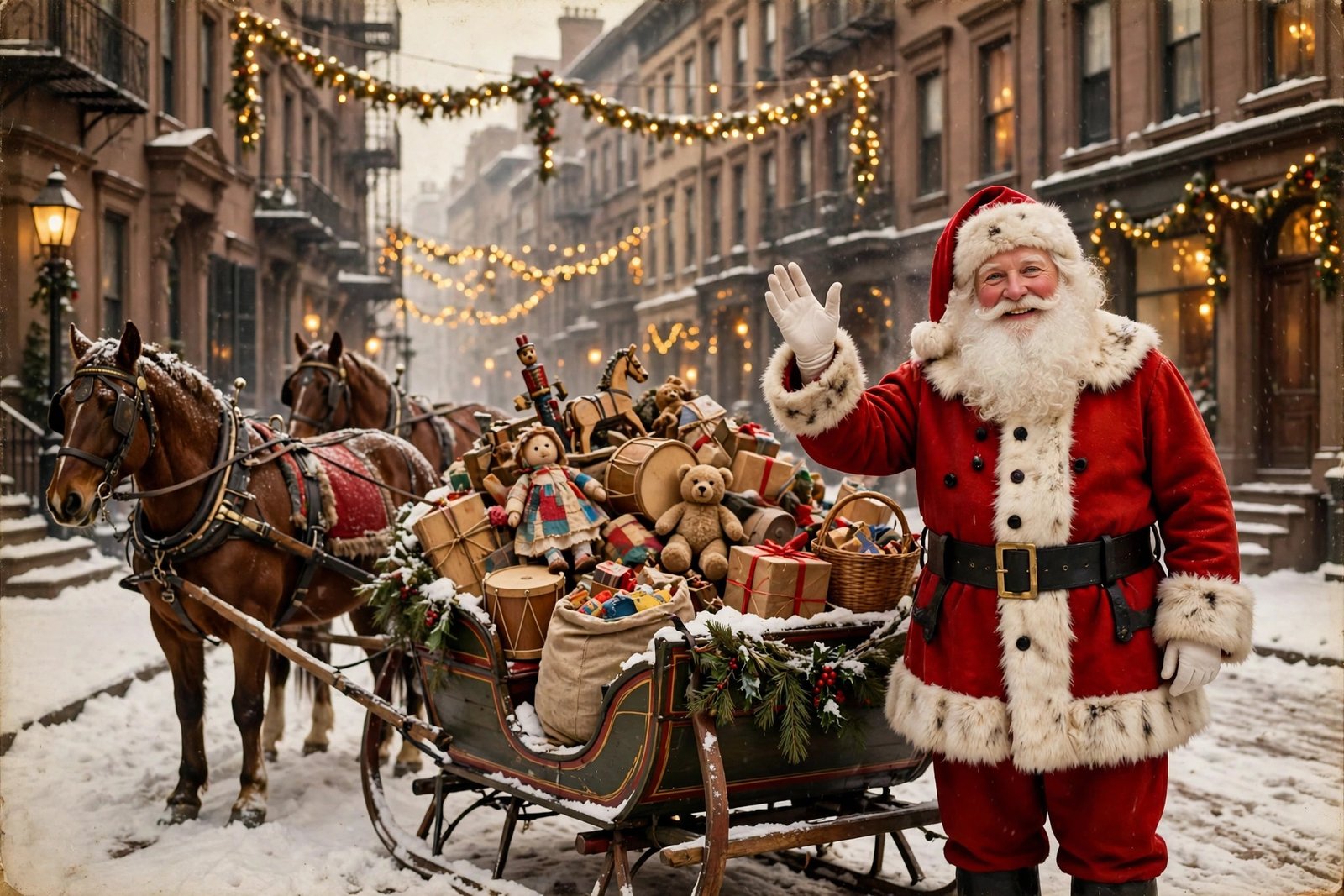
He wears a red suit, drives a sleigh pulled by eight reindeer, and slides down chimneys on Christmas Eve — but Santa Claus was not always the jolly, white-bearded figure we know today. The Santa on every mall throne and Christmas card is a distinctly American creation, assembled over two centuries from a fourth-century bishop, a Dutch folk tradition, a New York satirist, a famous poem, a Civil War cartoonist, and a soft-drink advertising campaign.
None of it happened by accident. Each generation of Americans took the Santa they inherited and reshaped him a little — and the result is one of the most recognizable figures on the planet. This is the story of how Santa Claus became American, from St. Nicholas of Myra to the North Pole workshop, the Coca-Cola ads, and the military radar station that still tracks his sleigh every Christmas Eve.
It Starts With a Real Saint: Nicholas of Myra
The story begins in the fourth century with Nicholas, the bishop of Myra, a port city in what is now Turkey. Nicholas died on December 6, 343 CE, and over the centuries he became one of the most beloved saints in Europe, known for secret gift-giving and kindness to children. The legends attached to him are older than the United States itself: coins slipped into shoes, dowries left anonymously for poor families, and rescues of children in danger.
By the Middle Ages, Nicholas was celebrated across Europe, and his feast day — December 6 — was a day when children received small gifts. In the Netherlands, that celebration became Sinterklaas, held on December 5 or 6, when children left their shoes by the hearth overnight and found them filled with treats in the morning. The Dutch carried that devotion with them when they crossed the Atlantic, and it landed in the place where the American Santa would be born: New Amsterdam, the Dutch colony that became New York City.
The Pilgrims who settled New England, by contrast, wanted nothing to do with saints or Christmas feasting — Christmas did not become an official holiday in Massachusetts until 1856. It was the Dutch, not the Pilgrims, who planted the seed of Santa in American soil.
Sinterklaas Comes to New Amsterdam
When Dutch colonists settled New Amsterdam in the 1600s, they brought Sinterklaas with them. Dutch families in the colony kept the custom of filling children’s shoes on St. Nicholas Eve, and their English neighbors noticed. After the English took over the colony and renamed it New York, the Dutch tradition did not disappear — it lingered in the city’s Dutch families, waiting for the moment when New Yorkers would want a Christmas of their own.
That moment came after the American Revolution. Newly independent New Yorkers, eager to distance themselves from British culture, developed a fondness for the city’s Dutch roots. John Pintard, a founder of the New-York Historical Society, promoted St. Nicholas as a symbol of the city and tried to have him recognized as New York’s patron saint. In 1810, Pintard organized a feast-day celebration for the Historical Society, and among the guests was a young writer named Washington Irving.
Washington Irving Invents the American Santa
In 1809, Washington Irving — later famous for “The Legend of Sleepy Hollow” and “Rip Van Winkle” — published A History of New York under the pen name Diedrich Knickerbocker. It was a satire, a joke history of Dutch New York, and in it Irving gave St. Nicholas a starring role. He wrote that the saint had appeared in a dream to the Dutch colonists and guided them to settle Manhattan, riding over the treetops in the wagon in which he brought his yearly presents to children.
Irving’s St. Nicholas was a reinvention. Gone was the tall, solemn European bishop. In his place stood a short, stout, merry, pipe-smoking Dutchman in colonial dress, who dropped presents down chimneys and filled stockings hung by the fire. Irving also did something that would echo for centuries: he translated the Dutch name “Sinterklaas” into English as “Santa Claus,” one of the first times the name appeared in print.
It is worth remembering that Irving was joking. He was parodying the Historical Society’s earnest efforts to manufacture tradition for a fast-growing city. But the joke stuck. New Yorkers loved this cheerful, child-centered St. Nick, and the figure began to spread beyond the joke and into American Christmas itself.
The Poem That Gave Santa His Reindeer
The next great leap came on December 23, 1823, when a poem titled “A Visit from St. Nicholas” was published anonymously in the Troy, New York Sentinel. The scholar and poet Clement Clarke Moore later took credit for it, though some literary historians argue it was written by Henry Livingston Jr. Whoever wrote it, the poem — now known by its first line, “‘Twas the Night Before Christmas” — fixed the modern image of Santa more firmly than anything before it.
The poem gave Santa his sleigh and his eight reindeer, naming each one: Dasher, Dancer, Prancer, Vixen, Comet, Cupid, Donder, and Blitzen. It gave him his physical form — the round belly, the rosy cheeks, the white beard, the twinkling eyes — and his laugh, and it gave children the ritual of hanging stockings and listening for sleigh bells on the roof. It also gave Santa his entrance: down the chimney, with a bound, leaving gifts and disappearing up the flue.
Before the poem, Santa was a loose collection of folk customs. After it, he had a shape, a vehicle, a team, and a schedule. The poem was reprinted endlessly, memorized by generations of American children, and it remains the single most influential text in Santa’s history. Nearly everything that came after — the illustrations, the advertisements, the movies — was filling in a picture the poem had already drawn.
Thomas Nast Draws Santa Into Shape
If the poem gave Santa his words, Thomas Nast gave him his face. Nast, a German-American political cartoonist for Harper’s Weekly, first drew Santa Claus in the magazine’s January 3, 1863 issue, showing him handing out gifts to Union soldiers in camp during the Civil War. Over the following decades, Nast drew Santa again and again — more than thirty times in all — and with each drawing, the image grew more settled.
Nast’s Santa wore a red suit, carried a sack of toys, and lived and worked at the North Pole. He gave Santa a workshop, a wife, and a naughty-or-nice list. He made the North Pole Santa’s home, a detail that has stuck so firmly that generations of children now write their letters there. Nast’s drawings were the first widely seen pictures of Santa in America, and they established the visual template that everyone else would follow.
Department Stores, “Yes, Virginia,” and Santa Goes Commercial
By the late nineteenth century, Santa had moved from the page into the marketplace. American department stores discovered that a live Santa in the store at Christmas brought in families — and sales. The first department-store Santa is generally credited to the late nineteenth century, and by the early 1900s the store Santa was an American institution, with children lining up to sit on his knee and whisper their wishes.
It was in this era that Santa also became a newspaper legend. In September 1897, an eight-year-old girl named Virginia O’Hanlon wrote to the New York Sun asking whether Santa Claus was real, because her friends said he was not. The editor Francis P. Church answered with one of the most famous editorials in American journalism: “Yes, Virginia, there is a Santa Claus. He exists as certainly as love and generosity and devotion exist.” The editorial, published on September 21, 1897, was reprinted for decades and remains beloved today.
Coca-Cola and the Santa Everyone Recognizes
Here is the most repeated myth in Santa’s history: that Coca-Cola invented the red-suited Santa. It is not true — and Coca-Cola itself says so. Red-suited Santas appeared in illustrations and Christmas cards decades before the famous ads, and Nast had already dressed Santa in red in the nineteenth century.
What Coca-Cola did, starting in 1931, was hire the artist Haddon Sundblom to paint a single, consistent Santa for its holiday advertising — a warm, human-sized, rosy-cheeked grandfather with a white beard and an easy smile, inspired by Clement Clarke Moore’s poem. Sundblom painted that Santa year after year until 1964, and Coca-Cola put him in magazines, on billboards, and in shop windows across the country and around the world.
The effect was standardization. Before Sundblom, Santa came in many forms — tall and gaunt, elfin, even a little frightening. After three decades of the same jolly Santa in every December, the image was fixed: red suit, white fur trim, black boots, round belly, twinkling eyes. Coca-Cola did not invent the red suit, but it did more than anyone else to make the jolly red-suited Santa the one the whole world pictures. It was advertising as folk art, and it worked.
NORAD Tracks Santa: A Wrong Number Becomes a Tradition
One of the strangest and most charming chapters in Santa’s American story began with a wrong number. In 1955, a child trying to reach Santa misdialed a number printed in a department-store advertisement and reached the Continental Air Defense Command operations center in Colorado Springs. Colonel Harry Shoup, the commander on duty, played along and told the child where Santa was — and the tradition was born.
When NORAD, the North American Aerospace Defense Command, was formed in 1958, it took over the tradition, and it has tracked Santa every Christmas Eve since. Today, NORAD Tracks Santa is a global event, with a website, a phone line, and volunteers answering children’s calls from around the world. It is a military command running a children’s fantasy, and it is one of the most American things about Santa: a Cold War radar network, repurposed for Christmas magic.
Santa Claus, Indiana: A Town That Took His Name
America’s devotion to Santa even reshaped the map. The town of Santa Claus, Indiana, was founded in 1854 under the name Santa Fe, but when residents applied for a post office in 1856, they learned another Indiana town already used that name. They settled on Santa Claus instead, and the post office was established on May 21, 1856.
The name went largely unnoticed until the 1920s, when Postmaster James Martin began promoting the Santa Claus postmark and answering the letters to Santa that arrived at the little post office. Volunteers known as Santa’s Elves still answer thousands of children’s letters every year, a tradition going back to at least 1914, and the post office creates a special Christmas pictorial postmark each December that draws mail from around the world.
Why Santa Became American — and Stayed That Way
So why did this figure, born in fourth-century Turkey and raised in the Netherlands, become so thoroughly American? Part of the answer is timing. Santa arrived in New York just as the young United States was inventing its own traditions, and he was flexible enough to be reinvented by every generation that adopted him. A satirist made him funny. A poet gave him reindeer. A cartoonist gave him a home at the North Pole. A soft-drink company gave him a face the whole world could recognize. A military command gave him a radar escort.
Part of it is also that Santa fits something in the American story: generosity as a value, childhood as a sacred season, and the idea that a stranger might come down your chimney in the middle of the night and leave something good behind. He is a folk figure who became a commercial figure without ever quite losing his folk heart — and the “Yes, Virginia” editorial, still reprinted more than a century later, is the proof. It argues, in the end, that Santa exists the way love and generosity exist: not as something you can catch in a chimney, but as something real all the same.
That is the Santa who shows up every December in malls and parades, on television and in NORAD’s tracking maps, and in the town of Santa Claus, Indiana, where the letters still get answered. He began as a bishop in Myra, became a Dutchman in New Amsterdam, and ended up as America’s most famous immigrant — a figure the country adopted, rewrote, and gave to the world.
Related reading
- The American Christmas Tree Tradition: History and Meaning
- Macy’s Thanksgiving Day Parade: History of America’s Favorite Parade
- The First Thanksgiving at Plymouth in 1621: What Really Happened
Frequently Asked Questions
Was Santa Claus invented in America?
No — Santa grew from St. Nicholas of Myra, a fourth-century bishop, and the Dutch Sinterklaas tradition. But the modern Santa — the red suit, the reindeer, the North Pole workshop, the chimney entrance — was created in the United States, mainly in nineteenth-century New York, through the work of Washington Irving, Clement Clarke Moore, and Thomas Nast.
Did Coca-Cola invent Santa’s red suit?
No. Red-suited Santas appeared in illustrations decades before Coca-Cola’s 1931 campaign, and Thomas Nast had already drawn Santa in red in the nineteenth century. Coca-Cola’s artist Haddon Sundblom standardized the jolly, rosy-cheeked Santa and spread that image worldwide through ads that ran until 1964 — he popularized the look, he did not invent it.
Who wrote “‘Twas the Night Before Christmas”?
The poem “A Visit from St. Nicholas” was published anonymously in the Troy, New York Sentinel on December 23, 1823. Clement Clarke Moore later claimed authorship, though some historians credit Henry Livingston Jr. The poem named Santa’s eight reindeer and set the modern image of his Christmas Eve visit.
How did NORAD start tracking Santa?
In 1955, a child misdialed a number from a department-store ad and reached the Continental Air Defense Command operations center in Colorado Springs, where Colonel Harry Shoup told the child where Santa was. NORAD took over the tradition when it was formed in 1958 and has tracked Santa every Christmas Eve since.
Is there really a town called Santa Claus?
Yes — Santa Claus, Indiana, in Spencer County. Founded as Santa Fe in 1854, it took the name Santa Claus when it applied for a post office in 1856. Its post office answers thousands of children’s letters to Santa every year, a tradition going back to at least 1914.