
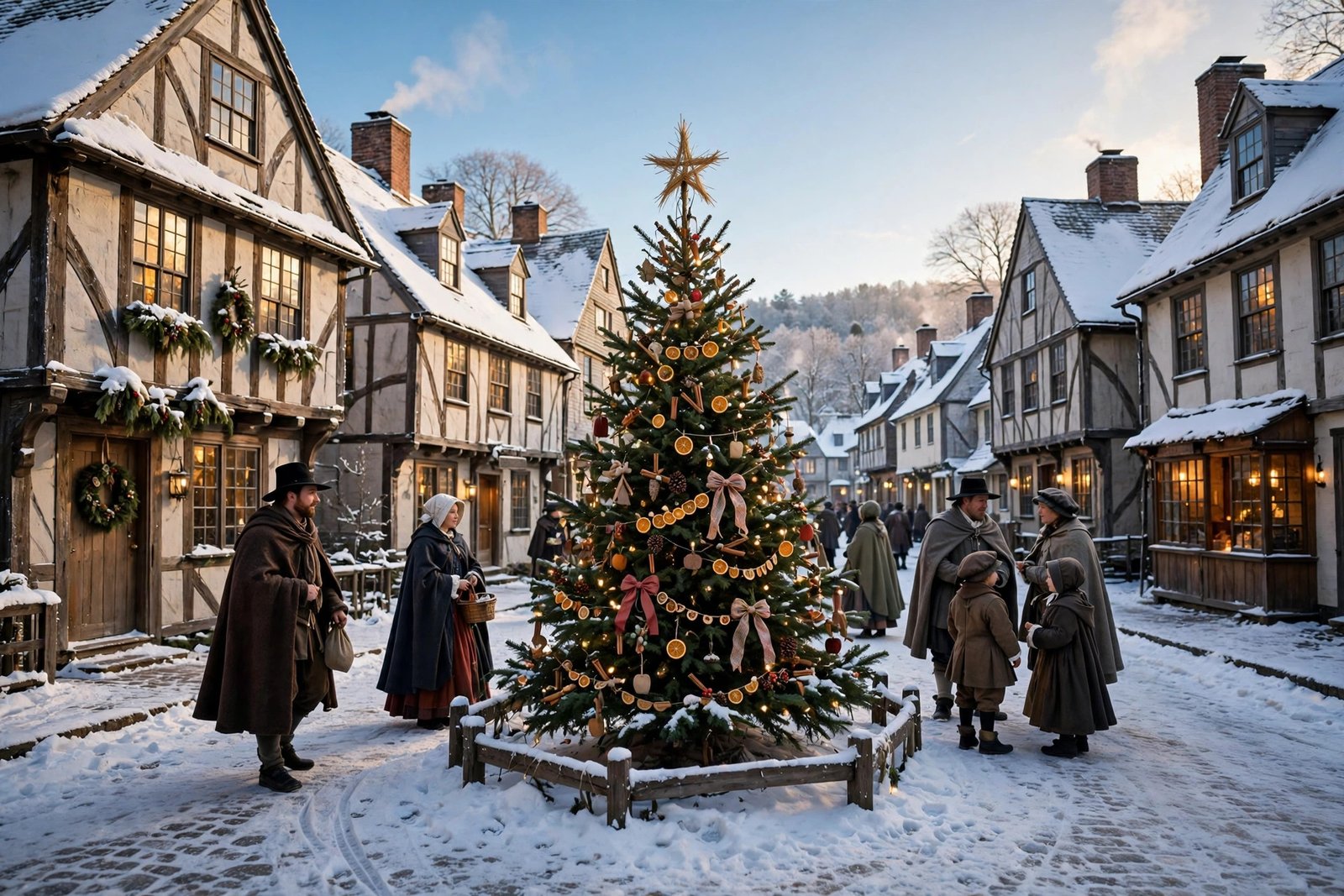
Picture this: it is Christmas morning in Boston, and instead of sleeping in, opening gifts, or sitting down to a feast, you are at work. If you stay home, skip your chores, or even enjoy a good meal with your family, a constable can fine you five shillings. That was not a nightmare. It was the law.
For 22 years in the 1600s, celebrating Christmas was a crime in the Massachusetts Bay Colony. The Puritans who ran the colony saw December 25 not as a holy day but as a disorderly, unbiblical, and faintly pagan festival, and they used the full power of the government to stamp it out. The story of how Christmas was banned in America — and how it fought its way back to become the country’s biggest holiday — is one of the strangest chapters in American history.
Christmas in 17th-Century England Was a Rowdy Party
To understand why the Puritans banned Christmas, you first have to understand what Christmas looked like in the 1600s. It was nothing like the quiet, family-centered holiday most Americans know today. In England, Christmas was a season of feasting, drinking, gambling, dancing, and public revelry that stretched across twelve days. Wassailers went door to door demanding food and drink. A “Lord of Misrule” presided over pranks and upside-down fun. Church services were part of it, but so were street games, heavy drinking, and celebrations that regularly spilled into disorder.
The Puritans were a reform movement inside English Protestantism, and they believed the Church of England had kept far too many Catholic customs. They wanted a church purified of what they saw as human inventions, and Christmas was near the top of their list. The Bible, they pointed out, gives no date for the birth of Jesus. December 25 had been fixed by the early church centuries after the fact, and the Puritans believed the date carried the fingerprints of older Roman winter festivals. To them, treating the day as holy was not devotion. It was superstition, and the drunken revelry around it only proved the point.
Their objections were not only theological. They were also practical. A holiday that shut down work, filled the streets with drinking and gambling, and turned social order upside down struck them as a threat to the godly, disciplined communities they were trying to build. When the Puritans gained power in England during the Civil War, Parliament banned the observance of Christmas in 1647, along with Easter and Whitsun. The ban met fierce resistance — there were pro-Christmas riots in several cities — but it stayed in force until the monarchy was restored in 1660.
The Pilgrims’ First Christmas: A Workday in Plymouth
Across the Atlantic, the Separatists who founded Plymouth Colony in 1620 felt the same way. Their very first Christmas in the New World was spent working. On December 25, 1620, the Mayflower’s passengers went ashore to cut timber and begin building their common storehouse. The ship’s log noted that Christmas Day was “not observed by these colonists, they being opposed to all saints’ days.” Nobody rested that day.
A year later, the colony’s governor, William Bradford, had a run-in that became one of the most famous Christmas stories in American history. On Christmas Day 1621, Bradford called the settlers out to work, as usual. Some newcomers, who had arrived on the ship Fortune that autumn, excused themselves, saying it went against their consciences to work on the day. Bradford let them stay behind. But when he returned at noon, he found them playing games in the street — pitching the bar and playing stoolball, an early bat-and-ball game. He confiscated their equipment and told them that if keeping the day was a matter of devotion, they should keep to their houses, “but there should be no gaming or reveling in the streets.” As Bradford dryly recorded, nothing of the kind was attempted openly afterward.
That was the Puritan pattern in miniature: work was holy, play on a holy day was not, and public revelry was a disorder to be corrected. It would be nearly forty more years before the colony put that attitude into a statute.
The Law of 1659: Five Shillings for Keeping Christmas
On May 11, 1659, the General Court of the Massachusetts Bay Colony passed a law with the blunt title “Penalty for Keeping Christmas.” The text is short enough to quote in full, and it is worth reading because it shows exactly what the colony was criminalizing:
“For preventing disorders arising in several places within this jurisdiction, by reason of some still observing such festivals as were superstitiously kept in other countries, to the great dishonor of God and offence of others, it is therefore ordered by this Court and the authority thereof, that whosoever shall be found observing any such day as Christmas or the like, either by forbearing of labor, feasting, or any other way, upon such accountants as aforesaid, every person so offending shall pay for every such offence five shillings, as a fine to the county.”
Five shillings was a real sum for an ordinary colonist — the modern equivalent is often put at roughly $48 — and the fine applied to every offense. Staying home from work counted. Feasting counted. “Any other way” counted. The same law also fined people for playing cards or dice, because games of chance belonged to the same world of idleness and disorder.
The law stayed on the books for 22 years. It was not a dead letter, either. The colony’s leaders enforced it as part of a broader campaign against holidays, Sabbath-breaking, and public misbehavior. For a generation of New Englanders, December 25 was simply an ordinary workday, and anyone who treated it differently risked a fine.
Why the Puritans Objected: Scripture, Pagan Roots, and Disorder
The Puritan case against Christmas rested on three arguments, and each one tells us something about how they saw the world. First was Scripture. The Puritans believed that worship had to be commanded by the Bible, and the Bible never commands anyone to celebrate the birth of Christ, let alone on December 25. As one of their sayings put it, “They for whom all days are holy can have no holiday.” Every day belonged to God, so singling out one day for feasting looked like human invention, not obedience.
Second was the holiday’s origin. The Puritans knew that December 25 had been settled on centuries earlier, and they believed the date was tangled up with Roman midwinter festivals. Celebrating it, in their view, meant honoring a day with pagan associations, which was a form of idolatry. The Reverend Increase Mather, one of New England’s most powerful ministers, denounced the season in print, and his son Cotton Mather later preached against it too, arguing that the revelry of the season was incompatible with genuine devotion.
Third was the behavior itself. Christmas in the 1600s was not a quiet evening by the fire. It was drinking, gambling, wassailing, and crowds in the streets. The Puritans were building towns where the Sabbath was strictly kept and idleness was a sin. A holiday that licensed excess for twelve days was the opposite of everything they stood for. The ban, then, was not only about a date on the calendar. It was about what kind of society New England would be.
Repeal in 1681 — But Not a Warm Welcome
The ban ended in 1681, not because the Puritans changed their minds, but because England forced their hand. The monarchy had been restored in 1660, and the Crown was increasingly impatient with Massachusetts’ theocratic independence. Under mounting pressure from London, the colony repealed its most restrictive laws, including the Christmas ban. The law was gone. The attitude was not.
Christmas remained deeply unpopular in New England for generations. In 1686, the royal governor, Sir Edmund Andros, held a Christmas service in Boston, and the town’s Puritan establishment was scandalized. Shops stayed open on December 25. Work went on as usual. Churches did not hold Christmas services. The cultural stigma was so deeply rooted that Massachusetts did not make Christmas a state holiday until 1856, and Boston’s public schools kept their doors open on December 25 well into the 19th century. The legal ban had lasted 22 years. The social ban lasted far longer.
There was also a political edge to the dislike. After the American Revolution, Christmas was seen by some New Englanders as an English custom, and therefore suspect in a new republic. The holiday that would one day define the American winter had, for more than a century, been treated as foreign, popish, and vaguely disloyal.
The Great Reinvention: Irving, Dickens, and the Christmas Tree
So how did a banned holiday become America’s favorite? The answer is that Christmas was reinvented in the 19th century — not restored, but remade into something new. And writers did much of the remaking.
Washington Irving led the way. In his History of New York, published in 1809 under a pseudonym, Irving gave American readers a jolly St. Nicholas who rode over the treetops and dropped presents into stockings hung by the chimney. A decade later, his Sketch Book included stories set at an idealized English country Christmas, full of warmth, generosity, and old-fashioned hospitality. Historians agree that Irving’s Christmas was largely invented — a nostalgic fantasy of a holiday that had never quite existed — but Americans loved it, and they began to copy it.
Clement Moore’s poem “A Visit from St. Nicholas,” with its sleigh, its reindeer, and its twinkling St. Nick, gave the season its most enduring imagery. Then, in 1843, Charles Dickens published A Christmas Carol, and the transformation was complete. Dickens took the holiday out of the streets and the taverns and put it in the family parlor: Scrooge’s redemption was about generosity, warmth, and love for one’s fellow man. The book was an instant success on both sides of the Atlantic and has never been out of print.
Immigration did the rest. German immigrants brought the indoor decorated Christmas tree, a custom that seemed strange at first and then became universal — helped along by the famous image of Queen Victoria and her German husband, Prince Albert, gathered around a tree with their children. Irish and other Catholic immigrants brought well-attended Christmas Masses and the idea of staying home from work on the day. The rowdy carnival of the 1600s was gone. In its place was a holiday of family, gifts, trees, and goodwill.
1870: Christmas Becomes a Federal Holiday
The legal journey ended on June 28, 1870, when President Ulysses S. Grant signed a bill making Christmas a legal holiday for federal workers in Washington, D.C. The same law covered New Year’s Day, Independence Day, and Thanksgiving. It applied only in the District of Columbia at first — it took further legislation in 1885 to extend the holidays to federal employees nationwide — but it was the first federal recognition of December 25 as a holiday, and it marked a remarkable turnaround. The day that Massachusetts had once fined people for observing was now honored by the United States government.
Historians often note that Grant’s decision was also an act of national reconciliation. Elected after the Civil War, Grant was looking for things that could unite a divided country, and a shared holiday built around family and faith was one of them. The holiday that the Puritans had feared would divide a godly community had become a symbol of national unity.
What the Ban Still Tells Us Today
The Puritan war on Christmas is more than a curiosity. It is a reminder that traditions are not handed down unchanged from the distant past. They are made, unmade, and remade by each generation. The Christmas the Puritans banned was a loud, public, twelve-day carnival. The Christmas Americans celebrate today — trees, stockings, family dinners, and Dickens on the shelf — was largely invented in the 1800s by writers, immigrants, and shopkeepers. The holiday survived its ban not because it was ancient, but because people reshaped it into something they wanted.
If you visit Boston this December, you can walk streets where the ban was once enforced and see the city dressed in lights. Plimoth Patuxet Museums, the living-history museum on the site of the Plymouth Colony, recreates the world the Pilgrims built, and its historians are happy to explain why those first settlers worked through Christmas. The distance between that world and ours — between a fine for feasting and a federal holiday — is the story of how America learned to celebrate.
Related Reading
Explore more American history and holiday traditions on Famus News:
- The American Christmas Tree Tradition: How a German Custom Became a Holiday Icon
- Christmas Tree Farms Across the USA: Where to Cut Your Own
- The Boston Tea Party of 1773: The Night That Sparked a Revolution
Frequently Asked Questions
Did the Puritans really ban Christmas in America?
Yes. In 1659, the Massachusetts Bay Colony passed a law fining anyone five shillings for observing Christmas “either by forbearing of labor, feasting, or any other way.” The ban lasted 22 years, until it was repealed in 1681 under pressure from the English Crown.
Why did the Puritans hate Christmas?
The Puritans believed the Bible gives no date for Jesus’ birth and never commands a celebration of it, so they saw December 25 as a human invention with pagan associations. They also objected to the drinking, gambling, and public revelry that came with the 17th-century holiday.
Was Christmas banned anywhere else?
Yes. The Puritan-led Parliament in England banned the observance of Christmas in 1647, and the ban stayed in force until the monarchy was restored in 1660. In the colonies, however, Virginia and New York continued to celebrate the holiday freely.
When did Christmas become a holiday in Massachusetts?
Massachusetts did not make Christmas a state holiday until 1856, nearly two centuries after the ban was repealed. Boston’s public schools kept classes in session on December 25 well into the 19th century.
When did Christmas become a federal holiday in the United States?
President Ulysses S. Grant signed the law on June 28, 1870, making Christmas a legal holiday for federal workers in Washington, D.C., along with New Year’s Day, Independence Day, and Thanksgiving. The holidays were later extended to federal employees nationwide.
Sources: History.com — How Christmas Was Celebrated in the 13 Colonies; Mass.gov — Massachusetts Law Banning Christmas; Mental Floss — When Americans Outlawed Christmas; New England Magazine — How the Puritans Banned Christmas; History of Massachusetts — When Christmas Was Banned in Boston; The Hymns and Carols of Christmas — The Victorian Christmas Revival; House of Cadmus — Old Christmas: The Impact of Washington Irving; Huntington Historical Society — How Christmas Became a Holiday; Pilgrim Roots — Pilgrims and Christmas.