
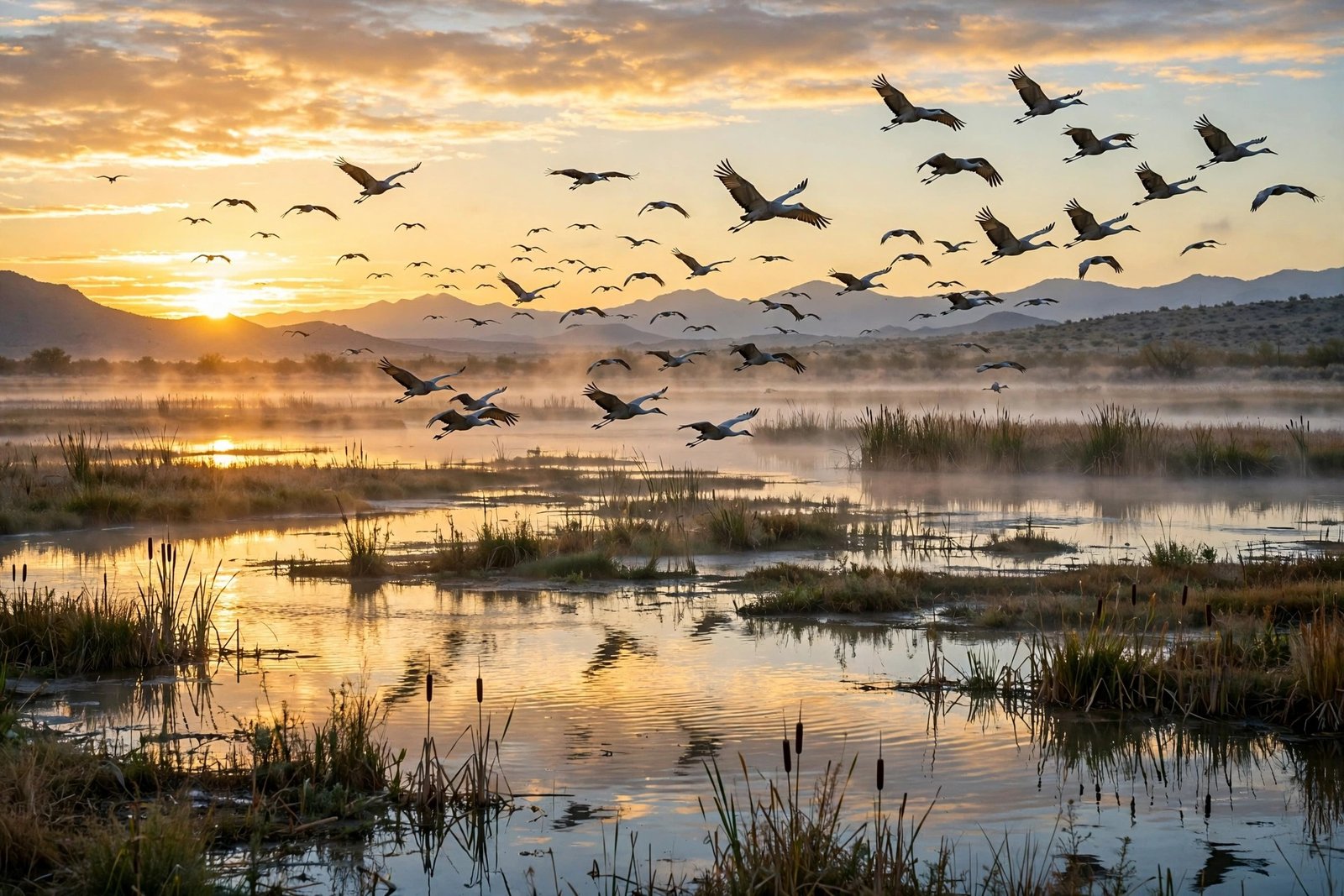
There is a morning in New Mexico when the sky fills before the sun does. Thousands of sandhill cranes lift from shallow ponds in the dark, their bugling calls rolling across the water, and then, in a rush of wings, tens of thousands of snow geese follow them into a pinkening sky. If you have ever wanted to see one of North America’s great wildlife spectacles without a plane ticket to a remote wilderness, November at Bosque del Apache National Wildlife Refuge is your moment. The cranes are arriving, the geese are building, and the refuge in the Middle Rio Grande Valley is entering its finest season.
This guide is built for a November visit, with one important date to keep straight. The refuge’s famous Festival of the Cranes, now in its 37th year, is scheduled for December 2 to 5, 2026, according to Friends of Bosque del Apache, the festival’s co-host. November is not the festival itself. It is something many seasoned birders prefer: the peak arrival season, with big bird numbers, cooler light, and far fewer crowds than festival weekend. Come in November and you get the spectacle itself. Come back in December, if you wish, for the lectures, workshops, and guided tours that turn that spectacle into a celebration.
Where Bosque del Apache is and why the birds come here
Bosque del Apache National Wildlife Refuge sits near San Antonio, New Mexico, in Socorro County, about twenty miles south of the town of Socorro and roughly ninety minutes south of Albuquerque. The name means woods of the Apache in Spanish, a nod to the cottonwood forest, or bosque, that lines the Rio Grande floodplain. The refuge covers 57,331 acres between the Chupadera Mountains to the west and the San Pascual Mountains to the east, and it was established in 1939 to provide a critical stopover site for migrating waterfowl. Today it is managed by the U.S. Fish and Wildlife Service, and more than 30,000 of its acres are designated wilderness.
The birds come here for the same reason travelers have always stopped in the Rio Grande Valley: water, food, and safety in one place. Refuge staff manage river water through gates, ditches, and ponds to mimic natural flooding cycles, creating shallow wetlands where cranes and geese can roost overnight, protected from predators by the water around them. Nearby grain fields, grown under cooperative agreements with farmers, give the birds daytime feeding grounds. That pairing — safe water at night, rich fields by day — is what makes the refuge a winter home rather than just a rest stop. The greater sandhill cranes that winter here belong largely to the Rocky Mountain population, birds that nested in Wyoming, Idaho, Montana, and Colorado and then traveled south through Colorado’s San Luis Valley on their way to New Mexico.
November matters because it is when that system fills up. First crane arrivals begin in late October, and the U.S. Fish and Wildlife Service describes the biggest bird numbers as present from early November through late January. A valley-wide estimate cited by Friends of Bosque del Apache, attributed to a Fish and Wildlife Service biologist, puts 17,000 to 20,000 greater sandhill cranes across the Middle Rio Grande Valley. That is a valley figure, not a promise of how many birds you will see from any single deck on any single morning, and wise visitors treat it that way. Bird numbers shift daily with weather, water levels, and field conditions. What November reliably offers is a refuge in full transition, with new arrivals still coming in and the daily rhythm of fly-out and fly-in already well established.
The daily rhythm: fly-out at dawn, fly-in at dusk
Plan your day around the birds, not around a checklist, and Bosque del Apache will reward you. The pattern is beautifully simple. Cranes and geese spend the night roosting in shallow ponds. Around dawn, they leave in the morning fly-out, heading to nearby fields to feed. They spend the day scattered across wetlands and grain fields, and at dusk they return in the evening fly-in, settling back onto the ponds for the night. Dawn and dusk are therefore the two great shows of the day, and the middle hours are for slower exploration: ducks on the ponds, raptors over the fields, mule deer at the edges, and the cottonwood light that photographers travel hundreds of miles to capture.
For the fly-out, arrive early — genuinely early. The refuge’s auto tour route is open from one hour before sunrise to one hour after sunset, year-round, and the best viewing spots fill with photographers well before first light. Dress in layers. November mornings in the high desert are cold, even when the afternoon turns mild, and you will be standing still in the dark, waiting, before the birds move. Bring binoculars even if you are not a birder, because the difference between a distant gray shape and a crane with its red crown and trailing legs is the difference between seeing birds and understanding them. And listen. The sandhill crane’s bugle is one of the oldest sounds in North America, and hearing thousands of cranes call at once is the part of the morning that visitors remember longest.
The fly-in reverses the show, and it rewards patience differently. As the light softens, cranes return in loose, bugling groups, dropping toward the ponds, while snow geese may arrive in great, swirling masses that fill the sky and then settle onto the water in a sound like distant surf. Exact roosting and feeding locations change through the winter, so the smartest move on arrival is to stop at the Visitor Center and ask refuge staff where birds have been active that day. A five-minute conversation can save you an hour of driving to a quiet pond while the action is happening somewhere else.
Driving the auto tour loop and walking the trails
The heart of a Bosque del Apache visit is the auto tour loop, approximately 12 miles long and bisected by a two-way connector road, with a maximum speed limit of 25 miles per hour and some sections posted at 10 miles per hour. Drive it slowly, pull fully into turnouts, and expect the vehicle ahead of you to stop suddenly — it almost certainly means someone is watching wildlife. The loop passes managed wetlands, ponds, grain fields, and observation decks, and it is designed so that you can see a great deal without ever leaving your car, which makes it an excellent option for families, older visitors, and photographers carrying heavy gear.
Do not stay in the car the whole time, though. The refuge offers twelve nature trails of varying length and difficulty, from short boardwalk strolls to longer walks through cottonwood forest and desert uplands. The Rio Viejo Trail, an approximately 1.46-mile loop through restored cottonwood forest along a former channel of the Rio Grande, is a peaceful November walk that takes about 45 minutes and rewards slow looking. Trails are also where you meet the refuge beyond its famous birds: over 370 bird species have been recorded here, along with mule deer, coyotes, porcupines, and muskrats, and November’s changing cottonwood leaves add gold to a landscape that summer visitors never see. Check trail conditions at the Visitor Center, since water-control construction work that began in early October 2026 may cause intermittent road closures around the tour loop.
A few practical rules keep the refuge working for wildlife and visitors alike. Stay on designated roads and trails, obey closed-area signs, and never approach or feed wildlife. Leashed pets are allowed seasonally on the tour loop, but check the refuge’s current dog-walking guidance before bringing a dog, since rules vary by season. Drones and off-road driving are not allowed, and commercial activity requires a special use permit. These are not bureaucratic details. In a place where thousands of birds choose to spend the winter, the quiet and the distance you keep are part of the habitat.
The Festival of the Cranes: what December adds
If November is the spectacle, the Festival of the Cranes is the celebration built around it. Co-hosted by Friends of Bosque del Apache and Bosque del Apache National Wildlife Refuge, the festival has brought together birders, photographers, artists, conservationists, and nature lovers for more than 35 years, and the 2026 edition runs December 2 to 5 at the refuge and the Socorro Convention Center. Programs include birding tours, photography workshops, expert presentations, guided hikes, and special events, and the 2026 keynote is scheduled to be delivered by Dr. Richard Beilfuss, president and CEO of the International Crane Foundation, on crane conservation and the decade ahead.
Festival weekend is a different experience from a November visit, and visitors should choose knowingly. The festival offers expert guidance, a community of fellow bird lovers, and programs you cannot get on an ordinary day, including an annual photo contest with categories described by Cornell Lab’s All About Birds for sandhill cranes, wildlife, people, landscapes, and comedy. It also brings crowds, and popular tours and workshops can fill. If you want the festival, check the official festival agenda from Friends of Bosque del Apache early and register for the events you care about, rather than assuming a place will be available on arrival. If you want quiet mornings and open decks, November gives you the birds without the festival crush, and many photographers consider that the better trade.
There is also a longer history worth knowing. Some older guides describe the festival as falling on the weekend before Thanksgiving, and that timing reflects earlier editions of the event. The current official schedule has moved, and for 2026 the dates are December 2 to 5. That shift is a useful reminder for any wildlife trip: always confirm dates on the official festival page before booking travel, because a beloved annual event can move by weeks from one year to the next. What has not changed is the reason the festival exists — to celebrate the return of the cranes to their winter home, and to support the refuge and the valley that sustain them.
A November viewing plan: one perfect day
Here is a simple plan that works for first-time visitors. Stay the night before in Socorro, the nearest town with lodging and restaurants, or in San Antonio itself, and set an alarm that feels unreasonable. Arrive at the refuge before sunrise, check in at the Visitor Center area for the latest bird locations if it is open, and position yourself at a pond-side deck for the fly-out. Stay through the first hour of light, when cranes are still moving and the low sun turns the ponds gold, then drive the auto tour loop slowly, stopping at decks and turnouts as the birds settle into fields.
Spend the middle of the day walking a trail or two, eating lunch in Socorro, and visiting the Visitor Center exhibits to learn how refuge staff manage water and habitat. Return to the refuge in the late afternoon, well before sunset, and choose a fly-in viewpoint based on what staff told you that morning. Bring water, snacks, sunscreen, and layers, and keep your camera batteries warm in a pocket on cold mornings. If you are photographing, practice panning on flying cranes early in the day, when the light is soft and the birds are plentiful, and save the dramatic snow-goose blastoffs for moments when a whole flock lifts at once. And build in a second morning if you can. Wildlife does not perform on schedule, and a two-morning visit turns a lucky sighting into a reliable memory.
Beyond the cranes: what else to look for
It would be a mistake to visit Bosque del Apache and look only for cranes. The refuge’s winter cast includes snow geese and Ross’s geese in numbers that can rival the cranes, along with a wide variety of ducks, from mallards and pintails to teal and shovelers. Raptors patrol the fields and skies: bald eagles winter here, along with hawks and harriers, and a patient watcher may see an eagle perched over a pond at first light. Elk bugle during the autumn rut, and dawn or dusk visits in November still offer a chance to hear or see them. Even the landscape rewards attention, from the Chupadera and San Pascual mountains framing the valley to the cottonwood bosque itself, a rare ribbon of green in the Chihuahuan Desert.
Frequently asked questions
When is the best time to see sandhill cranes at Bosque del Apache?
The peak period runs from early November through late January, with first arrivals in late October. November is an excellent time to visit because bird numbers are already high, the daily fly-out and fly-in rhythm is established, and crowds are smaller than during the December festival.
When is the 2026 Festival of the Cranes?
The 37th annual Festival of the Cranes is scheduled for December 2 to 5, 2026, at Bosque del Apache National Wildlife Refuge and the Socorro Convention Center, co-hosted by Friends of Bosque del Apache and the refuge. Check the official festival agenda for the current program and registration details before traveling.
What time of day should I visit for the best crane viewing?
Dawn and dusk. Cranes and geese roost in shallow ponds overnight, leave in the morning fly-out around dawn to feed in nearby fields, and return in the evening fly-in at dusk. The auto tour loop is open from one hour before sunrise to one hour after sunset.
Where is Bosque del Apache and how do I get there?
The refuge is at 1001 Highway 1, San Antonio, New Mexico, about twenty miles south of Socorro and roughly ninety minutes south of Albuquerque. The approximately 12-mile auto tour loop is the main way to see the refuge by car, with observation decks and twelve nature trails for walking.
Do I need to book anything for a November visit?
A regular November visit does not require festival registration, but you should check the refuge’s current visitor information before you go, including any intermittent road closures from water-control construction work in fall 2026. Festival events in December are separate and popular tours and workshops can fill, so register early if you plan to attend.