
It is the most famous photograph of World War II, and one of the most reproduced images in American history. Six men push a heavy wooden pole upright on a barren volcanic peak. A large American flag unfurls against a gray sky. The men lean into the pole with all their weight, their faces hidden, their bodies straining. It is a picture of effort, teamwork, and triumph, and it has come to stand for the entire American war in the Pacific.
The photograph was taken on February 23, 1945, on the island of Iwo Jima, five days after U.S. Marines landed on its black sand beaches. The flag was raised on the summit of Mount Suribachi, a dormant volcano at the southern tip of the island, by Marines of Easy Company, 2nd Battalion, 28th Marine Regiment, 5th Marine Division. The photographer was Joe Rosenthal of the Associated Press. What most people do not know is that Rosenthal’s photograph shows the second flag raising that day. A smaller flag had been raised that morning by another group of Marines, and it was that first flag that drew cheers across the island. The second flag went up because commanders wanted a larger one visible from everywhere on Iwo Jima. Rosenthal happened to be climbing the mountain at just the right moment, and he captured a scene that would define how America remembers the war.
The flag raising was a bright moment in a very dark battle. The fighting on Iwo Jima lasted from February 19 to March 26, 1945, and it was one of the bloodiest battles in Marine Corps history. About 6,800 Americans were killed and about 19,000 were wounded, while nearly the entire Japanese garrison of about 21,000 was killed. Twenty-seven Medals of Honor were awarded for the battle, more than for any other single battle in U.S. history. The photograph endures because it captures what those men were fighting for.
Why Iwo Jima Mattered
Iwo Jima is a tiny volcanic island, only about eight square miles, lying roughly 750 miles from mainland Japan and about 660 miles south of Tokyo. Its name means Sulfur Island, a harsh place of black sand and jagged rock. But in 1945, it was one of the most important pieces of ground in the Pacific. American planners wanted Iwo Jima for its airfields. The island sat between the Mariana Islands, where American B-29 bombers were based, and the Japanese home islands. Capturing it would give American fighters a base for escorting bombers to Japan and an emergency landing strip for damaged B-29s returning from bombing runs. The battle, code-named Operation Detachment, was expected to be quick.
February 19, 1945: Landing on the Black Sand
On the morning of February 19, 1945, after days of naval gunfire and air bombardment, U.S. Marines of the 3rd, 4th, and 5th Marine Divisions landed on Iwo Jima’s beaches. About 70,000 Marines would take part, the largest force of Marines ever committed to one operation. The Japanese defenders waited until the beaches were crowded, then opened fire with mortars, machine guns, and heavy artillery. The black volcanic sand was soft and deep, and Marines struggled to move through it under fire. The fighting was close, brutal, and often hand to hand, as Marines used flamethrowers, satchel charges, and grenades against defenders in caves and concrete strongpoints. The battle would last five weeks.
The Climb Up Mount Suribachi
Mount Suribachi, the extinct volcano at the southern tip of Iwo Jima, was one of the first objectives of the battle. The 28th Regiment of the 5th Marine Division was ordered to capture it. The Marines reached the base of the volcano on the afternoon of February 21, and by the next nightfall, they had the mountain surrounded. On the morning of February 23, Lieutenant Colonel Chandler Johnson ordered Captain Dave Severance to send a platoon to the summit, and First Lieutenant Harold Schrier led a 40-man patrol up the slope. To the Marines’ surprise, the climb was quiet, and not a shot was fired on the ascent. The patrol carried a small flag, 54 inches by 28 inches, that battalion adjutant 1st Lieutenant George Greeley Wells had brought from the transport ship USS Missoula in his map case, as the Marine Corps manual directed. When Johnson asked for a flag, Wells produced it, and Schrier took it to the top.
The First Flag: A Small Flag at 10:30 in the Morning
At about 10:30 a.m. on February 23, 1945, Schrier and his men reached the summit of Mount Suribachi. Marine photographer Staff Sergeant Louis Lowery of Leatherneck magazine was there to record the moment. The Marines fastened the small flag to a length of Japanese iron pipe found on the summit, secured it between the rocks, and raised it. It was the first American flag raised on captured Japanese soil. Marines who could see the flag cheered, and ships offshore sounded their horns. Secretary of the Navy James Forrestal, watching from below, is said to have remarked that the raising meant a Marine Corps for the next 500 years. But the flag was small, and from much of the island it was hard to see. Johnson decided it should be replaced with a larger flag that would be visible across Iwo Jima. He sent a runner to fetch a bigger flag from the USS LST-997 offshore. Private First Class Rene Gagnon carried the replacement flag, a large 96-inch by 56-inch flag, up the mountain, along with walkie-talkie batteries. As the first flag was taken down for safekeeping, the second flag was prepared for raising.
The Second Flag and Joe Rosenthal’s Photograph
Joe Rosenthal, a photographer for the Associated Press, had come ashore with the Marines on the first day of the invasion. He was a civilian, not a soldier. His draft board had classified him as unfit for military service because of poor eyesight, so he went to war with a camera instead of a rifle. On February 23, he learned the Marines planned to plant a flag on Mount Suribachi and started up the mountain. On the way, a Marine photographer coming down told him the flag raising had already happened. Rosenthal decided to keep climbing anyway, to see for himself. When he reached the top, he found the Marines preparing to raise the larger replacement flag. To get a better angle, Rosenthal, who stood only about five feet four inches tall, built a small platform from a Japanese sandbag and some rocks. Marine Sergeant Bill Genaust filmed the scene with a 16mm motion picture camera. As the Marines angled the heavy pole upward and drove it into the ground, Rosenthal swung his bulky Speed Graphic camera toward the action and pressed the shutter. He took the photograph in a fraction of a second, almost without looking.
Rosenthal sent his film to Guam for processing, unaware he had taken one of the great photographs of the century. When the picture reached the Associated Press, editors recognized it at once. Within days, it was on the front pages of newspapers across the United States. It won the 1945 Pulitzer Prize for Photography and became the centerpiece of a war-bond poster that helped raise more than $26 billion. The six men in the photograph, as the Marine Corps later identified them after a review of photographic evidence lasting more than sixty years, were Sergeant Michael Strank, Corporal Harlon Block, Private First Class Franklin Sousley, Private First Class Harold Keller, Private First Class Harold Schultz, and Private First Class Ira Hayes. Strank, Block, and Sousley were killed in the fighting that followed; Keller, Schultz, and Hayes survived the war.
Was the Photo Staged? The Question That Would Not Go Away
Almost from the start, people asked whether Rosenthal’s photograph was staged. It looked too perfect to be real. The confusion began with Rosenthal himself. After taking the famous picture, he had asked the Marines to pose for a second, cheerful “gung-ho” photograph beside the flag. Days later, a friend asked if the picture had been posed, and Rosenthal, thinking of the group shot, said yes. The misunderstanding spread quickly. Rosenthal spent the rest of his life insisting that the flag-raising photograph was not staged. He had simply been lucky. The evidence backed him up: Sergeant Bill Genaust’s motion picture film of the same moment showed the second flag going up exactly as Rosenthal’s photograph showed it, with no posing and no second take. Genaust was killed in action nine days after filming the flag raising, and his body was never recovered, but his film settled the question. The photograph was real. Rosenthal later worked on the San Francisco Chronicle until his retirement and died in 2006, still insisting he was simply lucky.
The Battle Went On: 27 Medals of Honor
The flag raising on February 23 did not end the battle. It was only the fifth day of a fight that would last five more weeks. After Suribachi fell, the Marines turned north, toward the island’s airfields and the rugged high ground of the strongest Japanese defenses. The fighting only grew worse. The courage shown on Iwo Jima was extraordinary. Twenty-seven Medals of Honor were awarded for the battle, more than for any other single battle in American history. Twenty-two went to Marines and five to Navy personnel, including corpsmen who risked their lives treating the wounded under fire. Among them were Gunnery Sergeant John Basilone, killed on the first day at Iwo Jima, and Private First Class Jacklyn Lucas, who threw himself on two grenades to save his fellow Marines and survived. Admiral Chester Nimitz, commander of the Pacific Fleet, summed up the battle in words that are still quoted today: “Among the Americans who served on Iwo Island, uncommon valor was a common virtue.” The words are carved into the Marine Corps War Memorial, beneath the statue of the flag raising.
The Cost of Iwo Jima
When Iwo Jima was declared secure on March 26, 1945, the cost was staggering. About 6,800 Americans had been killed and about 19,000 wounded. The Japanese garrison of about 21,000 was almost entirely wiped out. Only a small number of Japanese soldiers survived to be taken prisoner. It was, as the National WWII Museum has put it, one of the bloodiest battles in Marine Corps history, and it horrified planners who feared a greater slaughter if the war reached Japan’s home islands. The island served its purpose: American fighters flew from its airfields to escort bombers to Japan, and damaged B-29s found a safe place to land. The flag raising, which had seemed like a small victory in the middle of a terrible battle, became the image Americans carried with them for the rest of the war. It appeared on posters, postage stamps, and magazine covers.
From Photograph to Monument
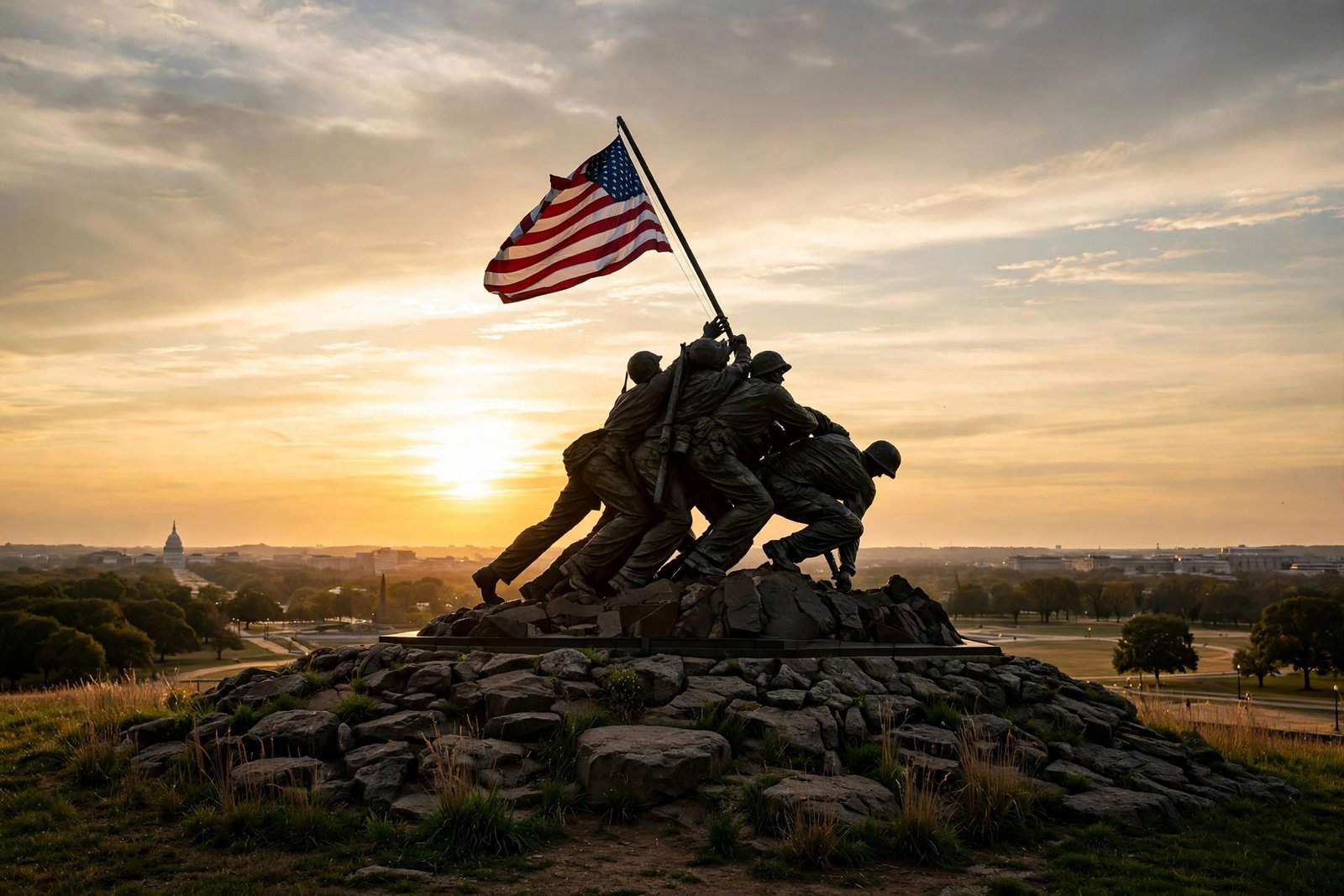
Before 1945 was over, Congress commissioned the sculptor Felix de Weldon to turn Rosenthal’s photograph into a monument. De Weldon worked on the Marine Corps War Memorial from 1945 until its completion in 1954, and the three surviving flag raisers posed so he could model their faces in clay. The faces of the three who had been killed were modeled from photographs. Cast in bronze in Brooklyn, it was shipped to Arlington in pieces and reassembled. The memorial stands on a hill in Arlington, Virginia, overlooking Washington, D.C. Its figures are 32 feet tall, raising a 60-foot bronze flagpole, and the statue as a whole is 78 feet tall and weighs 100 tons, making it one of the largest bronze statues in the world. It cost $850,000, paid for entirely with private donations, with no public funds used. It was dedicated on November 10, 1954, the 179th anniversary of the founding of the Marine Corps. The two flags raised on Mount Suribachi on February 23, 1945, are preserved today at the National Museum of the Marine Corps in Quantico, Virginia.
Frequently Asked Questions
When was the flag raised on Iwo Jima?
The flag was raised on February 23, 1945. A smaller flag went up at about 10:30 a.m. under 1st Lt. Harold Schrier, and a larger replacement flag was raised later that day. Joe Rosenthal photographed the second raising.
Who took the famous Iwo Jima photograph?
Associated Press photographer Joe Rosenthal took the photograph on February 23, 1945. He was a civilian war correspondent. The photo won the 1945 Pulitzer Prize for Photography.
Was the Iwo Jima flag-raising photo staged?
No. Rosenthal insisted all his life that the photograph was not staged, and motion picture film shot by Marine Sergeant Bill Genaust at the same moment confirms it.
How long did the Battle of Iwo Jima last?
The battle ran from February 19 to March 26, 1945, a total of 36 days. The island was declared secure on March 26, 1945.
How many Americans were killed at Iwo Jima?
About 6,800 Americans were killed and about 19,000 were wounded. Nearly the entire Japanese garrison of about 21,000 was killed. Twenty-seven Medals of Honor were awarded for the battle, more than for any other single battle in U.S. history.
Where is the Iwo Jima memorial?
The Marine Corps War Memorial, based on Rosenthal’s photograph, stands in Arlington, Virginia, dedicated on November 10, 1954. The two flags raised on Mount Suribachi are displayed at the National Museum of the Marine Corps in Quantico, Virginia.
Related reading
- Pearl Harbor: December 7, 1941, the day that brought America into World War II
- The U.S. Marine Corps birthday: November 10 and the history of the Corps
- Veterans Day: the history of Armistice Day 1918 and honoring America’s veterans
Sources: This article draws on the National Archives (Photograph of Flag Raising on Iwo Jima, February 23, 1945 and Battle for Iwo Jima anniversary), the U.S. Marine Corps (Remembering Iwo Jima: 78 Years and Remembering Greeley), Marine Barracks Washington’s Marine Corps War Memorial history, the National WWII Museum (Battle of Iwo Jima), and HISTORY (Raising the Flag on Iwo Jima: Behind the Photo).