
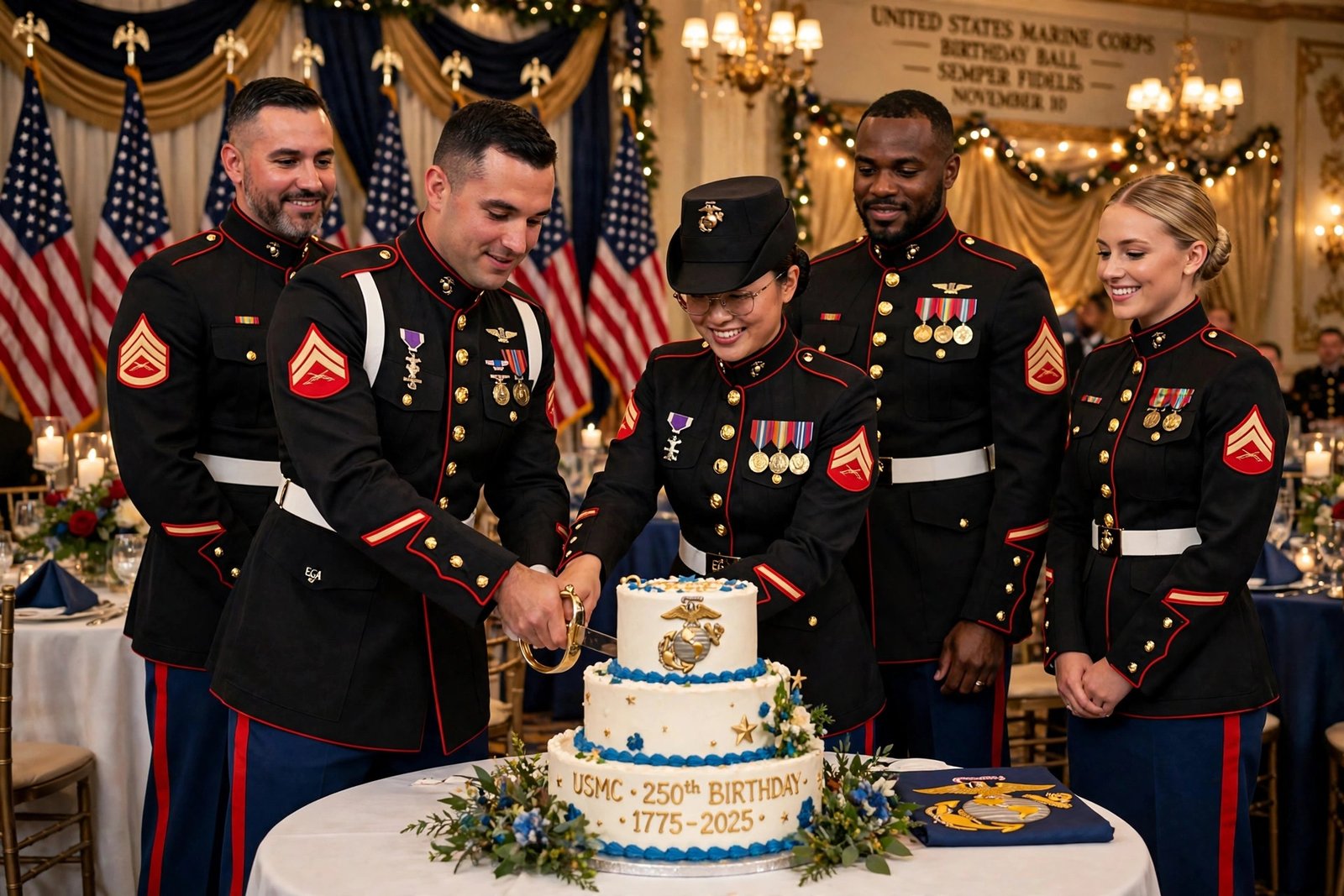
Every year on November 10, Marines around the world pause whatever they are doing, dress in their finest uniforms, and celebrate the birthday of their Corps. It is a day unlike any other in American military life: part formal ball, part history lesson, part family reunion. In 2026, the celebration carries extra weight, because the United States Marine Corps turns 251 years old, and it does so in the same year America marks the 250th anniversary of its independence. The Corps is older than the nation it serves, and Marines never let anyone forget it.
The story begins in a Philadelphia tavern in the middle of a revolution, runs through some of the hardest fighting in American history, and continues today in every corner of the globe. This is the story of how the Marine Corps was born, how its birthday became sacred, and how Marines celebrate it, from the reading of a century-old order to the cutting of a cake with a sword.
Born in a Philadelphia Tavern: November 10, 1775
On November 10, 1775, the Second Continental Congress, meeting in Philadelphia, passed a resolution that two battalions of Marines be raised to serve aboard the young Continental Navy. The resolution called for men who were good seamen or familiar with maritime affairs, and it placed the new force under the command of Captain Samuel Nicholas, a Philadelphia innkeeper’s son who became the first Commandant of the Marine Corps.
Marine Corps tradition holds that Nicholas set up his first recruiting station at Tun Tavern, a waterfront tavern at the corner of Front and Water Streets in Philadelphia. The tavern’s owner, Robert Mullan, was himself commissioned as a captain in the new Corps. According to the lore every Marine learns in boot camp, the first volunteers signed up over mugs of ale, lured by the promise of adventure, steady pay, and service at sea. Some historians note that recruitment may also have taken place at the Conestoga Waggon, another Philadelphia tavern run by the Nicholas family, but Tun Tavern is the place the Corps claims as its birthplace, and a commemorative marker stands at the site today.
The timing mattered. The American Revolution was only months old, and the Continental Navy needed fighters who could serve aboard ship and fight on land. The Marines’ first mission came quickly. In March 1776, Marines took part in the raid on Nassau in the Bahamas, the Corps’ first amphibious landing, seizing gunpowder and artillery that George Washington’s army desperately needed. That early operation set a pattern the Corps has followed ever since: go where the Navy goes, land fast, and fight hard.
When the Revolutionary War ended, the Continental Marines were disbanded along with the Navy. For more than a decade, America had no Marine Corps at all. That changed on July 11, 1798, when President John Adams signed a bill recreating the Corps as a permanent service. For years afterward, Marines marked July 11 as their birthday. The November date would not return until more than a century later.
From Two Battalions to a Permanent Corps
The re-established Marine Corps grew slowly at first, but it found its identity in the early decades of the republic. In 1805, Lieutenant Presley O’Bannon led a small force of Marines and mercenaries across hundreds of miles of desert to capture the city of Derna in Tripoli, during the First Barbary War. The victory gave the Marine Corps Hymn its famous line about the “shores of Tripoli,” and O’Bannon was reportedly presented with a Mameluke sword by the ruler of the region, a blade that still shapes Marine tradition today.
Through the nineteenth century, Marines served wherever American ships sailed: protecting American interests in the Caribbean and the Pacific, fighting in the Mexican-American War, and serving in the Civil War. In 1847, Marines took part in the assault on Chapultepec Castle outside Mexico City, adding the “Halls of Montezuma” to the Hymn and the blood stripe on the dress blue trousers that officers and noncommissioned officers still wear in honor of the officers and men who fell there.
By the time the United States entered World War I, the Corps was a small but fiercely professional force. That war would transform its reputation forever, and it would give Marines one of their most cherished nicknames.
How November 10 Became the Birthday
The birthday Marines celebrate today is the product of one determined officer’s research. In 1921, Major Edwin North McClellan, who headed the Corps’ Historical Section, argued that the Corps should honor its true founding date, November 10, 1775, rather than the 1798 re-establishment date. His memo reached Major General John A. Lejeune, the 13th Commandant, who agreed.
On November 1, 1921, Lejeune issued Marine Corps Order No. 47. The order opens with the words every Marine knows by heart: “On November 10, 1775, a Corps of Marines was created by a resolution of Continental Congress.” It summarizes the Corps’ history and mission, and it directs that the order be read to every command on November 10 of that year and every year thereafter. More than a century later, Marines still follow that instruction. Wherever they are stationed, on ships, in field tents, or in ballrooms, the order is read aloud, and the current Commandant’s birthday message is read alongside it.
The first formal Marine Corps Birthday Ball was held in Philadelphia in 1925, with guests including the Secretaries of War and Navy and Lejeune himself. The centerpiece of the evening was the unveiling of a memorial tablet at the site of Tun Tavern. Early balls took many forms, from dances and pageants to mock battles and sporting events. It was not until 1952 that Commandant General Lemuel C. Shepherd Jr. standardized the celebration across the Corps, formalizing the cake-cutting ceremony that remains the emotional heart of the birthday today.
The Birthday Ball and the Cake-Cutting Ceremony
The modern Marine Corps Birthday Ball is a formal affair: dress blues, a banquet, dancing, toasts, and the reading of Marine Corps Order 47. But the moment everyone waits for is the cutting of the birthday cake, and it is carried out with a precision that would satisfy a drill instructor.
The cake is cut with a Mameluke sword, the curved blade that traces back to Lieutenant O’Bannon’s campaign in Tripoli in 1805. The first piece of cake goes to the guest of honor. The second piece goes to the oldest Marine present. That Marine then hands the piece to the youngest Marine in the room, symbolizing the passing of knowledge, tradition, and responsibility from one generation to the next. It is a simple gesture, and it reliably brings a lump to the throat of everyone watching.
The ceremony also includes a toast to fallen comrades, often with an empty place setting at the table. Marines take the occasion seriously because the birthday is not really about cake. It is about belonging to something older and larger than any individual, and about remembering the Marines who came before.
The cake-cutting tradition developed gradually. Evidence points to a ceremony at Quantico, Virginia, in 1935, and a well-documented one at Marine Barracks Washington in 1937, when Commandant Thomas Holcomb presided over an officer open house featuring a massive cake shaped like Tun Tavern. Shepherd’s 1952 standardization made the ceremony uniform across the Corps, and it entered the Marine Corps Drill Manual in 1956.
The Commandant’s Birthday Message
Each year, the Commandant of the Marine Corps issues a birthday message that is read to Marines around the world. For the 251st birthday, General Eric M. Smith, the Commandant, released a message marking 251 years of service and describing the Corps as the nation’s premier expeditionary force in readiness. His message recalls the Corps’ first amphibious landing at Nassau two and a half centuries ago, the volcanic sands of Iwo Jima, the bold landing at Inchon, and the mountains of Afghanistan, and notes that tens of thousands of Marines are forward deployed and stationed around the world at any given hour.
The message closes with the traditional greeting, “Happy 251st Birthday, Marines!” It is signed by General Smith and Sergeant Major of the Marine Corps Carlos A. Ruiz. For Marines, the birthday message is more than a formality. It is the one piece of writing that reaches every Marine, everywhere, on the same day, and it ties the newest private to the Marines who landed at Nassau in 1776.
Battles That Defined the Corps
No history of the Marine Corps is complete without its battles, because the Corps’ identity was forged in them. At Belleau Wood, France, in June 1918, Marines advanced through open wheat fields under heavy German machine-gun fire and refused to retreat, halting a German offensive that threatened Paris. The French renamed the woods the “Wood of the Marine Brigade” in their honor, and German troops are said to have called the stubborn Americans “Teufel Hunden,” or Devil Dogs, a nickname Marines wear with pride to this day.
In February 1945, Marines landed on Iwo Jima, a small volcanic island in the Pacific, in what became the largest and bloodiest all-Marine battle in history. The fighting lasted 36 days. On the fifth day, Marines raised the American flag atop Mount Suribachi, and photographer Joe Rosenthal’s image of the second flag raising became one of the most famous photographs of the war. Nearly 7,000 Marines were killed and many more wounded, and 27 Medals of Honor were awarded for actions during the battle. Fleet Admiral Chester Nimitz’s tribute endures: “Among the men who fought on Iwo Jima, uncommon valor was a common virtue.”
The Korean War brought the fighting withdrawal from the Chosin Reservoir in the bitter winter of 1950, a battle Marines still study as a model of discipline under impossible conditions. In Vietnam, the house-to-house fighting at Hue City in 1968 tested a new generation. In Iraq, the Second Battle of Fallujah in 2004 became the hardest urban fight American forces had faced in decades. Each generation of Marines has its own proving ground, and each one adds its own names to the roll of honor read aloud on November 10.
The Marine Corps Today
Today the Marine Corps remains the nation’s expeditionary force in readiness, the service that can deploy anywhere in the world on short notice. Marines serve aboard Navy ships, staff embassies around the globe, train alongside allies, and stand ready to respond to crises from natural disasters to armed conflict. The Corps has been reshaping itself in recent years for the challenges of the modern battlefield, with new investments in long-range fires, unmanned systems, and small, mobile units designed to operate across the Pacific.
What has not changed is the culture. New Marines still earn the title at recruit depots in Parris Island, South Carolina, and San Diego, California, through a demanding thirteen weeks of training that ends with the Crucible, a grueling final test, and the awarding of the Eagle, Globe, and Anchor emblem. The values drilled into every recruit are the same ones the Corps has carried since 1775: honor, courage, and commitment, summed up in the Latin motto Semper Fidelis, “Always Faithful.”
How Americans Can Mark the 251st Birthday
You do not have to be a Marine to honor the day. Many towns hold birthday ball events and ceremonies open to the public, and the Marine Corps War Memorial in Arlington, Virginia, draws visitors every November. If you know a Marine, a simple “Happy birthday, Marine” goes a long way on November 10, and it is the correct greeting. Thanking a veteran is always welcome, but on this day, Marines would rather hear the birthday greeting.
Families can also use the day to talk with children about service and sacrifice, visit a local veterans’ memorial, or support organizations that serve Marine families. The important thing is to remember that behind the formal balls and the cake-cutting is a simple fact: for 251 years, Americans have volunteered to serve as Marines, and many of them never came home. The birthday is a celebration, but it is also a remembrance.
Frequently Asked Questions
When was the U.S. Marine Corps founded?
The Marine Corps was founded on November 10, 1775, when the Second Continental Congress resolved that two battalions of Marines be raised to serve with the Continental Navy. The Corps was disbanded after the Revolutionary War and re-established as a permanent service on July 11, 1798, but Marines celebrate November 10 as their official birthday.
Why is Tun Tavern important to the Marine Corps?
Tun Tavern in Philadelphia is regarded as the birthplace of the Marine Corps because, according to tradition, Captain Samuel Nicholas opened the Corps’ first recruiting station there in 1775. The original building burned down in 1781, but a commemorative marker stands at the site.
What is Marine Corps Order 47?
Marine Corps Order 47, issued by Commandant John A. Lejeune on November 1, 1921, declared November 10, 1775, the official birthday of the Corps and directed that the order be read to every command each November 10. Marines still read it aloud every year.
Why is the birthday cake cut with a sword?
The cake is cut with a Mameluke sword, honoring the blade associated with Lieutenant Presley O’Bannon’s 1805 campaign at Derna, Tripoli. The first piece goes to the guest of honor, the second to the oldest Marine present, who passes it to the youngest Marine, symbolizing the passing of tradition to the next generation.
How old is the Marine Corps in 2026?
The Marine Corps turns 251 years old on Tuesday, November 10, 2026, counting from its founding on November 10, 1775.
Related reading
- Women in the U.S. Army: A History of Milestones, From Camp Followers to Combat Leaders
- The Tuskegee Airmen (Red Tails) of World War II — Who They Were and Why Their Story Matters
- The Old Guard: Inside the Tomb of the Unknown Soldier
Sources: 251st USMC Birthday Message, Office of the Commandant of the Marine Corps; Lasting Legacy: History of the Marine Corps Birthday, Marine Corps Air Ground Combat Center Twentynine Palms; The Commandant Behind Marine Corps Birthday Traditions, Military.com; Base Executive Director Reflects on Battle of Iwo Jima, Marine Corps Logistics Base Albany; The U.S. Marine Corps Birthday, Blue Star Families; United States Marine Corps Birthday, Wikipedia