
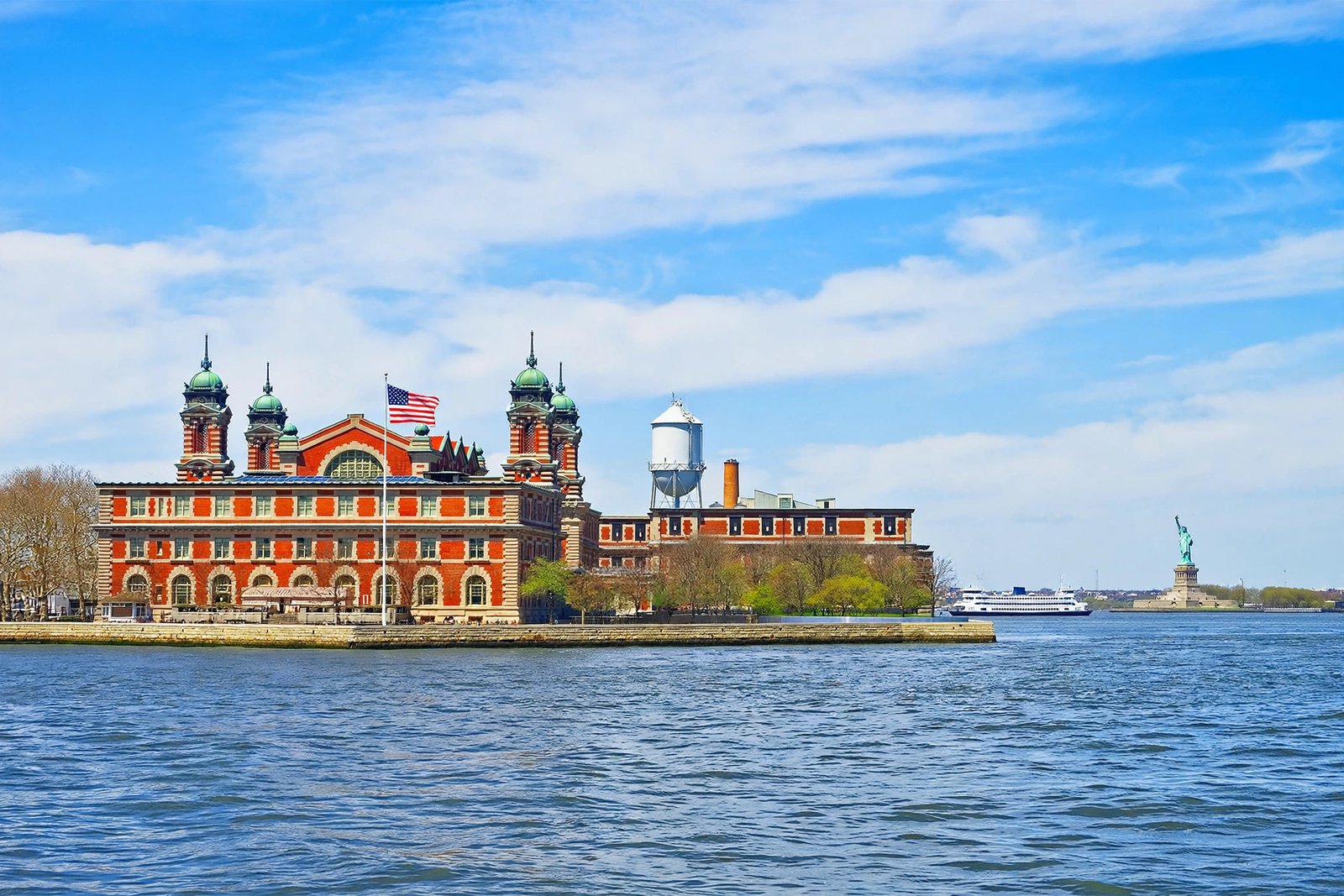
For many American families, the story of how their ancestors arrived in the United States passes through a single place: Ellis Island. Set in New York Harbor, this small island served as the federal immigration station through which vast numbers of newcomers entered the country in the late nineteenth and early twentieth centuries. To walk its halls today is to step into a story of hope, uncertainty, separation, and new beginnings, told through the experiences of people who crossed oceans with little more than what they could carry and a belief that a better life might lie ahead.
Ellis Island is more than a historic building. It is a symbol of American immigration itself, a place where personal stories and national history meet. Families visit to trace ancestors, students come to learn how immigration shaped the country, and travelers from around the world come to understand a chapter of history that still resonates today. The island’s museum, exhibits, and preserved spaces help visitors imagine what arrival felt like, from the first sight of land to the long process of inspection inside the main building.
Opening Day and the First Immigrant
The federal immigration station at Ellis Island opened on January 1, 1892. That opening marked a change in how immigration was managed, bringing the process under federal control at a dedicated station in New York Harbor. Before Ellis Island, immigration processing in New York had been handled in other locations, but the new station created a central gateway through which newcomers would pass on their way to a new life in America.
The first immigrant processed at Ellis Island was Annie Moore, a 15-year-old from County Cork, Ireland, who arrived on January 1, 1892. Her story has become emblematic of the Ellis Island experience, not because her journey was identical to every other immigrant’s, but because it captures the youth, courage, and hope that defined so many arrivals. A teenager leaving home and crossing the Atlantic to begin again in a new country represents the leap of faith at the heart of immigration, and her name is remembered as the beginning of a long line of arrivals that would follow.
The original station building was made of Georgia pine, a detail that hints at the practical, hurried nature of the early station. It was a working facility first, built to process large numbers of people efficiently, rather than a grand monument. That practical character would shape the Ellis Island experience for years, as officials, doctors, interpreters, and aid workers managed the daily flow of newcomers through inspection, questioning, and, for most, onward travel into the United States.
The Great Hall and the Inspection Process
After the first building, a new Main Immigration Building was opened on December 17, 1900, replacing the earlier structure and giving the station a more durable and spacious home. At the center of that building was the Great Hall, a large, high-ceilinged room where immigrants gathered after disembarking and waited for inspection. The hall’s scale was both impressive and intimidating, a space designed to hold crowds while officials worked through the steps of processing.
Arrival at Ellis Island involved a series of inspections and questions. Medical inspections looked for signs of illness or conditions that officials considered grounds for further examination. Legal inspections involved questions about identity, destination, work, family, and the ability to support oneself. Interpreters played a crucial role, helping newcomers who spoke many different languages understand what was being asked and communicate their answers. For most immigrants, the process was completed relatively quickly, ending with permission to enter the country and continue to their destinations.
For others, the process was longer and more anxious. Some were held for further medical checks, for additional questioning, or while waiting for family members or sponsors. Some were detained overnight or for longer periods, and a smaller number were ultimately denied entry and returned. Those experiences, of waiting, worry, and sometimes separation, are an essential part of the Ellis Island story. They remind visitors that immigration was not simply a celebration of arrival, but a process with real stakes for the people involved.
The Peak Years and the Great Wave
Between 1892 and 1954, almost 12 million immigrants were processed at Ellis Island, according to the National Park Service. That figure alone conveys the scale of the station’s work, but it becomes even more vivid when imagined day by day: ships arriving in the harbor, passengers disembarking, families carrying bundles and suitcases, children staying close to parents, and officials guiding crowds through the Great Hall. Ellis Island was, for decades, one of the busiest gateways in the world.
The peak year was 1907, when arrivals reached their highest point in the station’s history. That peak reflects a broader wave of immigration from Europe and beyond, driven by economic opportunity, political upheaval, religious persecution, and the simple desire for a better life. Immigrants came from many countries and cultures, bringing languages, traditions, foods, faiths, and skills that would shape American communities. Their journeys varied, but their destination shared a common hope: that the United States would offer work, safety, and a future for their families.
Life after Ellis Island was just as varied as the journey to it. Some newcomers joined relatives already in America, settling in cities and towns where immigrant communities provided support, work, and familiar culture. Others traveled onward to farms, factories, mines, and railroads across the country. Many worked in difficult jobs, learned a new language, and built lives step by step. Their children and grandchildren would go on to become part of every aspect of American life, from business and politics to arts, science, and sports.
Changing Laws and the Station’s Closing
The flow of immigration through Ellis Island did not continue unchanged. The Emergency Quota Act of 1921 and the Immigration Act of 1924 sharply reduced admissions, introducing quotas and restrictions that transformed who could come to America and in what numbers. Those laws reflected a shift in national policy, moving away from the relatively open immigration of the earlier peak years toward a system of limits that favored some groups over others and sharply curtailed arrivals from many countries.
As a result, Ellis Island’s role changed. Fewer immigrants arrived for processing, and the station increasingly served other functions, including detention and deportation proceedings. The grand era of mass processing through the Great Hall faded, even as the building remained a symbol of the earlier wave. The station eventually closed in 1954, ending more than six decades as a federal immigration station. By then, immigration processing had moved to other locations and systems, and Ellis Island entered a period of disuse before its later preservation.
Understanding those laws is important for understanding Ellis Island honestly. The station’s story includes both welcome and restriction, both opportunity and exclusion. It shows how immigration policy can open doors in one era and narrow them in another, and how those policy choices affect real families. Visitors who learn about both sides of that history come away with a fuller, more thoughtful understanding of American immigration than a simple celebration alone could provide.
From Abandoned Station to Museum
After its closing, Ellis Island might have been forgotten, but its significance was recognized in time for preservation. In 1965, Ellis Island became part of the Statue of Liberty National Monument, linking the immigration station with the nearby symbol of liberty that so many immigrants had seen on arrival. That connection is fitting, because the Statue of Liberty and Ellis Island together tell a paired story: an ideal of freedom on one side of the harbor, and the human reality of seeking that freedom on the other.
The museum at Ellis Island opened in 1990, transforming the Main Immigration Building into a place where visitors could explore the immigration story through exhibits, artifacts, photographs, and personal accounts. Restored spaces, including the Great Hall, allow visitors to stand where immigrants once stood and to imagine the noise, the waiting, and the emotion of arrival. Exhibits trace the broader history of immigration, the journeys across the Atlantic, the inspection process, and the lives immigrants built after entering the country.
Today, Ellis Island continues to evolve as a museum and historic site, with ongoing work to preserve its buildings and deepen its storytelling. Reporting on plans for the museum’s future, including a major makeover, shows how the site remains a living place of memory rather than a static monument. For visitors, that ongoing care matters, because it ensures that the stories preserved here remain accessible, accurate, and meaningful for new generations who come to learn about their own family histories and about the country as a whole.
A Legacy That Touches Millions of Families
Perhaps the most striking measure of Ellis Island’s legacy is its reach into the present. An estimated 40 percent of Americans today can trace an ancestor to Ellis Island, according to estimates cited by the National Park Service. Phrased as an estimate, that figure still conveys something profound: for a large share of the population, Ellis Island is not distant history but family history. A grandparent, great-grandparent, or earlier ancestor may have passed through its halls, carrying a name that appears in passenger records and family stories.
That personal connection explains why Ellis Island remains so popular with visitors. People come to search records, to find a name on a wall, to stand in the Great Hall and picture a relative’s arrival, and to share that story with children and grandchildren. Genealogy research has made those connections easier to explore, and the museum’s resources help visitors understand not just a name and a date, but the broader context of a journey: where a family came from, why they left, what they hoped for, and what they built after arriving.
For readers who want to explore the official history in more depth, the National Park Service offers background on Ellis Island immigration history, while a Smithsonian Magazine report on the Ellis Island museum makeover looks at how the museum is being renewed for future visitors. Both provide a starting point for learning more, whether the interest is personal, educational, or simply a love of American history. Ellis Island endures because its story is, in the end, America’s story: a story of arrival, adaptation, and the ongoing search for a better life.
Frequently Asked Questions
When did Ellis Island open and close?
The federal immigration station opened on January 1, 1892, and closed in 1954.
How many immigrants were processed at Ellis Island?
Almost 12 million immigrants were processed there between 1892 and 1954, according to the National Park Service.
Who was the first immigrant processed?
Annie Moore, a 15-year-old from County Cork, Ireland, was the first immigrant processed on January 1, 1892.
When was the Main Immigration Building opened?
The Main Immigration Building opened on December 17, 1900, replacing the first building made of Georgia pine.
What laws reduced admissions through Ellis Island?
The Emergency Quota Act of 1921 and the Immigration Act of 1924 sharply reduced admissions.
When did Ellis Island become a museum?
Ellis Island became part of the Statue of Liberty National Monument in 1965, and the museum opened in 1990.