
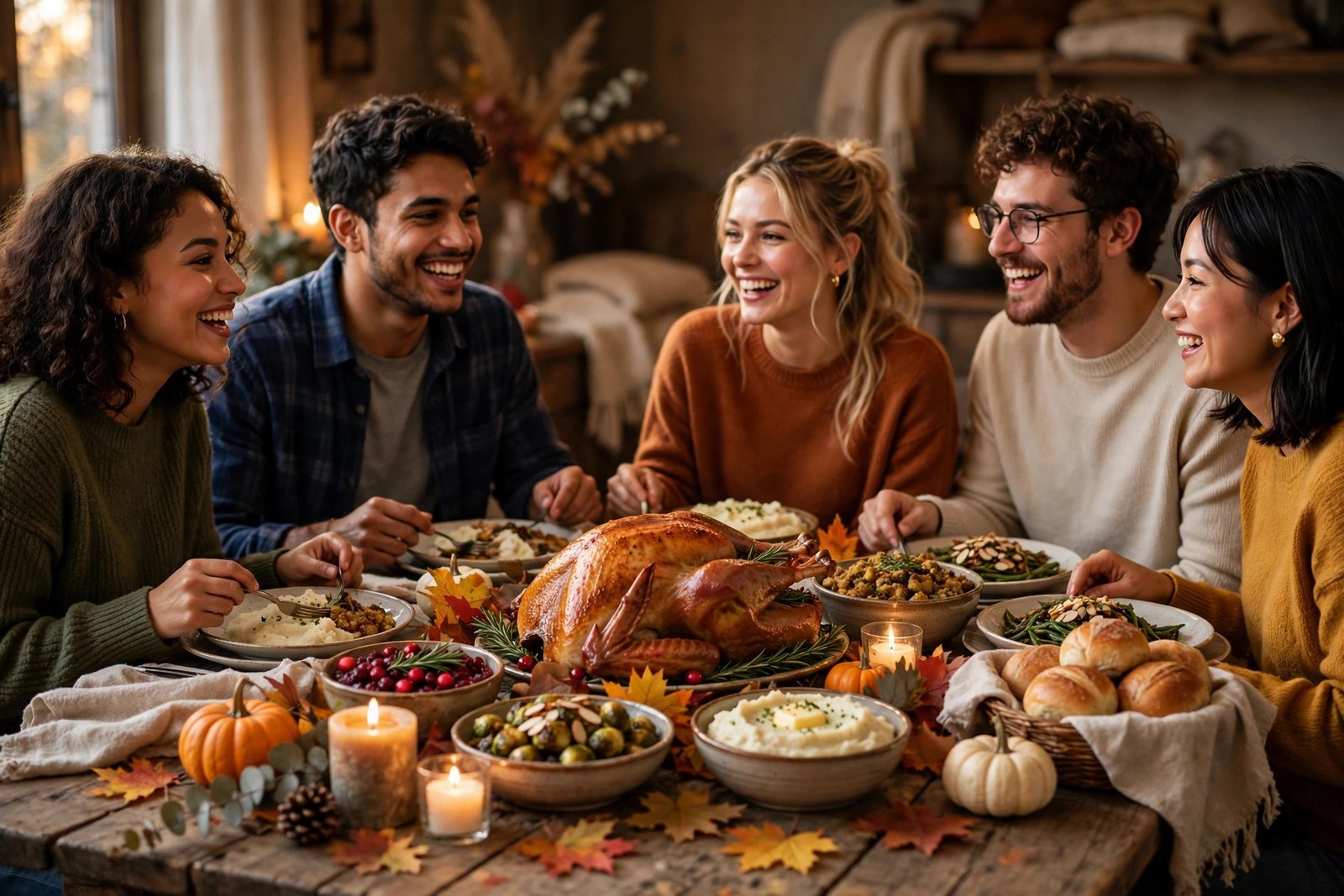
Somewhere between the family table and the group chat, a new holiday tradition took hold. Friendsgiving is a Thanksgiving-themed feast shared with friends, held before or instead of a family Thanksgiving, and for many Americans it has become just as anticipated as the main event. There is turkey or there is not, there are matching sweaters or there are not, but there is almost always a crowded table, a lot of laughter, and a feeling that chosen family deserves its own celebration.
What makes Friendsgiving interesting is that it is both very old and very new. Friends have gathered for holiday meals for as long as people have had friends and holidays. But the word itself, and the recognizable modern form of the celebration, belong to the twenty-first century, shaped by social media, by young adults living far from home, and by a culture that increasingly treats friendship as a form of family. This is the story of how Friendsgiving got its name, and how to host one of your own.
What Exactly Is Friendsgiving?
At its simplest, Friendsgiving is a Thanksgiving-themed meal eaten with friends rather than relatives. It can take place in the days or weeks before Thanksgiving, or it can stand in for a family gathering for people who cannot travel home or who simply want a second celebration. The menu usually borrows from Thanksgiving tradition, with turkey, stuffing, mashed potatoes, and pie making frequent appearances, but the rules are loose by design. Hosts adapt the meal to their crowd, their budget, and their cooking confidence.
Most people celebrate Friendsgiving as a second, separate event in addition to family Thanksgiving, often potluck-style. That potluck element is part of the charm and part of the practicality: when everyone brings a dish, no single host carries the whole burden, and the table ends up reflecting the tastes of the whole group. A friend’s grandmother’s stuffing recipe might sit next to a store-bought pie and a experimental side dish, and somehow it all works. The informality is the point. Friendsgiving is Thanksgiving without the pressure of tradition, where the guest list is chosen and the dress code is whatever makes people comfortable.
A Word Is Born
Merriam-Webster dates the first known use of the term Friendsgiving to 2007, when it appeared in Usenet posts and early Twitter messages. That timing matters. In 2007, social media was beginning to reshape how young adults talked about their lives, and a catchy portmanteau for a friends’ Thanksgiving dinner was exactly the kind of phrase that could travel. People were already holding these gatherings; now they had a name for them, and a name made the idea shareable.
The word kept spreading through the following years, carried by blog posts, party invitations, and social media captions. By 2011, the term had gained wide attention, including through a Baileys Irish Cream campaign that leaned into the concept. Marketing attention is often a sign that a cultural idea has arrived: brands do not build campaigns around phrases nobody recognizes. By the early 2010s, Friendsgiving was no longer an in-joke among a few friend groups. It was a recognizable event with its own expectations, its own Pinterest boards, and its own place on the holiday calendar.
The dictionary eventually caught up. The word was added to the Merriam-Webster dictionary in 2020, a milestone that confirmed what millions of celebrants already knew: Friendsgiving was a real word for a real tradition. Dictionary additions do not create traditions, but they do mark the moment when a tradition becomes part of the shared language, no longer needing explanation at the door.
Pop Culture Paved the Way
Long before the word existed, popular culture had already taught audiences to picture Thanksgiving as a friends’ holiday. A Charlie Brown Thanksgiving, first aired in 1973, centered on a friends’ Thanksgiving meal, with Charlie Brown, Snoopy, and the gang gathering around a table that famously featured toast and popcorn rather than turkey. Generations of viewers grew up with that image of friends making a holiday meal out of whatever they had, and making it work through togetherness rather than perfection.
The television show Friends, which ran from 1994 to 2004, featured Thanksgiving episodes each season, though it did not use the word Friendsgiving. Those episodes turned Thanksgiving into an ensemble event, with the six friends cooking, arguing, playing football, and sitting down together in ways that felt familiar to viewers whose own closest bonds were with friends. The show did not invent the concept, but it gave millions of people a vivid picture of what a friends’ Thanksgiving could look like: chaotic, funny, warm, and entirely its own thing.
These cultural precedents help explain why Friendsgiving felt instantly familiar when the word arrived. Audiences had already spent decades watching fictional friends celebrate Thanksgiving together. The real-life version was simply a matter of inviting your own people and setting your own table.
Why Friendsgiving Caught On
Several social shifts helped Friendsgiving grow. More young adults live far from their hometowns for work or school, making a trip home for Thanksgiving expensive or impractical. Friend groups often function as chosen family, especially for people whose family relationships are complicated or distant. And the holiday season itself has stretched, with gatherings spreading across November rather than concentrating on a single day. Friendsgiving fits neatly into that longer season, giving people a reason to gather before the family obligations begin.
There is also something appealing about a holiday you design yourself. Traditional Thanksgiving comes with expectations: who hosts, who cooks, which dishes must appear, which conversations to avoid. Friendsgiving carries few of those burdens. You choose the guest list, the menu, and the vibe. If your group would rather order takeout than roast a turkey, that is a valid Friendsgiving. If your group wants a full traditional spread with all the trimmings, that works too. The flexibility is what keeps the tradition fresh year after year.
How to Host Your Own Friendsgiving
Hosting a Friendsgiving is easier than hosting a formal holiday dinner, but a little planning goes a long way. Start by picking a date. Remember that Thanksgiving itself is always the fourth Thursday of November, so a Friendsgiving usually works best in the weeks before, or on the weekend after, when friends are free and the calendar is less crowded. A Saturday evening often works well, giving everyone time to cook and no workday looming the next morning.
Next, settle the format. A potluck is the most popular choice, and it works best when you coordinate rather than leaving it to chance. Ask one person to bring the main dish, assign sides and desserts so you do not end up with five plates of mashed potatoes, and keep a shared list so everyone can see what is covered. If you would rather cook everything yourself, keep the menu simple and make-ahead friendly: dishes that can be prepared the day before will leave you free to enjoy your own party.
Think about the table itself. Friendsgiving does not require matching dishes or a formal seating plan, but a few touches make the evening feel special. Name cards can be a fun touch for a larger group, a simple playlist sets the mood, and a gratitude moment, where each person shares one thing they are thankful for, captures the spirit of the holiday without turning it into a ceremony. Some hosts add games, a movie after dinner, or a walk around the neighborhood, all of which extend the evening beyond the meal.
Finally, remember that the best Friendsgiving is the one your friends actually enjoy. Do not overspend trying to impress people who would be happy with pizza and good company. Do not stress over a perfect turkey if a roast chicken or a vegetarian main will make everyone happier. The tradition works because it puts friendship first and formality second, and the hosts who embrace that spirit tend to throw the gatherings people remember. For a fuller account of the holiday’s origins and celebration ideas, see this Friendsgiving history and celebration guide, and the Friendsgiving overview offers a helpful summary of how the tradition developed.
One last hosting tip is worth remembering: the evening does not have to end when the plates are cleared. Some of the best Friendsgiving memories are made after dinner, whether that means a board game, a walk, or simply lingering at the table with coffee and pie. Build a little unscheduled time into the evening so nobody feels rushed out the door, and send guests home with leftovers if you have them. A container of stuffing or pie on the way out is a small gesture that extends the warmth of the gathering into the next day.
Frequently Asked Questions
What is Friendsgiving?
Friendsgiving is a Thanksgiving-themed feast shared with friends, held before or instead of a family Thanksgiving. Most people celebrate it as a second, separate event in addition to family Thanksgiving, often potluck-style.
When was the word Friendsgiving first used?
Merriam-Webster dates the first known use of the term to 2007, when it appeared in Usenet posts and early Twitter messages. The word was added to the Merriam-Webster dictionary in 2020.
Did the TV show Friends invent Friendsgiving?
No. Friends, which ran from 1994 to 2004, featured Thanksgiving episodes each season but did not use the word. Earlier still, A Charlie Brown Thanksgiving from 1973 centered on a friends’ Thanksgiving meal. Both helped popularize the idea of friends celebrating Thanksgiving together.
When is the best time to host a Friendsgiving?
Most hosts choose a date in the weeks before Thanksgiving or on the weekend after it. Thanksgiving itself is always the fourth Thursday of November, so plan around that date and your friends’ travel schedules.
Does Friendsgiving have to include turkey?
Not at all. The menu is up to the host and guests. Many gatherings feature traditional Thanksgiving dishes, but others center on takeout, vegetarian mains, or whatever the group enjoys most. The friendship matters more than the menu.