
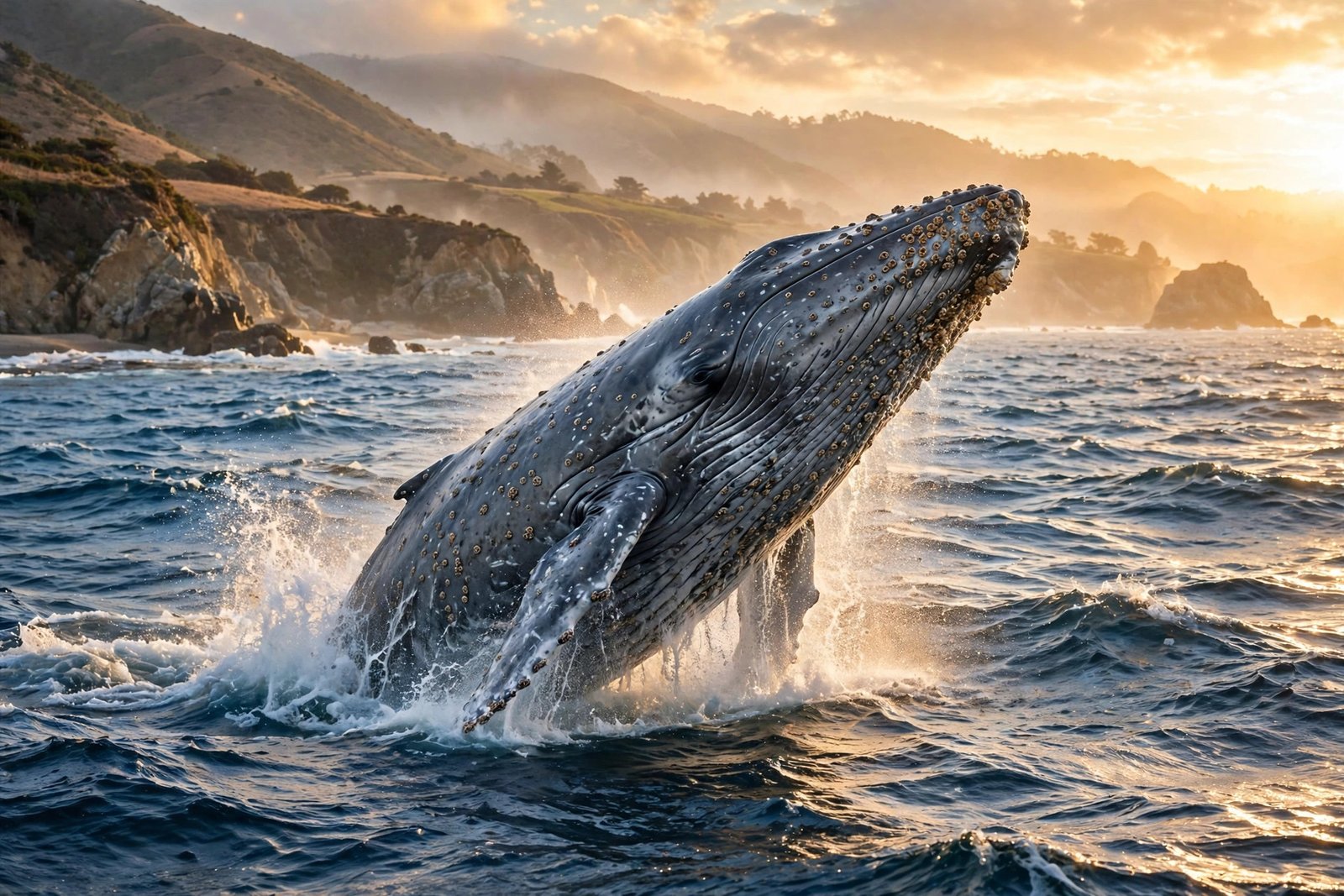
Every winter, one of the great wildlife spectacles in North America passes almost close enough to touch from the California shore. Gray whales, on their way between Arctic feeding grounds and the warm lagoons of Mexico, swim a coastal highway that runs the length of the state. You do not need a boat, expensive gear, or a lucky break to see them. On a calm morning, from a headland or a beach, you may only need patience, binoculars, and a little knowledge of when and where to look.
This guide explains the eastern Pacific gray whale migration, the best months and places to watch along the California coast, what whale behavior to look for, and how to watch responsibly so the whales can keep making this journey for generations to come.
One of the Longest Migrations on Earth
According to NOAA Fisheries, gray whales in the eastern North Pacific travel about 12,000 miles round trip between summer feeding grounds in the Arctic and the warmer waters of Mexico, where they spend the winter and females rear their calves. That makes their journey one of the longest annual migrations of any mammal. It is also one of the most visible, because gray whales migrate close to shore along the West Coast rather than far out in the open ocean.
Up close, gray whales are easy to recognize by their mottled gray and white coloration and the barnacles on their heads, NOAA notes. They are baleen whales, which means they feed by filtering small prey from the water and the seafloor instead of hunting large prey with teeth. In the Arctic summer, they feed heavily, building up the energy reserves that will carry them through months of travel and, for mothers, nursing a calf. A smaller group, known as the Pacific Coast Feeding Group, does not travel all the way to the Arctic and instead feeds along the Pacific coast between southeast Alaska and northern California.
The migration is not a single stampede. It unfolds in waves, with different groups traveling at different times. That staggered timing is part of what makes California whale watching last for months rather than days, and it is why the best time to go depends on what you hope to see.
The Route: From the Arctic to Baja California
The story begins in the far north, where gray whales spend the summer feeding in Arctic waters. As autumn advances, they begin moving south along the coasts of Alaska, British Columbia, Washington, and Oregon before reaching California. From there they continue down the Baja California peninsula to shallow, sheltered lagoons, where mating takes place and calves are born.
California sits right in the middle of this route, which is why the state gets two chances at the migration every year: once when the whales head south, and again when they head north. NOAA describes the southbound movement as running from November to mid-February, with the northbound journey continuing through May. The whales hug the coastline for much of the way, a habit that protects calves from predators in deeper water and, happily for watchers, brings them within sight of land.
For the whales, the journey is a serious undertaking. They travel for weeks, largely without feeding on the southbound leg, living off stored energy. Mothers face the hardest version of the trip, swimming south while pregnant, giving birth in the lagoons, and then guiding a newborn calf thousands of miles back north. When you watch a mother and calf pass a California headland in spring, you are seeing the final stretch of an extraordinary act of endurance.
When to Go: The California Gray Whale Calendar
The broad gray whale season in California runs from December through April, but the character of the viewing changes through the season. In December and January, most of the whales you see are heading south. These are often adults traveling steadily, and they may pass a little farther offshore than the spring travelers. Mid-January is often described as a peak time off Southern California, when the southbound flow is strong.
February is a transition month. Some whales are still heading south while others have already turned north. In the lagoons of Baja California, calves are being born and nursed, and the first northbound whales begin appearing along the California coast. By March and April, the northbound migration is in full swing, and this is the season many regular watchers love most. Mothers with calves travel slowly and stay especially close to shore, seeking the safety of shallow water where large predators are less likely to attack a young whale. If you want the best chance of a long, close look, spring is hard to beat.
May still brings stragglers north, and a few gray whales linger along the coast into summer. But for a dedicated gray whale trip, plan between December and April, and check recent local sighting reports before you go, since exact timing shifts a little from year to year with ocean conditions and food availability.
Best Places to Watch Gray Whales in California
Almost any high coastal viewpoint can work during migration season, but a few places stand out because of their geography, their history, or their facilities.
In the south, Cabrillo National Monument on the Point Loma Peninsula in San Diego is one of the most storied whale-watching spots in the country. The park has long been a public venue for observing gray whales, and its Whale Watch Overlook looks directly out over the migration path. From December to March, visitors can look beyond the kelp forest toward the horizon and see Pacific gray whales pass by, according to California State Parks information about the nearby Cabrillo area. San Diego also offers boat tours, and parks such as Torrey Pines State Reserve give walkers a clifftop view.
Farther north, the Monterey Bay area is a classic. Point Lobos State Natural Reserve, just south of Carmel, offers trails to several overlooks where migrating gray whales can be seen from December through April. The reserve is also a wonderful place to spend a whole day, with sea otters, sea lions, harbor seals, and tide pools to enjoy while you wait for a spout. Monterey Bay itself is one of the great whale-watching regions in the world, and tour boats leave from Monterey and Moss Landing.
On the central coast, Big Sur’s high cliffs give sweeping views, though you should check road conditions before a trip there. Farther north, Point Reyes National Seashore offers headland viewpoints, and the Mendocino coast, including Mendocino Headlands State Park, is a fine spring watching area. The common thread is elevation and a clear view to the horizon: the higher and calmer your viewpoint, the easier it is to spot a distant blow.
What to Look For: Reading the Water
Gray whales rarely announce themselves with a dramatic leap. More often, the first sign is a spout, a puff of mist that rises above the water when the whale exhales. Gray whale blows are bushy and can rise to around ten feet, and on a calm day they are visible from a long way off. After the spout, look for the back rolling through the surface, and then, just before a deeper dive, the flukes, or tail, lifting clear of the water.
Other behaviors are worth knowing. Spy-hopping is when a whale rises vertically, head out of the water, to look around, a behavior gray whales are known for. Breaching, when a whale launches much of its body out of the water and crashes back down, is less common for gray whales than for some other species, but it does happen and it is unforgettable when it does. Mothers and calves often travel as a pair, with the calf tucked close beside its mother, sometimes riding in her slipstream. If you see two backs surfacing together, one much smaller than the other, you are probably watching a family.
Patience is the real skill in whale watching. Whales surface, breathe a few times, and dive again, sometimes staying down for several minutes. Pick a comfortable spot, scan slowly along the horizon rather than staring at one patch of water, and watch for repeated spouts in the same direction of travel. Early morning is often best, when the wind is lighter and the sea is calmer.
From a Boat or From Shore?
Both approaches have their charms, and California offers excellent versions of each. Shore watching is free, relaxed, and surprisingly effective for gray whales precisely because they travel so close to land. You can bring a picnic, settle on a headland, and let the whales come to you. It is also the gentlest option for the animals, since no boat is approaching them at all.
Boat tours, on the other hand, put you closer to the action and come with a naturalist guide who can identify species, explain behavior, and point out animals you might otherwise miss. Tours run from many California harbors, including San Diego, Dana Point, Newport Beach, Monterey, and Santa Cruz. If you choose a boat trip, look for an operator that follows responsible viewing guidelines, keeps a respectful distance, and limits time spent with any one group of whales. A good operator will be proud to tell you how they protect the animals they show you.
Kayaking near whales deserves special caution. A kayak is quiet and low in the water, which means a whale may not notice you, and you may find yourself closer than you intended. Stay well clear of the migration path, never paddle toward a whale, and give mothers and calves an especially wide berth.
How to Watch Responsibly
Gray whales are protected under the Marine Mammal Protection Act, and responsible watching is both a legal duty and a simple courtesy to a wild animal on a demanding journey. NOAA Fisheries viewing guidelines urge the public to observe marine animals from a safe and respectful distance and not to approach or touch them. For large whales, NOAA recommends remaining at least 100 yards away, about the length of a football field, and limiting time spent observing individuals or groups to 30 minutes or less.
California State Parks echoes that advice in its Sharing the Road with Whales guidance, advising boaters and paddlers not to approach a whale within 300 feet, not to cut across its path, not to make sudden speed or direction changes, and never to get between a mother and her calf. If a whale approaches you, the responsible move is to stay still or move slowly away, not to chase or follow it. Do not feed marine mammals, do not try to swim with them, and keep drones well away, since noise and close proximity can stress the animals.
If you see a whale that appears entangled, injured, or in distress, do not attempt to free it yourself. California State Parks advises reporting entangled whales immediately to NOAA’s Whale Entanglement Hotline at 1-877-SOS-WHALE. Reporting a sighting through a program such as the Whale Alert app can also help researchers track whale distribution and reduce the risk of vessel strikes.
A Conservation Comeback Worth Celebrating
The gray whale’s story is one of the great conservation turnarounds on the American coast. Hunted to near extinction by commercial whaling, the eastern North Pacific population recovered under protection and was removed from the endangered species list in 1994. Today, NOAA calls gray whales the most commonly observed whale on the U.S. West Coast, and its scientists monitor their abundance, calf production, and body condition along the California coast.
That recovery is not a reason for complacency. NOAA declared an unusual mortality event for gray whales that ran from late 2018 until early November 2023, with strandings observed along the entire West Coast from Mexico to Alaska. Researchers have linked such boom-and-bust cycles to changing conditions in Arctic feeding grounds, a reminder that a migration spanning the whole Pacific coast depends on healthy oceans at both ends of the route. Watching respectfully, supporting marine protected areas, and keeping the coast clean are small ways every visitor can help the next generation of gray whales complete the journey.
So pack your binoculars, dress in layers, and head for a headland this winter or spring. Stand quietly, scan the horizon, and wait for that first bushy spout. When a gray whale rolls past, close enough to see yet entirely wild and free, you will understand why Californians have gathered on these cliffs to watch this migration for generations.
Frequently Asked Questions
When is the best month to see gray whales in California?
December through April is gray whale season, with mid-January often cited as a peak for the southbound migration off Southern California. March and April are excellent for the northbound migration, when mothers with calves travel slowly and close to shore.
Do I need a boat to see gray whales?
No. Because gray whales migrate close to shore, they can often be seen from headlands and beaches, especially at places like Cabrillo National Monument, Point Lobos, and Point Reyes. A boat tour can bring you closer and adds a guide, but shore watching is free and effective.
How far away should I stay from a whale?
NOAA recommends at least 100 yards from large whales, and California State Parks advises boaters and paddlers not to approach within 300 feet. Never cut across a whale’s path or get between a mother and her calf.
What does a gray whale spout look like?
Gray whale blows are bushy and can rise to about ten feet above the water. On a calm day, the spout is usually the first thing you will notice, followed by the whale’s mottled back rolling through the surface.