
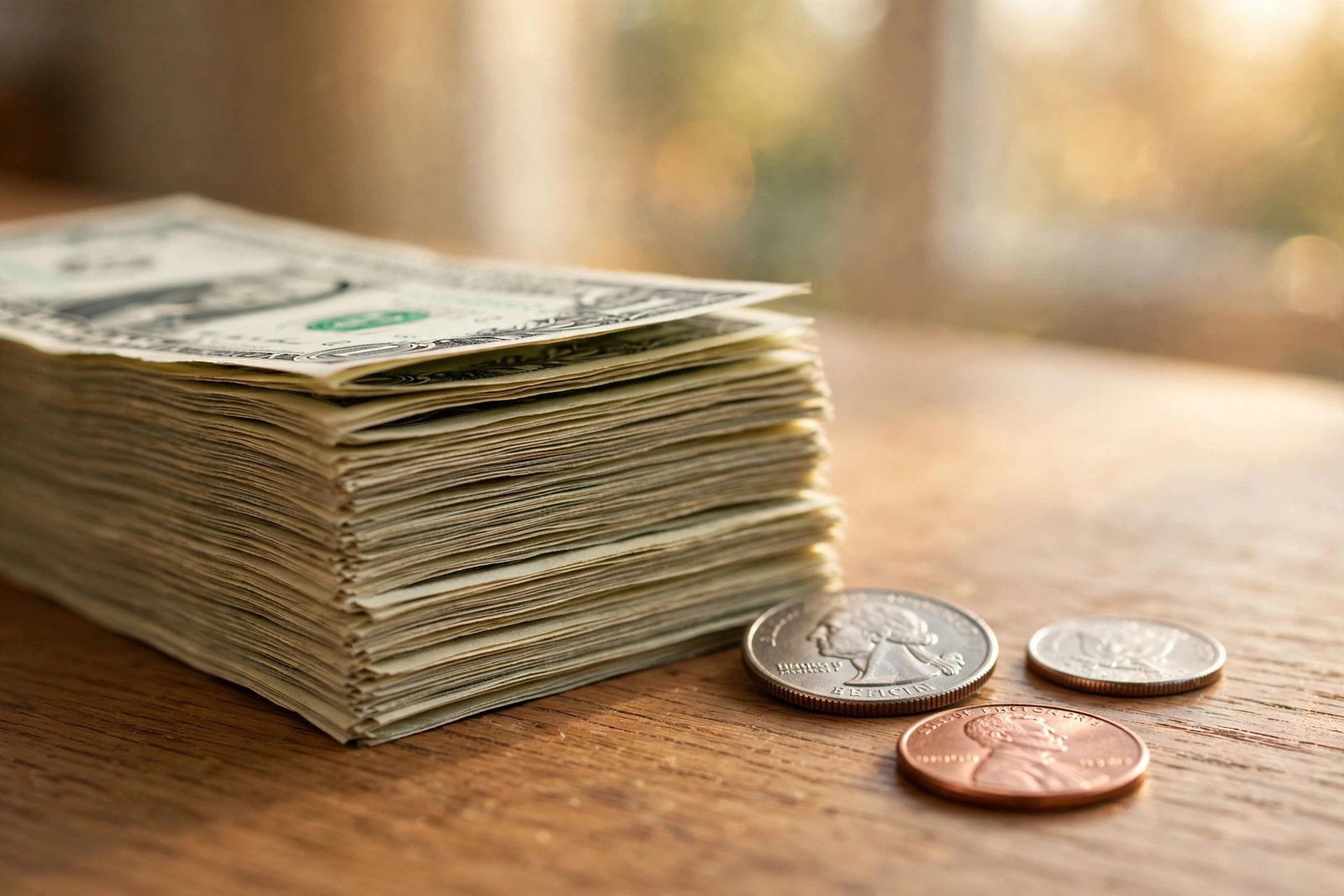
Pull a dollar bill out of your wallet and look at it. The green is so familiar that most of us never stop to ask why it is there at all. Other countries print their money in bright blues, reds, purples, and oranges. American money has been green for more than 160 years, through wars, depressions, redesigns, and the rise of digital payments. The color is so tied to the dollar that “greenback” has become a synonym for American cash itself, and green has become the color of money in cartoons, movies, and slang around the world. But the green was never a decoration. It was a weapon in a war against counterfeiters, a practical choice made in a moment of national crisis, and then a tradition that proved too useful, and too deeply loved, to abandon.
A Nation That Needed Money Fast
The story starts in 1861, in the first summer of the Civil War. The United States government was in trouble. It needed to pay soldiers, buy supplies, and keep the Union war effort running, and the Treasury was running low on gold and silver coin. Tax revenue was not enough, and borrowing had limits. So Congress took a step the federal government had not taken since the Revolutionary War: it authorized the Treasury to print paper money.
These first federal notes were called Demand Notes, and they were essentially government IOUs. Each note was redeemable on demand in gold or silver coin at certain Treasury facilities, which is where the name came from. The Treasury issued them in denominations of five, ten, and twenty dollars, and they were the first paper money put into general circulation by the federal government. They were printed by the American Bank Note Company under contract, and the backs of the notes were printed in green ink. The public noticed immediately. People started calling them “greenbacks,” and the nickname stuck so firmly that it outlived the notes themselves.
The timing mattered. Before the Civil War, paper money in America was a chaotic patchwork. State-chartered banks printed their own notes in a wild variety of designs, sizes, and colors, and some of those banks failed, leaving their notes worthless. There was no single, trusted national currency. The greenbacks changed that. For the first time, ordinary Americans carried the same federal paper money from Maine to Minnesota, and the green back became the visual signature of a currency you could trust.
Why Green? The Counterfeiting Problem
So why green, of all colors? The honest answer, given by the Bureau of Engraving and Printing itself, is that no definite explanation can be made for why this particular color was chosen. But the Bureau’s own publications offer the explanation historians find most convincing, and it comes down to photography.
In the mid-1800s, photography was a new and growing technology, and it was also a counterfeiter’s best friend. The early camera saw everything in shades of black and white. A feature printed in color lost its individuality when it was photographed: the color information simply vanished. Counterfeiters had learned to exploit this. They would photograph a genuine banknote, print copies of the black-and-white image, and then overprint the colored parts by hand. The colored inks in common use at the time were easy to wash off a genuine note without disturbing the black ink, which made the counterfeiter’s job even simpler: remove the color, photograph the rest, print copies, and add the color back.
Green ink changed the equation. According to the Bureau of Engraving and Printing’s publication Currency Notes, it is believed that the green ink was meant as a deterrent to counterfeiters who would have used photography as a means of reproduction. Unlike other colored inks, the green ink could not be removed from a note without disturbing the black ink, and removing the colored ink was an essential step in the counterfeiting process. A counterfeiter who tried to wash the green off would ruin the black printing underneath, destroying the very image they needed to copy. The green was, in effect, a security feature, and a clever one for its time.
There are other threads to the story, too. One colorful theory holds that the green ink was made from palm juice, a story that has circulated for generations but has never been firmly proven. Another traces the ink to Canada: Dr. Thomas Sterry Hunt, a professor at Laval University in Quebec, is credited with developing a green ink in 1857 as an anti-counterfeiting measure, and the patent was taken out on his behalf by George Matthews, a chemist with the Montreal City Bank. The American Bank Note Company held the patent rights to a protective green ink, and the rights were purchased by the noted banknote engraver Tracy R. Edson, whose company printed the new notes in 1861. The exact recipe remains part of the mystery, but the purpose is clear: green was chosen to make the money harder to fake.
The Greenback Becomes Permanent
The Demand Notes were only the beginning. In 1862, Congress passed the Legal Tender Act, which authorized a new class of currency called United States Notes, or Legal Tender Notes. These notes were not redeemable in gold or silver on demand; they were declared legal tender by the government itself, a bold assertion of federal power in the middle of a war. Like the Demand Notes, they had green backs, and the public called them greenbacks too. United States Notes continued to circulate until 1971, an extraordinary run of more than a century.
The green stuck through every change that followed. In 1869, the Bureau of Engraving and Printing began engraving and printing the faces and seals of United States banknotes, taking over work that had previously been done by private banknote companies. By 1877, Congress had mandated that the Treasury alone would engrave and print the nation’s notes, bonds, and other securities, and the Bureau had taken over the whole process. Through all of it, the green remained.
When the Federal Reserve System was created and the first Federal Reserve Notes were issued in 1914, they too were printed in green. The Federal Reserve Note is the kind of dollar bill Americans carry today, and the Bureau of Engraving and Printing has printed every one of them since 1914. The green had become more than a color. It was the look of American money.
The 1929 Redesign: A Chance to Change That Never Happened
If there was ever a moment when America might have abandoned green, it was 1929. That year, the Treasury redesigned United States currency from the ground up. The old large-size notes, which were roughly a third bigger than today’s bills, were replaced with the smaller, standardized size we still carry. The change was made to save money on production and to bring order to a system that had grown messy, with different sizes and designs for different kinds of notes.
A redesign like that would have been the natural moment to rethink the color. The government chose not to. According to the Bureau of Engraving and Printing, the use of green was continued for three reasons: the pigment of that color was readily available in large quantities, the color was relatively high in its resistance to chemical and physical changes, and green was psychologically identified with the strong and stable credit of the government.
Each of those reasons tells you something. Availability mattered because the Bureau prints billions of notes, and it needed an ink it could source reliably at scale. Durability mattered because a banknote has to survive years of folding, washing, and handling, and green ink held up. And the psychological point mattered most of all: after nearly seventy years, Americans associated green with the strength and stability of the United States government itself. To change the color would have been to throw away the trust the color had built. Tradition, it turned out, was a security feature of its own.
What Is Actually in the Ink?
Modern American currency is printed with a mix of inks, and green is only part of the story. The black ink used on the front of the notes is magnetic, which is one reason vending machines and bill validators can read them. The green ink on the back has a different composition, and the Bureau of Engraving and Printing keeps the exact formula secret, as it does with many of the security details of the notes. What is public is that the inks are specially formulated for durability and for resistance to the chemical and physical attacks that counterfeiters use.
The Bureau prints the nation’s currency at two facilities, in Washington, D.C., and in Fort Worth, Texas. The scale is enormous: tens of billions of notes are in circulation at any given time. Every one of them carries the green that started in 1861, and every one of them is still legal tender. The United States has never demonetized its paper currency, which means that a greenback from the Civil War era would still be redeemable at full face value today, at least in theory. That unbroken continuity is part of what makes the dollar trusted around the world.
Green Gets Company: The Modern Redesigns
For most of the twentieth century, the green was nearly the only color on American money. That changed in the early 2000s, when counterfeiting technology caught up with the old designs. Beginning with Series 2004, the Bureau introduced subtle background colors to the higher denominations: the $20 gained peach and blue tones, the $50 added blue and red, and the $100, redesigned in 2013, carries a blue ribbon and a color-shifting bell. The $5 and $10 followed with their own soft background tints.
Notice what did not change. The dominant green is still there on every note, front and back. The new colors are background tints, layered behind the familiar green and black printing, and they serve the same purpose the green served in 1861: they make the note harder to copy, because they add complexity a counterfeiter has to reproduce. The modern security features go further still. Today’s notes carry watermarks, security threads that glow under ultraviolet light, color-shifting ink that changes from copper to green as you tilt the note, microprinting too small to read without magnification, and raised printing you can feel with your fingertip. The green is now one layer in a stack of defenses, but it is still the layer everyone recognizes first.
There is a nice symmetry in that. The green was introduced to defeat the photography of the 1860s, and the new colors were introduced to defeat the scanners and printers of the 2000s. Counterfeiting technology changed; the strategy of using color as a defense did not.
How Green Conquered the World
The greenback’s influence did not stop at America’s borders. The United States dollar is the world’s primary reserve currency, the currency that central banks hold, that oil and other commodities are priced in, and that international trade is most often settled in. When people around the world picture money, they often picture a green American dollar. The color has become so associated with wealth that other countries’ banknotes are sometimes described by how close they come to the look of a dollar, and “green” has entered the language of money in dozens of countries.
That global reach is part of why the color has never changed. A redesign that abandoned green would confuse not only Americans but billions of people worldwide who recognize the dollar by its color at a glance. The Federal Reserve and the Bureau of Engraving and Printing know this, and every redesign since 2004 has kept the green front and center while adding new security features around it. The color is, in a very real sense, part of the dollar’s brand, and it is a brand worth trillions.
FAQ
Why are US dollar bills green?
US dollar bills are green because the first federal paper money, the Demand Notes of 1861, were printed with green ink on the back. The green was most likely chosen as a deterrent to counterfeiters: early cameras could only photograph in black and white, and the green ink could not be washed off a note without ruining the black printing underneath. The nickname “greenback” stuck, and the color was kept through every redesign that followed.
What is a greenback?
“Greenback” was the nickname given to the Demand Notes of 1861 because of the green ink on their backs. The name was then applied to the United States Notes authorized by the Legal Tender Act of 1862, and it eventually became a general slang term for American paper money of any kind. The term is still used today, more than 160 years later.
Who prints US dollar bills?
The Bureau of Engraving and Printing, part of the US Department of the Treasury, prints all United States paper currency at facilities in Washington, D.C., and Fort Worth, Texas. The Federal Reserve distributes the notes to banks. The Bureau has printed every Federal Reserve Note since the first series was issued in 1914.
Have US bills always been green?
All federal paper money issued since 1861 has been green, and every note issued since then remains valid and redeemable at full face value. The green was kept when the currency was redesigned to a smaller size in 1929, and it remains the dominant color today, even though modern notes also carry subtle background colors and advanced security features added since 2004.
What is US paper money made of?
United States currency is printed on a blend of 75 percent cotton and 25 percent linen, not wood-pulp paper. That is why a dollar bill feels different from ordinary paper and survives handling, folding, and even an accidental wash far better than a normal sheet would. The inks are specially formulated, and the exact formulas are kept secret by the Bureau of Engraving and Printing.
Related reading
- The US Dollar as the World’s Reserve Currency
- USA Facts by the Numbers
- American Inventions That Changed the World
Sources: U.S. Currency Education Program: History of U.S. Currency; Federal Reserve Bank of New York: It’s Not Easy Being Green; Federal Reserve Bank of San Francisco: Currency, Ten Questions; History Facts: Why Are U.S. Dollars Green?; Mental Floss: Why Is U.S. Currency Green?; Money Digest: The Real Reason US Money Is Green.