
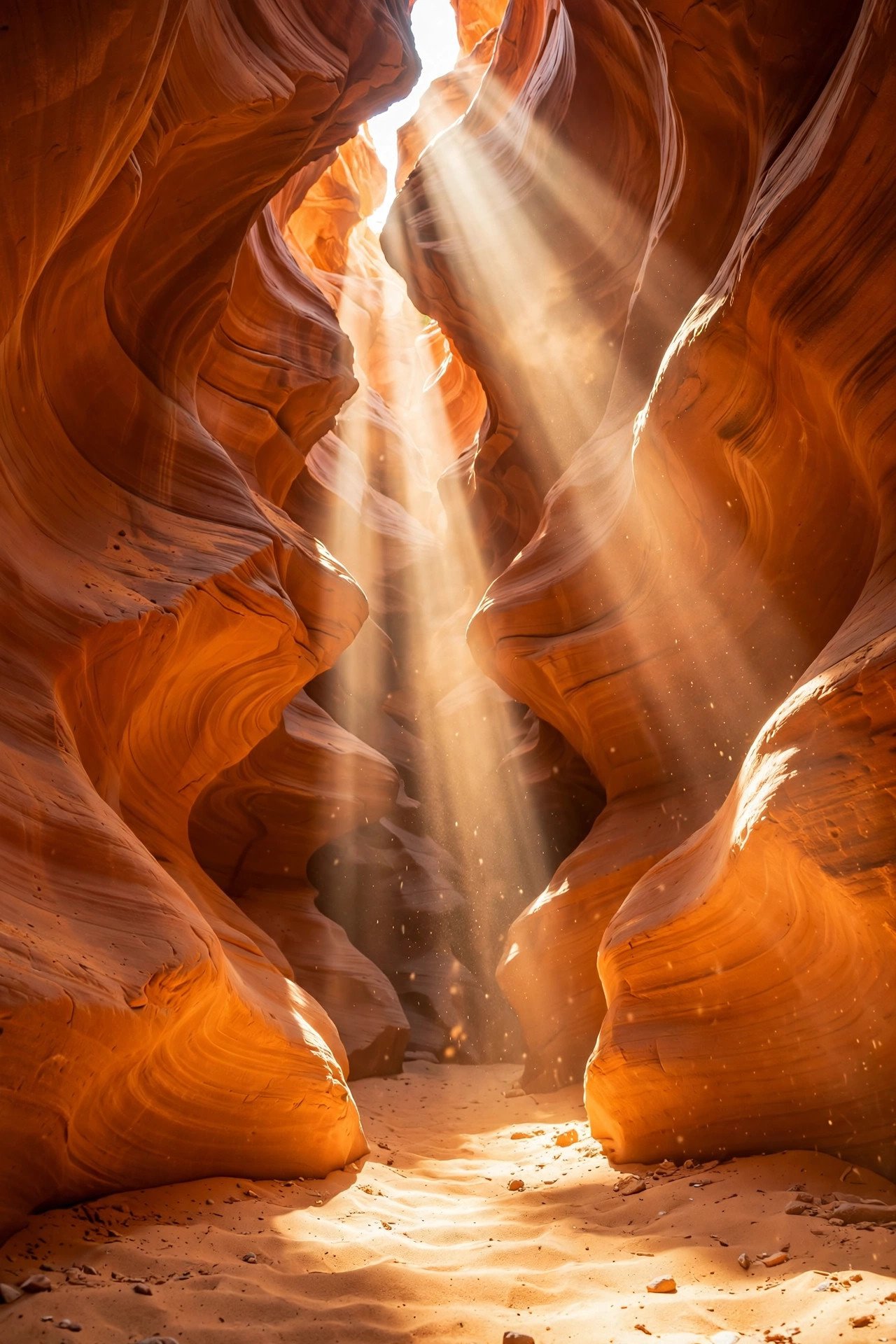
There are places in America that photographs simply cannot prepare you for, and Antelope Canyon is one of them. Step inside this narrow slot canyon near Page, Arizona, and the desert disappears. The world shrinks to a winding corridor of smooth, wave-like sandstone, lit from above by a thin ribbon of sky. The walls glow orange, pink, and violet, shifting color as the sun moves. It is one of the most photographed natural wonders in the United States, and it is also one of the most misunderstood. You cannot just drive up and walk in. You cannot wander off on your own. And if you show up at the wrong time of year, you will miss the famous light beams entirely. This guide covers everything you need to know before you go: which section to choose, how the canyon was formed, the rules that keep visitors safe, and how to plan a trip that lives up to the pictures.
What Is Antelope Canyon?
Antelope Canyon is a slot canyon carved into Navajo sandstone on Navajo Nation land, just east of Page in northern Arizona. It sits within Lake Powell Navajo Tribal Park, and it is managed by Navajo Nation Parks and Recreation. Unlike the wide, open canyons of the American Southwest, a slot canyon is a deep, narrow channel cut into rock by water. In places, Antelope Canyon is only a few feet wide at the bottom, while the walls rise more than a hundred feet overhead. The result is a sculpted, almost liquid landscape of curves and flowing lines that looks more like a work of art than geology.
Antelope Canyon has become famous around the world, and for good reason. The light inside the canyon behaves like nothing most people have ever seen. Sunlight filters down through the narrow opening above, bounces off the sandstone walls, and fills the corridor with a warm, glowing color that changes by the hour. Photographers travel from every continent to capture it. But the canyon is also a sacred place on Navajo land, and visiting it means following Navajo rules, traveling with a Navajo guide, and respecting a landscape that has been shaped by water over thousands of years.
Upper vs. Lower: Two Very Different Canyons
Upper Antelope Canyon, known in Navajo as Tsé bighánílíní, meaning “the place where water runs through rocks,” is the section most people picture when they think of Antelope Canyon. It is the wider of the two main sections, with a flat, sandy floor that makes walking easy. The walls rise about 120 feet above the canyon floor, and the corridor runs roughly a quarter of a mile. Because the floor is flat, Upper Antelope is the better choice for visitors who have trouble with stairs or who are traveling with small children. The trade-off is the exit: since the canyon went one-way, visitors climb out by a stairway at the far end.
Upper Antelope is also the home of the famous light beams. On clear, sunny days from roughly March through October, shafts of sunlight angle down through the narrow opening at the top of the canyon and strike the sandy floor. The beams are strongest around midday, roughly between 10 a.m. and 1 p.m., with the late-morning tours offering the best chance. Guides often stir the sand at designated photo spots, which makes the beams visible as glowing columns in the air. No operator can guarantee the beams, though. Clouds, haze, or the wrong time of year can hide them entirely, and from November through February the sun never climbs high enough to produce them at all.
Lower Antelope Canyon, called Hasdestwazi in Navajo, often translated as “spiral rock arches,” is a different kind of adventure. It is longer, narrower, and more physically demanding. Visitors descend steep metal staircases and climb ladders to reach the canyon floor, then walk a winding route through twisting passages that open into glowing chambers. There are no dependable light beams in Lower Antelope, but the reflected light is often brighter and more colorful than in Upper, and the canyon gives you more time inside. Many experienced visitors and photographers prefer Lower for exactly that reason: longer in the canyon, fewer crowds, and more varied shapes to photograph.
How the Canyon Was Carved
Antelope Canyon was carved by flash floods. That sounds almost impossible when you stand in the dry desert around Page, but it is the key to understanding the place. The canyon is cut into Navajo sandstone, a soft, wind-deposited rock laid down as ancient sand dunes some 190 million years ago. Over thousands of years, rare but powerful rainstorms sent walls of water rushing down Antelope Wash, a normally dry streambed. The floodwater carried sand and gravel that acted like sandpaper, grinding the sandstone smooth and deepening the channel with every storm.
Because the rock is layered and the water followed the path of least resistance, the canyon developed its famous flowing shapes: smooth curves, swirling bowls, and walls that ripple like fabric. The different colors come from the sandstone itself and from the way light bounces inside the narrow space. Iron-rich minerals give the rock its orange and red tones, while reflected light can tint the walls pink, purple, and gold depending on the time of day. The same water that created the canyon still shapes it today. Every monsoon season brings new floods that can rearrange the sand on the floor and subtly alter the passages, which is one reason the canyon looks slightly different from one year to the next.
The Light Beams: When and Where to See Them
The light beams are the single biggest reason most people visit Antelope Canyon, so it is worth being honest about them. They appear only in Upper Antelope Canyon, only on clear sunny days, and only when the sun is high enough to angle directly down through the narrow slot above. In practice, that means late March through mid-October, between about 10 a.m. and 1 p.m., with the best odds on the late-morning tours. Operators and guide services generally point to the 11 a.m. tours as the strongest bet, and some operators run a specific 11:20 a.m. departure aimed at beam hunters.
Even in season, the beams are not a permanent fixture. They appear in bursts as sunlight hits the dust and sand in the air, and your guide will stir the sand at the best spots to make them visible. A cloudy day will erase them. A hazy sky will dim them. And if you visit between November and February, you will not see them at all, though the canyon is still beautiful in winter light. If the beams are the reason for your trip, book the Upper Canyon for a midday tour in late spring or summer, and book weeks ahead: the beam-season midday slots are the first to sell out.
The Rules: Guided Tours Only
Here is the rule every visitor needs to understand before anything else: you can only enter Antelope Canyon on a guided tour with an authorized Navajo operator. There is no self-guided entry, no walk-up hike, and no way to drive your own car to the Upper Canyon. The Navajo Nation’s rule is short and absolute: tour guides are mandatory at all Antelope Canyon locations. Every operator must hold a Navajo Nation permit to guide, and Navajo Nation Parks and Recreation publishes the official list of authorized operators. Book through an operator on that list, and beware of third-party resellers that are not authorized.
Booking ahead is essential, especially in spring and summer. The most popular time slots, particularly the midday Upper Canyon tours, can sell out four to eight weeks in advance. Plan to arrive 30 to 45 minutes before your tour time for check-in, and remember that all tours run on Arizona time, which does not observe daylight saving. That detail catches out more visitors than you might think, especially in summer when neighboring states are an hour ahead.
There is also a Navajo Nation entry fee of $15 per person, per location, per day, which is separate from the tour price and is often included in the booking total. Your National Parks pass does not apply here: Antelope Canyon is a Navajo Tribal Park, not a National Park Service site, and the America the Beautiful pass is not accepted. Tour prices vary by operator and season, with Upper Canyon tours generally costing more than Lower, and the midday beam tours carrying a premium.
Photography Rules in 2026
If you are coming to take pictures, know the rules before you pack your bag. Tripods, monopods, and selfie sticks have been banned on standard tours at both Upper and Lower Antelope Canyon since 2019. The dedicated photography tours that once allowed tripods and extra time to compose shots were discontinued after the 2019 season, and Navajo Parks currently does not issue photography or filming permits for Upper or Lower Antelope Canyon. Photography today is handheld only: a phone or a handheld camera, no supports, no flash.
Bags are another thing to plan for. Rules differ by operator, and Lower is the strict one: the Lower Canyon operators do not allow bags of any kind, including clear ones. At Upper Canyon, some operators allow clear, see-through bags only. Drones are banned on all Navajo Nation land without a special permit, and commercial photography requires a separate permit that is not currently being issued for Upper or Lower. A phone in your pocket, a handheld camera, and a water bottle are the safe setup.
Staying Safe: Flash Floods Are Real
The beauty of Antelope Canyon comes with a real and serious danger. In August 1997, a flash flood swept through Lower Antelope Canyon and killed 11 tourists. It remains the defining tragedy in the canyon’s modern history, and it is the reason the rules are what they are today. Since then, no one is allowed in without an authorized Navajo guide, tours are canceled when storms threaten the watershed, and guides are trained to get groups out fast if conditions change.
The danger is deceptive because the floodwater comes from rain that falls far away. A storm over the watershed, miles upstream, can send a wall of water into the canyon while the sky directly overhead is blue and clear. That is why your guide watches the weather across the whole drainage, not just above Page, and why tours are canceled during the July-to-September monsoon season even when the morning looks perfect. Never argue with a cancellation, and never try to enter the canyon outside a guided tour. The flood of 1997 arrived with almost no warning, and in a slot canyon there is nowhere to climb to safety.
For visitors, the practical advice is simple: trust your guide, stay with the group, and keep an eye on the weather yourself before you go. If a tour is canceled for weather, take it as a sign the system is working. The canyon will still be there tomorrow.
Planning Your Visit: Page, Arizona Logistics
Page, Arizona, is the gateway town for Antelope Canyon, and it is a small desert town that punches far above its weight for travelers. It sits on the edge of Lake Powell and Glen Canyon, and it is the base for a cluster of remarkable places: Horseshoe Bend, the Glen Canyon Dam, Lake Powell, and the Vermilion Cliffs. Most visitors fly into Las Vegas, Phoenix, or Flagstaff and drive to Page, so plan your route in advance and fuel up: services are sparse on the desert highways around town.
Give yourself at least a full day in Page. A morning tour of Upper Antelope Canyon pairs naturally with a sunset visit to Horseshoe Bend, which is a short drive from town and one of the most famous viewpoints in the Southwest. If you have two days, add a Lower Canyon tour, a boat trip on Lake Powell, or a drive to the North Rim of the Grand Canyon. And remember that Page is in the Mountain Standard Time zone year-round: Arizona does not observe daylight saving time, so double-check your tour time against your phone, which may have switched time zones on the drive in.
FAQ
Can you visit Antelope Canyon without a tour?
No. A Navajo-authorized guide is mandatory for Upper Antelope Canyon, Lower Antelope Canyon, Canyon X, and every other Antelope Canyon location. There is no self-guided entry, and the Navajo Nation does not allow visitors to enter the canyon on their own. Book through an operator on the official Navajo Nation Parks and Recreation list.
When is the best time to see the light beams?
The light beams appear in Upper Antelope Canyon on clear, sunny days from roughly late March through mid-October, between about 10 a.m. and 1 p.m. The late-morning tours offer the best odds. From November through February, the sun does not climb high enough to produce beams. Even in season, clouds can hide them, so no operator can guarantee a sighting.
Which is better, Upper or Lower Antelope Canyon?
It depends on what you want. Upper has the light beams, a flat floor, and easier walking, but it is more crowded and more expensive. Lower is longer, brighter, and more adventurous, with steep stairs and ladders, and it costs less. Photographers often prefer Lower for color and variety, while first-time visitors chasing the classic beam photo usually choose Upper.
Can you bring a tripod or a drone?
No. Tripods, monopods, and selfie sticks have been banned on standard tours since 2019, and dedicated photography tours were discontinued. Photography is handheld only. Drones are banned on all Navajo Nation land without a special permit, and commercial photography permits are not currently being issued for Upper or Lower Antelope Canyon.
Is Antelope Canyon safe for children?
Upper Antelope Canyon works for young children in a front carrier, since the floor is flat sand, though the exit involves stairs. Lower Antelope Canyon requires children to be at least five years old at some operators because of the steep staircases and ladders. Check the age rules with your chosen operator before booking, and keep children close to your guide at all times.
Related reading
- America’s 63 National Parks: The Complete Guide
- Devils Tower, Wyoming: America’s First National Monument
- Great Sand Dunes National Park, Colorado: A Complete Guide
Sources: Navajo Nation Parks & Recreation: Guided Tour Operators; Slot Canyon Guide: Antelope Canyon 2026; Exploroff: Antelope Canyon Tours, Upper vs Lower; Work Hard Travel Well: How to Visit Antelope Canyon; Upper vs Lower Antelope Canyon (2026); Slot Canyon Guide: Upper Antelope Canyon Tickets and Light Beams.