
In the early hours of January 17, 1991, the sky over Baghdad lit up as coalition aircraft and cruise missiles struck targets across Iraq. For the next 42 days, the world watched a war unfold on live television — the first war ever broadcast in real time. When it ended on February 28, Kuwait was free, the Iraqi army had been driven out, and the U.S.-led coalition had achieved one of the most decisive military victories of the 20th century. Operation Desert Storm lasted just six weeks, and its ground campaign took only about 100 hours. Yet the war’s consequences would shape the Middle East for decades.
The operation was the combat phase of the Gulf War, the conflict that began when Iraq invaded Kuwait on August 2, 1990. Before a single shot was fired in anger, the United States spent nearly six months building an extraordinary international coalition — 35 nations acting under United Nations authority — and moving more than half a million American troops to Saudi Arabia. That buildup, called Operation Desert Shield, was itself one of the largest military deployments since World War II. Desert Storm was the payoff: a carefully planned air campaign followed by a daring ground maneuver that caught the Iraqi army completely by surprise.
August 2, 1990: Iraq Invades Kuwait
The crisis began before dawn on August 2, 1990, when Iraqi forces under President Saddam Hussein crossed the border and invaded Kuwait, a small, oil-rich neighbor on the Persian Gulf. Within hours, Iraqi tanks were in Kuwait City, and within days, Iraq announced that Kuwait had been annexed as its 19th province. The invasion shocked the world. Kuwait was a sovereign state and a member of the United Nations, and Iraq’s aggression threatened not only Kuwait but also Saudi Arabia, the world’s largest oil producer, just across the border.
The United States and the international community responded with remarkable speed and unity. The United Nations Security Council condemned the invasion and demanded Iraq’s immediate withdrawal, and within days it imposed sweeping economic sanctions. President George H.W. Bush declared that the aggression “will not stand,” and began assembling a coalition of nations willing to defend Saudi Arabia and, if necessary, to force Iraq out of Kuwait by military means. The Soviet Union, in its final years, joined in condemning its former client — a sign of how much the world had changed since the Cold War. In the end, the coalition that formed included 35 nations, operating under a series of 12 United Nations Security Council resolutions.
Operation Desert Shield: Building the Coalition
While diplomats worked at the United Nations, the military buildup began. On August 7, 1990, just five days after the invasion, the first American troops landed in Saudi Arabia. The mission was called Operation Desert Shield, and its first job was defensive: to protect Saudi Arabia from a possible Iraqi attack while the coalition gathered its strength. Over the next five months, the buildup grew into one of the largest deployments of American forces since World War II, with more than 500,000 U.S. personnel sent to the region, alongside troops from Saudi Arabia, Britain, France, Egypt, Syria, and many other nations.
General Norman Schwarzkopf, commander of U.S. Central Command, led the coalition forces, working alongside Saudi Arabia’s Prince Khaled bin Sultan as co-commander of the allied effort. The logistics were staggering: tanks, aircraft, ships, fuel, food, and ammunition poured into Saudi ports and airfields. The coalition also built a network of air bases, hospitals, and supply depots across the Saudi desert. At the same time, the United Nations set a deadline: Resolution 678, passed in late November 1990, authorized the use of force if Iraq had not withdrawn from Kuwait by January 15, 1991. As the deadline approached, Saddam Hussein showed no sign of leaving. The coalition prepared for war.
The Deadline Passes: January 15, 1991
January 15, 1991, came and went without an Iraqi withdrawal. The United Nations deadline had expired, and the coalition’s authorization to use force was now in effect. On the evening of January 16, President Bush addressed the American people, explaining that the objectives were clear: Iraqi forces would leave Kuwait, and Kuwait’s legitimate government would be restored. Hours later, the air campaign began.
The opening of the war was unlike anything the world had seen. At 3 a.m. Iraqi time on January 17, 1991, coalition aircraft and cruise missiles struck targets across Iraq and Kuwait, hitting air defenses, command centers, power grids, and communications networks. Stealth aircraft, which radar could barely detect, flew some of the first missions over Baghdad. Television viewers in the United States watched the bombing of the Iraqi capital live on CNN, as correspondents reported from a hotel rooftop while anti-aircraft fire filled the sky. It was the first war broadcast in real time, and it changed how the public experienced war forever.
The Air Campaign: Five Weeks of Bombing
The air campaign lasted about five to six weeks, from January 17 until the ground offensive began on February 24. Its goals were to win control of the skies, destroy Iraq’s command and communications, and wear down the Iraqi army dug in along the Kuwaiti border. Coalition aircraft flew more than 100,000 sorties and dropped more than 88,000 tons of bombs on Iraqi positions in Iraq and Kuwait. Within days, the coalition had achieved air supremacy, and the Iraqi Air Force — outnumbered and outmatched — largely stopped flying.
The air war also featured weapons that captured the public imagination. Precision-guided bombs, shown on television homing in on their targets, seemed to make war cleaner and more surgical than it had ever been. The Patriot missile system, designed to intercept incoming ballistic missiles, was put to the test against Iraq’s Scud missiles, which Saddam Hussein fired at Israel and Saudi Arabia in an attempt to widen the war and break the coalition apart. The first Patriot intercept of a Scud over Dhahran, Saudi Arabia, came on the first day of the conflict. The Scud attacks killed civilians and caused fear, but they failed to draw Israel into the war or to split the Arab members of the coalition away from the alliance.
By late February, the bombing had badly damaged Iraq’s military machine. Iraqi troops in Kuwait were short of food, fuel, and ammunition, their communications were shattered, and thousands had deserted or surrendered. Schwarzkopf and his commanders judged that the time had come for the ground offensive. But the plan they had prepared was not the frontal assault the Iraqis expected. It was something far more daring.
The Ground War: 100 Hours and the “Left Hook”
At dawn on February 24, 1991, the ground offensive began. Marines and Arab coalition forces attacked directly into Kuwait from the south, driving straight at the Iraqi defenses along the border — exactly where the Iraqis expected them. This frontal attack fixed the Iraqi army in place, pinning its attention south while the real blow fell elsewhere.
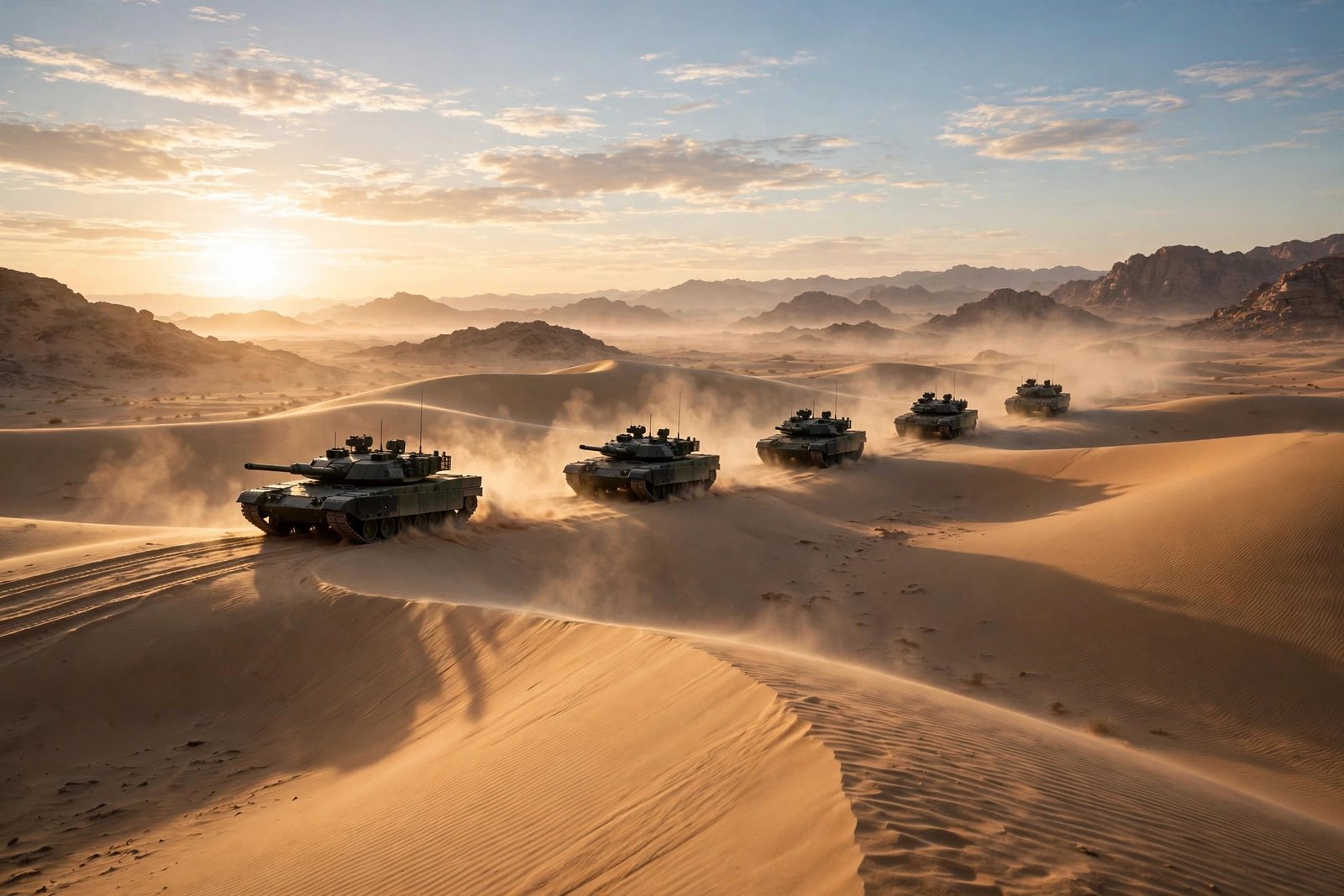
Meanwhile, to the west, the main armored force was executing one of the boldest maneuvers in modern military history. The U.S. VII Corps, including the British 1st Armoured Division, and the U.S. XVIII Airborne Corps, with the French 6th Light Armoured Division, swung deep into the Iraqi desert in a wide flanking movement that became known as the “Left Hook” — or, as Schwarzkopf called it, the “Hail Mary.” The maneuver covered hundreds of miles of open desert, bypassed Kuwait City entirely, and came down behind the Iraqi forces from an angle their commanders never anticipated. The Iraqi army, already battered by weeks of bombing, collapsed quickly. Some units fought; many more surrendered in large numbers, and some simply fled, setting fire to hundreds of Kuwaiti oil wells as they withdrew.
The speed of the advance stunned even the coalition’s own commanders. Kuwait City was liberated on February 26 and 27, and on February 28 — exactly 100 hours after the ground war began — President Bush declared a suspension of offensive combat operations. The ground war, famously, had lasted just four days. The operation as a whole, from January 17 to February 28, had taken 42 days, and some accounts count 43 days from the first air strikes to the ceasefire. Either way, it was one of the shortest major wars in modern history.
The Human Cost and the Aftermath
For the coalition, the victory came at a remarkably low cost in lives. Coalition forces suffered approximately 292 deaths in total, including deaths from accidents and friendly fire incidents. Iraqi military deaths are far harder to pin down, with estimates generally ranging from 20,000 to 35,000, and the figures remain disputed. Civilian casualties in Iraq and Kuwait, and the long-term effects of the bombing on Iraq’s infrastructure, were also severe, though exact numbers have never been firmly established.
The war’s aftermath was visible from space. As Iraqi forces retreated, they set fire to hundreds of Kuwaiti oil wells, and the burning wells poured black smoke across the region for months, creating an environmental disaster that took years to clean up. Kuwait itself was left devastated: looted, mined, and scarred by months of occupation. Yet the country’s government was restored, and the coalition’s mission — to liberate Kuwait — was accomplished.
The political aftermath was more complicated. Saddam Hussein remained in power in Baghdad, and within weeks of the ceasefire, his regime brutally suppressed uprisings by Kurds in the north and Shiites in the south. The United Nations imposed no-fly zones over parts of Iraq and a strict sanctions regime, and American and British aircraft patrolled Iraqi skies for more than a decade. The war also left a large American military presence in the Persian Gulf, a fact that would shape the region’s politics for years to come — and that would play a role in the conflicts that followed, including the Iraq War of 2003.
Why Desert Storm Still Matters
Operation Desert Storm mattered for reasons that went far beyond the liberation of Kuwait. It was the first major war of the post–Cold War era, and it showed what the United States could do with the military it had built during the Cold War — precision weapons, stealth aircraft, satellite communications, and a professional volunteer force. The war’s speed and the low coalition death toll made it look, at the time, like a model for future conflicts: a short, decisive campaign with clear goals and a broad international coalition behind it.
It also changed the way wars were seen at home. Desert Storm was the first war watched live on television, and the images of precision bombs, Patriot missiles, and the “Left Hook” became part of American culture. The war restored confidence in the American military after the long shadow of Vietnam, and the troops who served came home to a hero’s welcome — parades, yellow ribbons, and a country that, for once, seemed united in its gratitude.
Yet the war’s legacy is mixed. The coalition’s decision to stop at the Iraqi border and leave Saddam Hussein in power was debated for years, and the unresolved business of Iraq would return to dominate American foreign policy. What Desert Storm proved — that a broad coalition, clear objectives, and overwhelming force could liberate a country in 42 days — remains a benchmark in military history. What it could not prove was that a war’s ending could be as clean as its beginning.
Frequently Asked Questions
When did Operation Desert Storm take place?
Operation Desert Storm ran from January 17 to February 28, 1991 — a total of 42 days. It was preceded by Operation Desert Shield, the buildup phase that ran from August 1990 to January 1991, after Iraq invaded Kuwait on August 2, 1990.
How many countries were in the coalition?
The coalition that liberated Kuwait included about 35 nations, led by the United States and operating under United Nations Security Council authority. It included NATO allies such as Britain and France, Arab states including Saudi Arabia, Egypt, and Syria, and many other nations. The U.S. Army notes the force as a U.N.-authorized coalition of 34 nations in one account, while most histories count 35 — the difference reflects how contributing nations are tallied.
What was the “Left Hook”?
The “Left Hook” — also called the “Hail Mary” by General Schwarzkopf — was the wide flanking maneuver that decided the ground war. While Marines and Arab forces attacked into Kuwait from the south, U.S. and British armored corps swung deep into the Iraqi desert to the west, bypassing Kuwait City and encircling the Iraqi army from behind. The maneuver helped end the ground war in about 100 hours.
How long did the ground war last?
The ground offensive began on February 24, 1991, and ended with the ceasefire on February 28 — about 100 hours later. Because of that, Desert Storm is often called the “100-hour ground war,” even though the full operation, including the air campaign, lasted 42 days.
Who commanded the coalition forces?
General Norman Schwarzkopf, commander of U.S. Central Command, commanded the coalition forces. He worked alongside Saudi Arabia’s Prince Khaled bin Sultan, who co-commanded the allied effort. Schwarzkopf, nicknamed “Stormin’ Norman,” became one of the most famous American generals of the era.
Related Reading
If you enjoyed this look at Operation Desert Storm, you may also like these stories from Famus News: America’s Aircraft Carrier Fleet: Power at Sea, The F-35 Lightning II: America’s Fighter Jet Power, and The Battle of Mogadishu: Black Hawk Down, 1993.
Learn more from the official and primary sources: the U.S. Army’s account of Operation Desert Storm, Military.com’s six things to know about Operation Desert Storm, the History Collection’s account of the 100-hour ground war, the Defense Matrix Lab overview of the Gulf War, and the Defense Matrix Lab profile of Operation Desert Storm.