
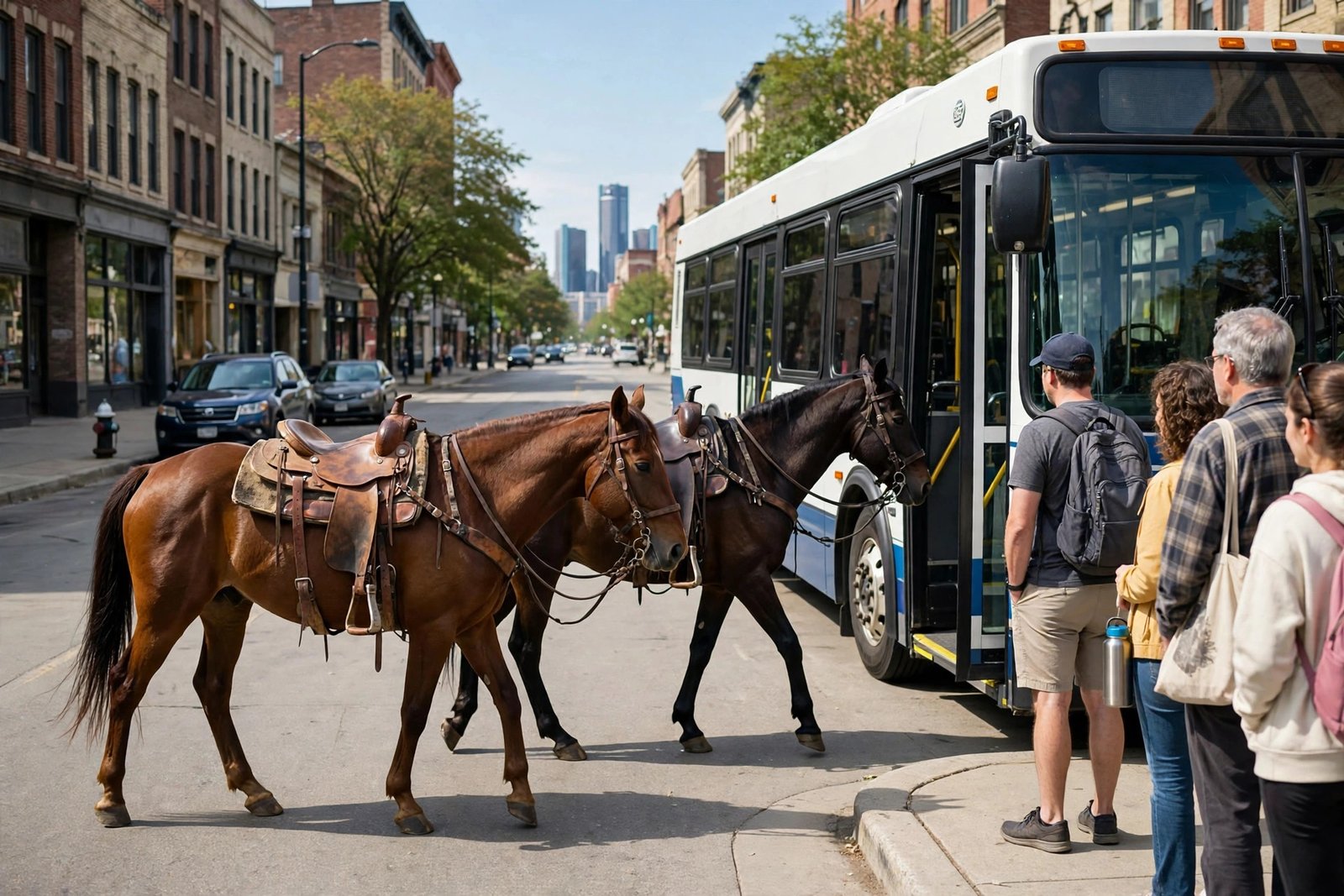
It starts like any other Saturday evening on Detroit’s east side. A bus pulls up to a stop on Seven Mile Road. The doors open. And then, in full view of a driver, a handful of passengers, and a woman filming from her car, two saddled horses walk calmly aboard a city bus — one after the other, as if they have done it a hundred times before. They amble down the aisle, turn around, and step off through the rear doors a few seconds later. The whole thing lasts less than a minute. Within a day, it was one of the most talked-about videos in America.
The clip, filmed on Saturday, November 7, 2026, near Seven Mile East and Strasburg Street, has now been viewed by millions of people across TikTok, X, and the news. The city of Detroit has confirmed it is real. The transit agency has launched an investigation and announced plans to retrain its bus operators. And the man who led the horses aboard says it was not even the first time he has taken them onto a bus. Here is what actually happened, who was involved, and why a thirty-second stroll through a city bus became a national moment.
What the Video Actually Shows
The footage, filmed by a Detroit driver named Ellessia Drew from her car as she passed the bus stop, is disarmingly ordinary in its first seconds. A Detroit Department of Transportation bus — a DDOT bus — sits at a stop on Seven Mile East. Two men stand beside it with two saddled horses. Then the front doors open, and the men lead the horses up the steps and inside.
Inside the bus, the horses walk down the aisle past the seats. The bus appears nearly empty. The automated announcement system, triggered as the doors close, can be heard saying “Welcome aboard” — a detail that quickly became a favorite of everyone sharing the clip. After a few seconds, the men guide the horses toward the rear doors and lead them back out onto the street. Nobody panics. Nobody runs. The horses, for their part, look entirely unbothered, as if boarding a city bus were just another part of the evening.
A second angle later emerged when the city released onboard surveillance footage from the bus itself. That footage shows the bus arriving at the stop where the two men were waiting with the horses, the driver lowering the wheelchair ramp to help the animals board, and the horses walking through the cabin before exiting at the rear. The surveillance video confirmed what the bystander clip suggested: this was not a trick of editing or a staged film set. It happened on a real bus, on a real route, in the middle of a real Saturday.
The Man Behind the Horses
The man who led the horses onto the bus is Jordan Williams, co-founder of a group called the Urban City Cowboys. Williams was in Detroit that weekend for a charity event, giving children rides on horses as part of a fundraiser. After the event, he and a friend were riding near Seven Mile Road with the two horses when they spotted a DDOT bus stopped nearby — and, as Williams later told local reporters, they saw a viral video opportunity and decided to ask the driver if the horses could come aboard.
Williams is no stranger to horses, or to the spotlight. The Urban City Cowboys is a Western rodeo school outside Detroit, and the group also offers equestrian therapy to children with disabilities. According to reporting on the incident, Williams works with twelve horses in the program, and one of the two horses on the bus — a horse named Raven — was visiting the big city for the first time. Williams has said the stunt was meant to be lighthearted, and he has been open about the fact that he has taken horses onto Detroit buses before, telling reporters it was not the first time.
That history matters, because it changes the story from a random prank into something more characteristic of Williams himself: a man who has built a public identity around bringing horses into unexpected urban places. The bus video was, in his telling, an extension of the same showmanship that draws crowds to his charity rides — a way to get people smiling, and to get the Urban City Cowboys noticed.
The Driver and the “Service Animal” Joke
The most replayed moment in the footage is not the horses themselves. It is the driver. According to the onboard audio, the driver asked Williams and his friend if they wanted to board, and when the question of how two large animals would get up the steps came up, the driver reportedly said, “If they can get in here, it is what it is.” He then lowered the wheelchair ramp so the horses could walk aboard more easily.
At one point, the driver can be heard mentioning something about the horses being service animals, and Williams responded with a joking remark. The exchange was clearly lighthearted in the moment — the driver sounded amused rather than alarmed — but it became the center of the official response, because the service-animal question is the only way a horse could plausibly be allowed on a bus at all.
Under DDOT policy, only trained service animals are allowed on buses. Federal rules define service animals narrowly: they are animals individually trained to do work or perform tasks for a person with a disability, and in practice that means dogs and, in limited circumstances, miniature horses that meet specific criteria. A full-sized saddled horse being led aboard for a video does not qualify, and the city has been clear about that. As one account of the city’s response put it, a saddled horse is neither a dog nor a miniature horse nor a service animal, and the incident is being treated as a violation of the rules on using the bus.
The City Responds: Real, Investigated, and Retrained
The video spread online within a day, and by Monday the city was responding. Alexis Ware, deputy director of media relations for the mayor’s office, confirmed the footage was genuine, saying, “The video is real. DDOT located the driver.” An investigation was launched, with details promised by the following Thursday. DDOT issued a statement saying it was “taking appropriate steps to address this incident as it is not consistent with DDOT policy and potentially creates an unsafe and uncomfortable ride for our passengers.”
The follow-up came quickly. DDOT said it plans to retrain all of its bus operators following the incident, and the department confirmed that the driver involved had been spoken to. The agency said it intends to use the incident as a case study for mandatory retraining of its bus operators, and to educate the public on safety protocols. As of the latest reports, the department has not publicly disclosed specific disciplinary measures against the individual driver, and the investigation’s full findings were still to come.
Local television station WXYZ Detroit covered the story closely, interviewing Williams and reporting the city’s response, and national outlets picked it up from there. CBS News shared the bystander video on X, where it spread well beyond Michigan. Parade magazine, Jalopnik, and other national publications covered it, each marveling at the same details: the calm horses, the amused driver, and the automated “Welcome aboard.” You can read Parade’s account of the video and Jalopnik’s detailed breakdown of the onboard audio for a fuller picture of how the story unfolded.
Why This Video Went So Viral
Animal videos go viral every day. A video of two horses boarding a city bus went further than most, and the reasons say something about what Americans actually share. The first is surprise. A horse is one of the largest animals most people ever encounter, and a city bus is one of the most ordinary places in American life. Putting the two together breaks a rule everyone understands without thinking: horses belong on trails and in fields, buses belong to commuters. The collision of the two worlds is funny precisely because it is so plainly wrong.
The second is how calm everyone is. There is no screaming, no chaos, no chase. The horses walk on, walk through, and walk off, and the driver treats it like a slightly unusual fare. That calm is what makes the clip endlessly rewatchable: it feels less like a stunt and more like a glimpse into an alternate world where this is simply how Saturdays work in Detroit. The automated “Welcome aboard” announcement is the perfect punchline, delivered by a machine that has no idea what has just boarded.
The third is the local pride baked into it. Detroit has a complicated relationship with the national spotlight, and a story this joyful — no crime, no disaster, no politics, just horses on a bus — gave the city a moment of pure, uncomplicated delight. People shared it not only because it was funny, but because it felt like Detroit being Detroit: a little unpredictable, a little defiant, and entirely unbothered by what anyone else thinks.
Why Animal-on-Transit Moments Keep Going Viral in America
The Detroit horses are the latest in a long American tradition of animals showing up where they do not belong — and cameras being there to catch it. Transit, in particular, seems to attract these moments. Buses, subways, and trains are shared spaces with unwritten rules, and an animal breaks every one of them at once. The surprise is instant, the scene is easy to film, and the video needs no explanation. You do not need context to understand a horse on a bus. You just need eyes.
There is also a deeper reason these clips travel so well. Public transit is one of the few places where strangers still share a small space every day, and an animal turns that anonymous crowd into a community, if only for a minute. Everyone on the bus becomes part of the same story. Everyone filming becomes a witness. The video works because it captures that rare feeling of strangers sharing something genuinely unexpected together.
And in an online landscape dominated by outrage and argument, an animal doing something harmless and strange is a safe thing to share. It asks nothing of the viewer. It offends no one. It is the rare viral moment that makes people laugh without making anyone a villain — even if, in this case, the transit agency did have to step in afterward and remind everyone that the rules exist for a reason. The Mary Sue’s explainer captures the amused tone of much of the coverage, while this report on the retraining plan covers the official response.
What Happens Next
For DDOT, the incident is now a training case. The agency has said it will retrain all of its bus operators, using the horses-on-a-bus episode as an example of what not to allow, and it has promised to educate the public on safety rules. The driver involved has been spoken to, and the investigation that began the Monday after the incident was expected to wrap up within days. Coverage of the investigation notes that the department has taken the matter seriously even while acknowledging that nobody was hurt.
For Williams and the Urban City Cowboys, the video is likely to bring more attention to the group’s charity work, including its horseback rides for children and its equestrian therapy programs. Williams has not hidden from the attention — he has spoken openly to local media about the stunt and about his group’s work. Whether the extra attention translates into donations or new riders remains to be seen, but the group is now known far beyond Detroit.
And for the rest of us, the video will live on as one of those clips that resurfaces every few months, passed from group chat to group chat, always with the same reaction: wait, did that really happen? In Detroit, on a Saturday in November 2026, it did. Two horses boarded a city bus, walked the aisle, and stepped off into the evening — and a city, and then a country, could not look away. A syndicated report on the incident, carried by ABC News, is summarized in this account of the transit investigation.
Frequently Asked Questions
When did the two horses board the Detroit bus?
The incident happened on Saturday, November 7, 2026, on Seven Mile East near Strasburg Street in Detroit. The video spread online within a day, and the city confirmed it was real the following Monday.
Who filmed the viral video?
The bystander video was filmed by Ellessia Drew, who was driving along Seven Mile when she saw the horses and the bus at the stop and recorded the scene from her car. The city later released onboard surveillance footage from the bus as well.
Who owns the horses?
The horses belong to Jordan Williams, co-founder of the Urban City Cowboys, a Western rodeo school and equestrian therapy group. Williams was in Detroit for a charity event giving children horseback rides. One of the horses, Raven, was visiting the big city for the first time.
Are horses allowed on Detroit buses?
No. Under DDOT policy, only trained service animals are allowed on buses. The city has said the incident was not consistent with its policy and could create an unsafe and uncomfortable ride for passengers. A saddled horse does not qualify as a service animal.
What happened to the bus driver?
DDOT said it located the driver and spoke to him, and that it plans to retrain all of its bus operators, using the incident as a case study. The department has not publicly disclosed specific disciplinary measures against the individual driver.
Related reading
Love a good viral moment? Read how the Labubu craze took over America, check out the Elf on the Shelf tradition that goes viral every year, and see how the Interstate Highway System was built.