
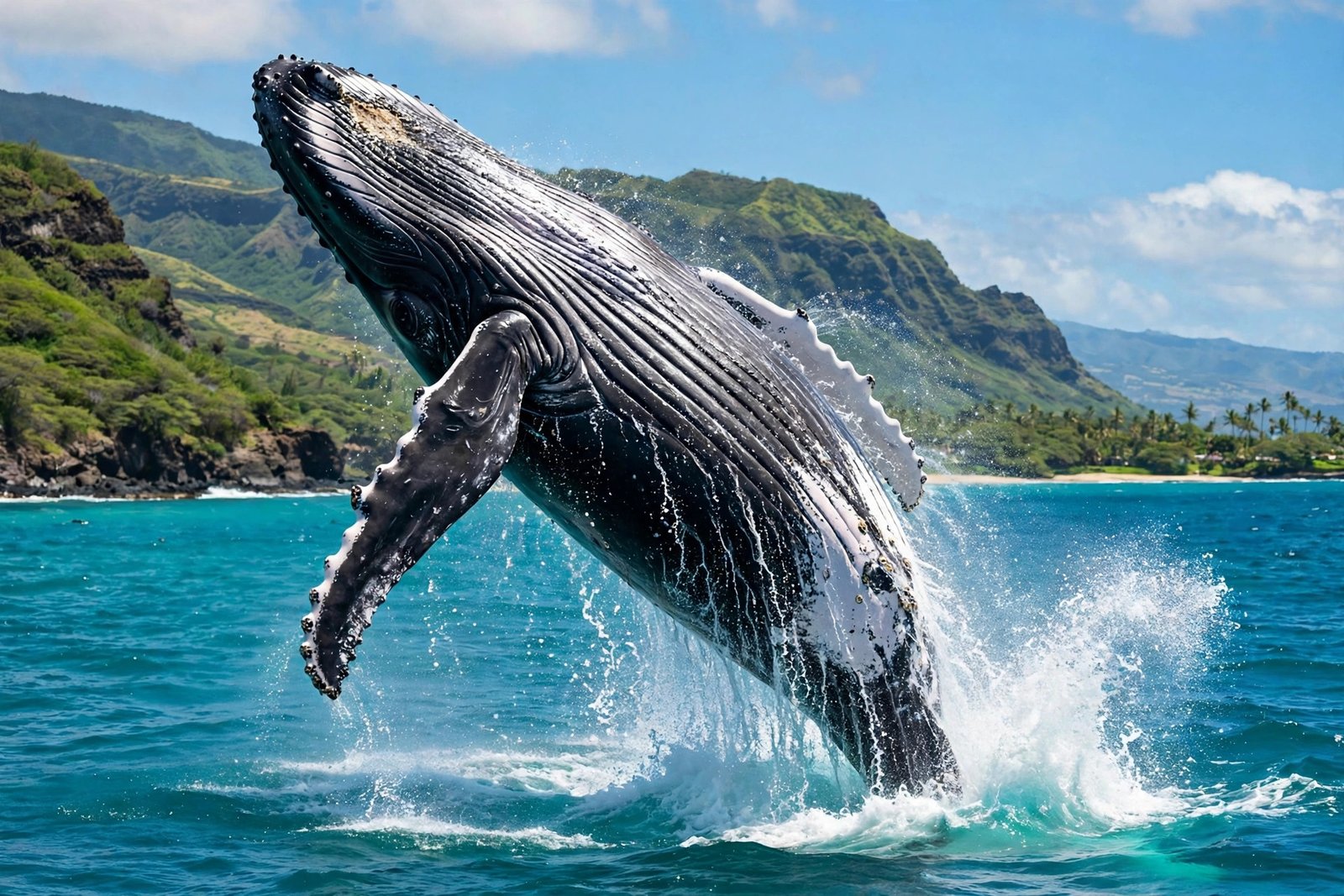
Every winter, one of the great wildlife migrations on Earth ends in the warm, shallow waters off Hawaii. Humpback whales, known in Hawaiian as kohola, travel thousands of miles from their cold feeding grounds off Alaska and Canada to the islands, where they mate, give birth, and nurse their calves before turning north again. For visitors, the result is a season unlike any other: from a beach, a coastal lookout, or the deck of a boat, you can watch a 40-ton animal breach clear of the water, slap the surface with a flipper longer than a car, or raise a newborn calf beside its mother. The season has a rhythm, though, and timing matters. Arrive too early or too late and you may see only a handful of whales; arrive in the heart of the season and the ocean seems to be full of them.
Why Humpbacks Come to Hawaii
Humpback whales are migratory by nature, dividing their year between cold, food-rich feeding grounds and warm, sheltered breeding grounds. In summer, the whales that winter in Hawaii feed in the nutrient-rich waters off Alaska and Canada, building up the blubber they will live on for months. In winter, they travel south to Hawaii, where the warm, shallow water is ideal for mating and calving but holds relatively little food. Mothers fast for much of the season, living off stored fat while nursing a calf that must grow fast enough to survive the long journey north in spring.
NOAA Fisheries notes that more than half of the humpback whales in the North Pacific seasonally use the waters around the Hawaiian Islands as their principal breeding and calving ground. That makes Hawaii not just a good place to see humpbacks, but the single most important wintering area for this population. The Hawaiian name kohola carries cultural weight as well: in Hawaiian tradition, whales are respected as family and as guardians of the ocean, and that respect is reflected today in the strict rules that govern how close people may approach them.
When Is Humpback Whale Season in Hawaii?
According to NOAA’s sanctuary guidance, humpback whales are generally in Hawaiian waters from November through May, with the peak from January through March. The sanctuary’s own overview describes whales as visible from shore and at sea from November through April, so the two descriptions differ slightly on the spring edge of the season. The practical message is the same either way: November and May are shoulder months, when sightings are possible but should not be counted on, while January, February, and March are the months to build a trip around.
Within that peak, February is often described as the busiest month, and for good reason. By February, most of the whales that will winter in Hawaii have arrived, mothers with calves are common, and males are actively competing for mates, producing the surface displays — breaches, tail throws, and pectoral slaps — that visitors hope to see. By late March, numbers begin to thin as the earliest whales start heading north, and by late April sightings become rare, though a few stragglers may linger into May. If your dates are flexible, aim for mid-January through mid-March. If you are locked into November or early December, treat a sighting as a wonderful bonus rather than a promise, and plan the rest of your Hawaii trip so it is rewarding with or without whales.
The Best Places to See Humpbacks: Maui
If you can only visit one island for whales, choose Maui. Most of the humpbacks that winter in Hawaii gather in the shallow, sheltered Auau Channel, the stretch of ocean between Maui, Lanai, and Molokai, which is widely regarded as one of the world’s great humpback nurseries. Maui’s west and south coasts face directly onto this channel, and boat tours depart from Maalaea Harbor, Lahaina Harbor, Kihei, and Kaanapali into waters where mothers and calves are concentrated. Maalaea Harbor is the closest launch point to the channel itself, while Lahaina offers a historic waterfront departure with views of the West Maui Mountains.
Shore watching on Maui is unusually good, because the whales come close to land. Papawai Point, also known as McGregor Point Lookout, west of Maalaea, is often cited as the best land-based viewing spot on the island, with sweeping views over Maalaea Bay. The scenic pullouts along Honoapiilani Highway between Maalaea and Olowalu offer similar panoramic views, and the beaches of Kaanapali, Lahaina, and Kihei all produce regular sightings in peak season. The sanctuary’s visitor center in Kihei is also worth a stop: it combines exhibits on whale behavior and conservation with shoreline viewing, and its staff can tell you what has been seen recently.
Boat Tours, Shore Watching, and What to Expect
A guided boat tour is the most reliable way to see whales, because the crew knows where whales were seen yesterday, how to read the water, and how to position the boat legally. Most tours last one to three hours, and many operators provide a naturalist guide who explains what you are seeing — the difference between a breach, a tail slap, and a pectoral slap, or why a male is singing, a haunting sound that can travel for miles underwater and is thought to play a role in mating. Some tours lower a hydrophone into the water so passengers can hear whale song directly, which is an experience that stays with people long after the boat docks.
Shore watching is free, flexible, and surprisingly effective in peak season, especially on Maui. Bring binoculars, a hat, sunscreen, and water, and settle in at a lookout for at least an hour rather than glancing at the ocean for five minutes. Look first for a spout — the misty exhalation when a whale surfaces to breathe — and then watch that spot, because the whale will usually surface again nearby. A breach, when a whale launches much of its body out of the water, is unmistakable, but subtler signs matter too: a tail fluke raised before a deep dive, a flipper slapping the surface repeatedly, or a series of small, circular slicks on the water where a whale has just passed.
The Rules: The 100-Yard Law and How to Watch Responsibly
This is the most important section in this guide, because the rules are not suggestions — they are federal law. Under the Marine Mammal Protection Act and sanctuary regulations, it is illegal to approach a humpback whale within 100 yards (about 90 meters, or roughly the length of a football field) by any means in Hawaiian waters. That means by boat, kayak, paddleboard, canoe, surfboard, drone, or while swimming. Aircraft must stay at least 1,000 feet above humpback whales. The rule applies year-round, everywhere in Hawaiian waters and out to 200 nautical miles, and it applies whether you are a tourist, a local boater, or a professional photographer.
If a whale approaches you — and in peak season, a curious calf or a resting mother may do exactly that — do not pursue it, do not reposition to stay close, and do not try to touch it. NOAA’s guidance is to stay calm, put boat engines in neutral if you are on a vessel, and wait for the whale to move away on its own. The same principle applies to other protected species you may meet: keep at least 50 yards from dolphins and 10 feet from sea turtles, and never touch, handle, or attempt to ride any marine animal. Touching wildlife can injure the animal, put you at risk, and break the law.
Boaters have additional responsibilities during whale season, which NOAA and the sanctuary describe as generally running from November through May. In water 600 feet deep or less, boaters are asked to keep their speed to 15 knots or less, and to slow to six knots or less within 400 yards when approaching or departing a whale-viewing area. These speed limits reduce the risk of a vessel strike, which is one of the most serious threats to humpbacks. If you see an entangled whale, an injured animal, or someone harassing wildlife, you can report it to the NOAA Fisheries hotline at 888-256-9840, or report a violation to the NOAA Fisheries Enforcement Hotline at 800-853-1964. Responsible watching is not a burden on the experience — it is what keeps the experience possible, year after year, for the whales and for the people who come to see them.
Conservation: A Recovery Story With Work Still to Do
Humpback whales were once hunted commercially to the edge of collapse, and their recovery is one of the genuine conservation success stories of the past half-century. In 2016, NOAA revised the Endangered Species Act listing for humpback whales, splitting the species into 14 distinct population segments. Nine of those segments, including the Hawaii segment that breeds in Hawaii and feeds in Alaska, were found not to warrant listing as threatened or endangered. At the time, NOAA estimated the Hawaii group at about 11,398 animals, increasing at a rate of roughly 5.5 to 6 percent. That delisting was not the end of protection: humpbacks remain protected under the Marine Mammal Protection Act, and the 100-yard approach rule in Hawaii remains in force.
The recovery is not a finished story, and recent research gives reason for continued attention. A study cited in recent whale guides estimated about 18,700 humpbacks wintering in Hawaii in 2013 and about 12,300 in 2021, a decline that followed the 2014 to 2016 marine heatwave. Those figures come from a research estimate, not an official census, and scientists continue to study how ocean conditions, food availability, and climate change affect the population. Entanglement in fishing gear and vessel strikes remain the most direct human threats, which is why the sanctuary runs a disentanglement network and why boat speed and distance rules matter so much. The sanctuary’s Ocean Count program, which has engaged volunteers in shore-based whale counts since 1996, also shows how ordinary people can contribute: counting whales from shore, season after season, builds the long-term data scientists need to spot trends.
Planning Your Trip: A Practical Checklist
Start with the calendar. Book for January through March if whales are the main reason for the trip, and book boat tours early, because peak-season departures from Maalaea and Lahaina fill quickly. If you are traveling in November, December, or April, keep your expectations flexible and build the trip around Hawaii’s many other attractions — beaches, volcanoes, food, and culture — so that a whale sighting is a highlight rather than a make-or-break moment. Check the sanctuary’s current guidance before you travel, because season details, harbor operations, and visitor-center hours can change from year to year.
Finally, let the whales set the pace. The most memorable encounters are rarely the ones you chase. They are the quiet moments: a spout on the horizon at sunrise, a mother and calf surfacing together just beyond the legal distance, a tail fluke rising slowly before a deep dive. Give yourself time, keep your distance, and listen — to the naturalist on your boat, to the sanctuary staff at the visitor center, and, if you are lucky, to the song of a humpback rising through the water beneath you. For official season and viewing information, see the Hawaiian Islands Humpback Whale National Marine Sanctuary, NOAA’s marine life viewing guidelines, the sanctuary’s regulations page, and Hawaii’s Department of Land and Natural Resources guidance on protected marine species.
Frequently Asked Questions
When is the best time to see humpback whales in Hawaii?
NOAA guidance describes the season as generally November through May, with the peak from January through March. February is often the busiest month. November and May are shoulder months when sightings are possible but not reliable, and sightings are very unlikely from June through October.
Which Hawaiian island is best for whale watching?
Maui is generally considered the best island, because most wintering humpbacks gather in the shallow Auau Channel between Maui, Lanai, and Molokai. Maalaea Harbor is the closest launch point to the channel, and Papawai Point near Maalaea is a top shore-watching spot. The Big Island, Oahu, and Kauai also offer good seasonal viewing.
How close can I get to a humpback whale in Hawaii?
Federal law prohibits approaching a humpback whale within 100 yards by any means — boat, kayak, paddleboard, drone, or swimming — and aircraft must stay at least 1,000 feet above whales. If a whale approaches you, stay calm, do not pursue it, and let it move away. The rule applies year-round in Hawaiian waters.
Can I see whales from shore, or do I need a boat tour?
Both work. Shore watching from Maui lookouts such as Papawai Point is free and effective in peak season, especially in the morning when the ocean is calm. A guided boat tour gets you into the channel with a naturalist guide and is the most reliable way to see whales, but no operator can guarantee a sighting.
Are humpback whales in Hawaii endangered?
The Hawaii distinct population segment was removed from the Endangered Species Act list in NOAA’s 2016 revision, which found it did not warrant listing as threatened or endangered. Humpbacks remain protected under the Marine Mammal Protection Act, and threats such as entanglement, vessel strikes, and changing ocean conditions mean conservation work continues.
Related reading
If you enjoyed this article, you may also like: Gray Whale Migration: California Watching Guide Florida Manatee Season Guide California Condor Comeback: 607 Birds.