
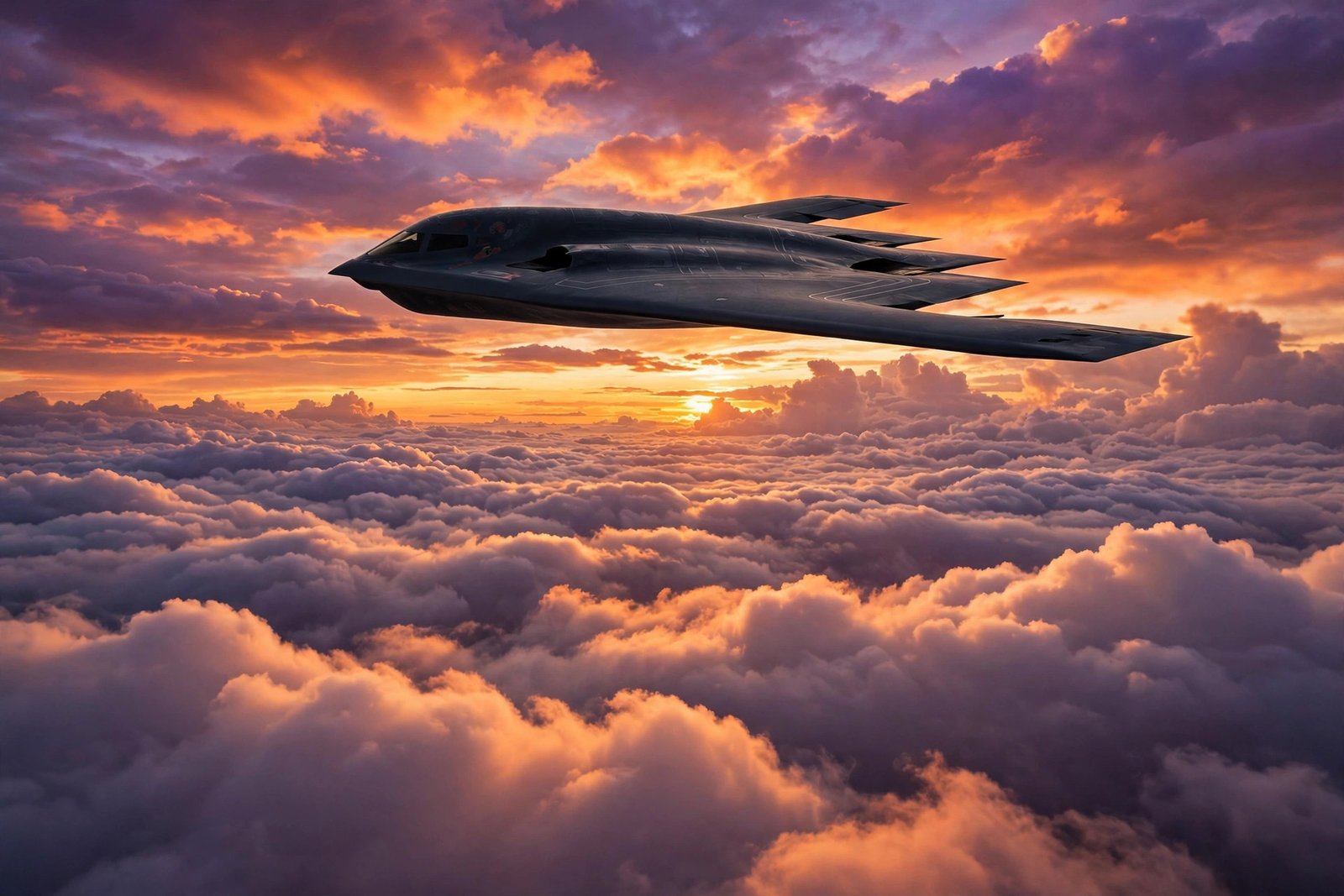
On a quiet Friday morning in November 2023, a strange gray flying wing lifted off a runway in the California desert and slipped into the sky. A few dozen witnesses watched from the edge of Air Force Plant 42 in Palmdale, and within hours, photos and video of the aircraft were racing around the world. It was the first flight of the B-21 Raider, the newest bomber built for the United States Air Force and the first new American bomber to take flight in more than three decades.
The B-21 matters because long-range bombers are the most visible arm of American air power. They can cross oceans, reach any target on the planet, and return home — and they are a central pillar of the nuclear deterrent that has kept great-power war at bay for generations. The Raider is the Air Force’s bet on what that mission looks like for the next half-century.
Yet much about the B-21 remains classified: its exact range, payload, and sensor suite are closely guarded secrets. What follows is what is publicly known and verified — the program’s history, its first flight, its bases, its testing milestones, and the role it is expected to play in keeping America safe.
What Is the B-21 Raider?
The B-21 Raider is a long-range, nuclear-capable, penetrating strike stealth bomber being built for the United States Air Force by Northrop Grumman. According to the U.S. Air Force fact sheet, its mission is to deliver both conventional and nuclear munitions, penetrating the most advanced air defenses to hold any target at risk anywhere in the world. It is designed to operate as part of a larger family of systems for long-range strike, including intelligence, surveillance and reconnaissance, electronic attack, and communications capabilities.
The aircraft is a flying wing, a shape with no fuselage or tail in the traditional sense. If you have seen a photo of the B-2 Spirit, the B-21 will look familiar: a smooth, dark, bat-like triangle. But the Raider is smaller and lighter than the B-2, and it carries a generation of stealth technology learned from decades of operating the B-2 and the F-35. Northrop Grumman calls it the world’s first sixth-generation aircraft to reach the skies.
The B-21 grew out of the Air Force’s Long Range Strike Bomber program, which began in 2011. On October 27, 2015, the Air Force awarded the engineering and manufacturing development contract to Northrop Grumman, and development took place behind closed doors at the company’s Palmdale, California, facility — the same plant where the B-2 was built in the 1980s and 1990s.
The Name: Honoring the Doolittle Raiders
The name “Raider” honors the Doolittle Raiders, the 80 U.S. Army Air Force airmen who, led by Lt. Col. James “Jimmy” Doolittle, flew 16 B-25 Mitchell medium bombers off the deck of the aircraft carrier USS Hornet on April 18, 1942, to strike Japan in the months after Pearl Harbor. The raid did little physical damage, but its effect was enormous: it forced Japan to recall combat forces for home defense and boosted morale among Americans and their allies at one of the darkest moments of the war.
The Air Force says the designation B-21 recognizes the Raider as the first bomber of the 21st century. It is a fitting lineage. The original Raiders flew a mission that seemed impossible, in aircraft never designed for carrier takeoffs, against an enemy that believed itself untouchable. The B-21 is meant to carry that same spirit into an era of advanced air defenses and long-range missiles: an aircraft built to go where others cannot and to return.
When the Air Force unveiled the B-21 to the public on December 2, 2022, at a ceremony in Palmdale, Secretary of Defense Lloyd J. Austin called it “the first strategic bomber in more than three decades.” It was the first new bomber introduced since the end of the Cold War.
First Flight: November 10, 2023
Nearly a year after the public unveiling, the B-21 took to the air for the first time on November 10, 2023. The aircraft flew from Air Force Plant 42 in Palmdale to Edwards Air Force Base, where the Air Force’s flight test program is based. An Air Force spokeswoman confirmed to Military.com that day that the B-21 had begun flight testing, and images of the aircraft taxiing and climbing into the sky quickly spread online.
The first flight was a milestone, but it was only the beginning of a long test campaign. Each flight builds on the last: expanding the speed and altitude envelope, testing the aircraft’s handling, and eventually releasing weapons. By September 2024, two more B-21 test aircraft were in ground testing, and a second B-21 took flight about a year after the first.
The test program is managed by the Air Force Test Center and the 412th Test Wing’s B-21 Combined Test Force at Edwards Air Force Base, with Northrop Grumman personnel working alongside Air Force test pilots and engineers. In 2026 the pace of public milestones quickened noticeably — a sign that the aircraft is moving from basic flight testing into the harder work of proving it can fight.
Sixth-Generation Stealth: What Makes It Different
Calling the B-21 a “sixth-generation” aircraft is not just marketing. Generations of fighter and bomber design are defined by the capabilities that matter most in their era. Fifth-generation aircraft like the F-35 combined stealth with sensor fusion — the ability to gather information from many sources and present it to the pilot as a single picture. The B-21 builds on that foundation with what Northrop Grumman describes as next-generation stealth, advanced networking, and an open systems architecture.
Open systems architecture is one of the most important design choices in the program. In older aircraft, new sensors, weapons, and software were often difficult and expensive to add because the jet’s systems were tightly woven together. The B-21 was designed from the start so that new capabilities can be plugged in as technology matures, without rebuilding the aircraft — so the B-21 flying in 2040 may carry sensors and weapons that do not exist today.
The stealth itself is also a step forward. Northrop Grumman says the B-21’s advanced low-observable design allows it to penetrate the most sophisticated air defenses and operate undetected in contested environments. The Air Force is careful about what it says publicly, but the intent is clear: the B-21 is designed for a world where advanced radar networks and long-range surface-to-air missiles make old approaches to bombing far more dangerous than they were a generation ago.
Replacing the B-1 and the B-2
The B-21 is designed to gradually replace the Air Force’s aging B-1 Lancer and B-2 Spirit bombers. The B-1, a supersonic bomber that first entered service in the 1980s, has flown hard for decades and is increasingly expensive to maintain. The B-2, the world’s first stealth bomber, remains formidable, but only 21 were ever built, and the fleet is small, aging, and costly to keep flying. The B-52 Stratofortress, which first flew in the 1950s, will keep flying alongside the B-21 — the Air Force expects the B-52 to continue operating through 2050 — but the B-1 and B-2 will retire as enough Raiders arrive to take their place.
How many B-21s will there be? The Air Force’s official fact sheet lists the inventory as a minimum of 100 aircraft. Air Force leaders have said the fleet could grow larger, and studies have suggested figures as high as 145 aircraft, but 100 remains the plan of record. That number matters: a fleet of at least 100 bombers would roughly double the number of nuclear-capable bombers the United States can put in the air, and it would give the Air Force the depth to sustain operations over weeks or months rather than days.
Cost is always part of the conversation with a program this size. The Air Force has set an average procurement unit cost requirement of $692 million per aircraft in base-year 2022 dollars. The program has been held up as a model of cost discipline, in part because the Air Force directed Northrop Grumman to use mature technology and existing production tooling rather than chasing unproven ideas.
Where the B-21 Will Be Based
When the B-21 enters service, its first home will be Ellsworth Air Force Base in South Dakota. The Air Force announced Ellsworth as the first B-21 main operating base and the location of the formal training unit in 2021, after completing the strategic basing process and an environmental impact statement. Whiteman Air Force Base in Missouri and Dyess Air Force Base in Texas are the preferred locations for the remaining main operating bases, and they will receive aircraft as they become available.
Ellsworth was chosen because it has the space and existing facilities to handle the new bomber’s missions with minimal disruption. The base already hosts the B-1, and Whiteman is the current home of the B-2, so all three bases bring decades of bomber experience to the transition.
The first B-21 aircraft is on track to arrive at Ellsworth in 2027, according to Northrop Grumman, and the Air Force has said the aircraft is expected to enter service in the mid-2020s. Test aircraft at Edwards Air Force Base will keep flying even as the first operational jets arrive in South Dakota, and the formal training unit at Ellsworth will begin teaching the first generation of B-21 pilots, maintainers, and weapons officers.
Testing Milestones in 2026
The year 2026 has brought the B-21 program into sharper public focus. In April 2026, the Air Force released photographs confirming that the B-21 had been refueled in flight by a KC-135 tanker — a capability that extends the bomber’s already long reach and lets it stay airborne far longer on a single mission. Aerial refueling is a quiet but essential part of global strike: it is what allows a bomber based in the American heartland to reach targets on the other side of the planet.
Then, on November 13, 2026 — just days before this article was written — Northrop Grumman announced that the B-21 had demonstrated weapons release capability. In a statement from Edwards Air Force Base, the company said the test marked a major step forward for America’s next-generation bomber, showing that the aircraft can carry and employ combat power. It is one thing for a new jet to fly well; it is another for it to prove it can do the job it was built for. Weapons release is the moment a test program stops being about the airplane and starts being about the weapon system.
The Air Force and Northrop Grumman have also moved to speed up production. In an agreement announced in 2026, the two sides agreed to expand production capacity using $4.5 billion in funding already authorized and appropriated under the fiscal year 2025 reconciliation legislation. The deal increases annual production capacity by 25 percent, compressing delivery timelines. Air Force Secretary Troy Meink said the B-21 is “foundational to our long-range strike capability and to credible deterrence,” and that accelerating production now ensures the Air Force can deliver operational capability to combat commanders faster.
The B-21 and American Deterrence
To understand why the B-21 matters, it helps to understand the nuclear triad — the three-part system that underpins American deterrence: land-based intercontinental ballistic missiles, submarine-launched ballistic missiles, and nuclear-capable bombers. Each leg has strengths the others lack: missiles are fast and always ready, submarines are nearly impossible to find, and bombers are visible, recallable, and flexible. A bomber can be sent to a region as a signal and called back if a crisis eases. Missiles cannot do any of that.
The B-21 is one of three major triad modernization efforts, alongside the LGM-35 Sentinel intercontinental ballistic missile and the Columbia-class submarine. Together, they represent the largest renewal of America’s nuclear forces since the Cold War. The B-21’s specific contribution is a survivable, penetrating bomber that can operate in the most contested environments — the kind of airspace where older bombers would struggle to survive.
What Comes Next
Between now and the first delivery to Ellsworth in 2027, the B-21’s test program will continue to expand: more flight hours, more weapons tests, and more work with the sensors and networks that make the aircraft a system rather than a single jet. The Air Force has been careful not to promise a specific date for the first operational mission, and that caution is warranted — flight test programs always find surprises, and the service would rather fix them on the ground at Edwards than discover them in service.
The B-21 Raider is not yet an operational weapon. It is a test aircraft becoming a fleet, a design becoming a deterrent. But its first flight, its steady testing progress, and the Air Force’s decision to accelerate production all point in the same direction: within a few short years, the flying wing that slipped into the California sky in November 2023 will be standing alert in South Dakota, carrying forward the name of 80 airmen who flew into history in 1942. To follow the program as it develops, the best sources are the Air Force fact sheet and Northrop Grumman’s B-21 page — they will tell you what is real, and keep you ahead of the rumors that fill the gaps.
Related reading
Want to learn more about American air power? Check out these stories from Famus News:
- F-35 Lightning II: America’s Fighter Jet Power
- US Air Force Power Explained
- Golden Dome Missile Defense USA Explained
Frequently Asked Questions
When did the B-21 Raider first fly?
The B-21 Raider made its first flight on November 10, 2023, flying from Air Force Plant 42 in Palmdale, California, to Edwards Air Force Base. An Air Force spokeswoman confirmed the same day that flight testing had begun.
How many B-21 bombers will the Air Force buy?
The Air Force plans to buy a minimum of 100 B-21 aircraft, according to its official fact sheet. Air Force studies have suggested the fleet could grow to as many as 145 aircraft, but 100 remains the plan of record.
What aircraft will the B-21 replace?
The B-21 will gradually replace the B-1 Lancer and the B-2 Spirit bombers. The B-52 Stratofortress will continue flying alongside the B-21 and is expected to remain in service through 2050.
Where will the first B-21 be based?
Ellsworth Air Force Base in South Dakota will be the first B-21 main operating base and the home of the formal training unit. Whiteman Air Force Base in Missouri and Dyess Air Force Base in Texas are the preferred locations for the remaining bases.
Why is it called the Raider?
The B-21 is named in honor of the Doolittle Raiders, the 80 airmen who bombed Japan on April 18, 1942, in the months after Pearl Harbor. The designation B-21 recognizes the aircraft as the first bomber of the 21st century.