
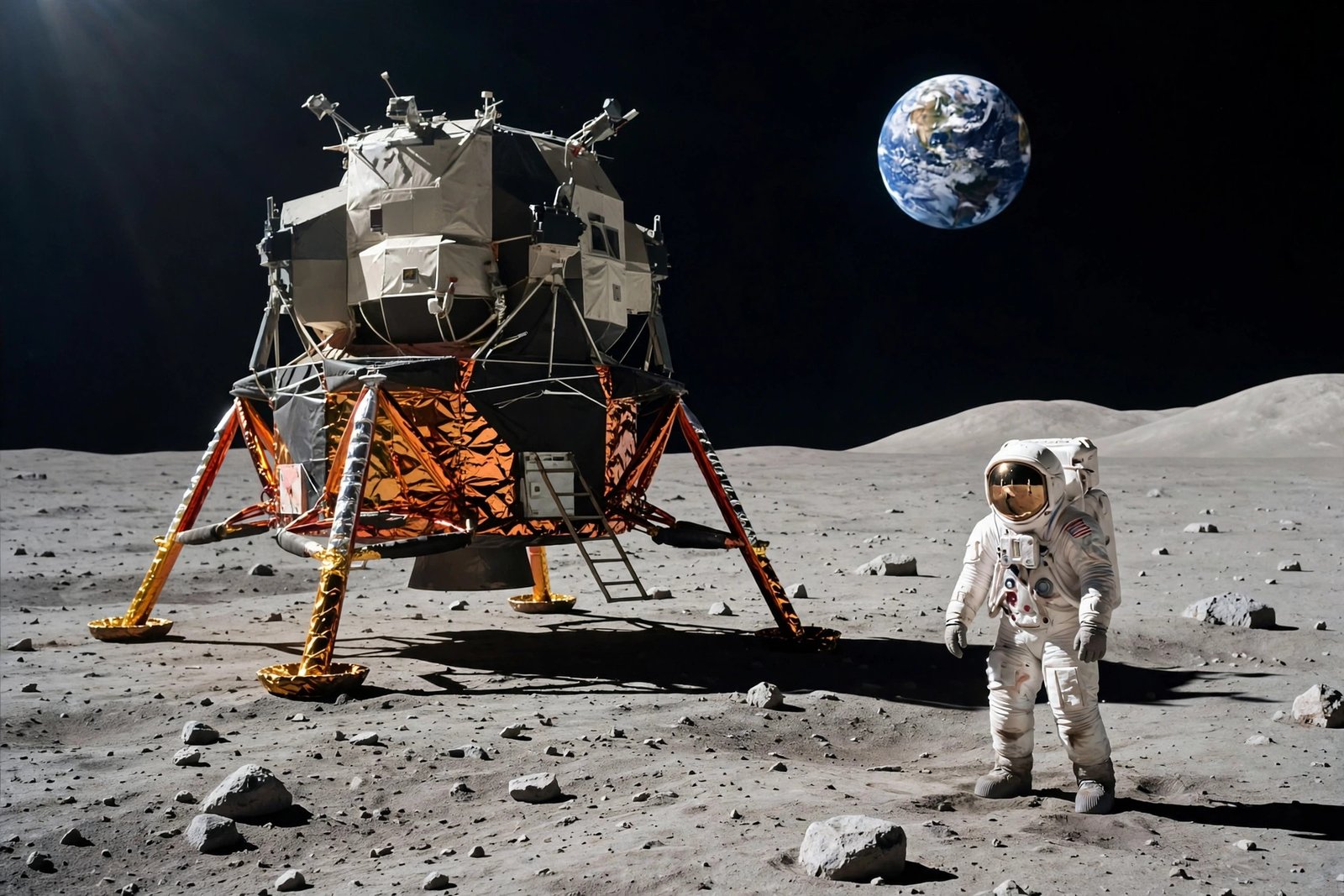
On a hot summer morning in July 1969, the whole world seemed to hold its breath. A rocket taller than a thirty-story building stood on a launch pad in Florida, and inside it sat three American astronauts about to attempt something no human being had ever done before: fly to the Moon, land on its surface, and come home alive. Eight days later, they had done exactly that, and the words spoken on the lunar surface became some of the most famous ever uttered. The story of Apollo 11 is not just a story about rockets and science. It is a story about a national promise, a fierce rivalry, and the moment humanity first stepped onto another world.
The Space Race: Why America Aimed at the Moon
Apollo 11 did not begin in 1969. It began more than a decade earlier, in the fear and excitement that followed the Soviet Union’s launch of Sputnik, the first artificial satellite, in 1957. For the first time, a human-made object was circling the Earth, and it had been put there by America’s Cold War rival. The Soviet Union followed that success with more firsts, including putting the first human in space in 1961. To many Americans, it felt as though the United States was falling behind in a contest that mattered far beyond science. Space had become a measure of national strength, and the Soviet Union was winning.
President John F. Kennedy answered that challenge with one of the boldest promises in American history. On May 25, 1961, in an address to Congress, he committed the nation to a goal that sounded almost impossible at the time: “before this decade is out, of landing a man on the Moon and returning him safely to the Earth.” It was a staggering pledge. When Kennedy spoke those words, NASA had only just sent its first American into space on a brief suborbital flight, and no one had ever flown to the Moon, orbited it, or landed on it. The spacecraft that would make the journey did not exist yet. The rockets powerful enough to carry it had not been built.
Yet the goal gave the entire American space program a single, clear purpose. As Britannica notes, Apollo 11 was the culmination of the Apollo program and a massive national commitment by the United States to beat the Soviet Union in putting people on the Moon. The program drew on technologies and experience developed through the earlier Mercury and Gemini programs, which taught NASA how to fly in space, rendezvous between spacecraft, and work outside a capsule. Apollo 8, flown in December 1968, had already carried the first crew around the Moon, proving that the journey was possible. Apollo 11 would be the mission that finished the job.
The Crew and the Machine
Three men flew Apollo 11, and each had a job that the mission could not succeed without. Commander Neil Armstrong, a civilian test pilot and Navy veteran, would command the mission and take the first step onto the Moon. Lunar module pilot Edwin “Buzz” Aldrin, an Air Force colonel with a doctorate in astronautics, would fly the lunar lander down to the surface alongside Armstrong. Command module pilot Michael Collins would remain alone in lunar orbit, flying the command module Columbia while his two crewmates explored the surface below. If anything went wrong on the Moon, Collins was the only person who could bring them home, and if the lander failed to return, he would have to fly home alone.
Their spacecraft was really three spacecraft in one. The command module, Columbia, housed all three astronauts and was the only part of the ship that would return to Earth. The service module provided propulsion, electrical power, oxygen, and water. The lunar module, Eagle, was a strange, spidery craft built only for the Moon. It had two stages: a descent stage with a large engine and fuel tanks for landing, and a lighter ascent stage containing a cabin for two astronauts and a small engine to lift them back to lunar orbit. The Eagle had never flown with a crew in lunar orbit before Apollo 11, and it would be abandoned in space after doing its job.
Carrying it all into space was the Saturn V, the most powerful rocket ever flown successfully at the time. According to Britannica, the Saturn V stood 111 metres (363 feet) high and weighed more than 6.6 million pounds at liftoff. Hundreds of thousands of spectators gathered near the launch site in Florida to watch it fly, and the whole world watched on television.
Launch Day: July 16, 1969
Apollo 11 launched from Kennedy Space Center in Florida on July 16, 1969, at 9:32 a.m. Eastern Daylight Time. NASA’s own mission record confirms the launch at 13:32 UTC, with the lunar landing to follow four days later. The Saturn V rose from Launch Complex 39A on a column of fire, and within minutes the crew was in orbit around the Earth. After a checkout of the spacecraft, the crew fired the third stage engine again for translunar injection, the maneuver that set their course for the Moon.
The journey took three days. During the long coast through space, the crew checked their spacecraft and watched the Earth shrink behind them as the Moon grew larger ahead. On July 19, they fired their engine to slow down and enter orbit around the Moon.
On the morning of July 20, Armstrong and Aldrin crawled from the command module through a connecting tunnel into the lunar module Eagle. Collins stayed behind in Columbia, and the two spacecraft separated. Armstrong and Aldrin were now on their own, flying a fragile craft toward a surface no human had ever touched. Collins, alone in lunar orbit, later wrote about the strange solitude of his position, circling the Moon while his crewmates descended below him, out of radio contact whenever they passed behind the far side.
The Landing: “The Eagle Has Landed”
The descent to the lunar surface was tense from the start. As Eagle dropped toward the Moon, its guidance computer began flashing alarms that flight controllers in Houston quickly decided could be ignored. Then Armstrong looked out the window and saw that the automatic landing system was steering Eagle toward a field of boulders around a large crater. With the spacecraft running low on fuel, he took manual control and flew it forward, searching for a smooth patch of ground.
At about 500 feet above the surface, Armstrong was flying the lunar module by hand, looking for a safe place to set down. In mission control, the callouts of remaining fuel grew more urgent. Finally, at 4:17 p.m. Eastern Daylight Time on July 20, 1969, the Eagle touched down in the Sea of Tranquility, a broad, flat lava plain chosen for its smooth terrain. Armstrong’s voice came over the radio with words that instantly entered history: “Houston, Tranquility Base here. The Eagle has landed.”
The landing had been closer than anyone wanted to admit. According to NASA’s mission timeline, the lunar module touched down with only about 25 seconds of fuel remaining. A little more delay, a slightly rockier landing zone, and Armstrong would have had to abort the landing and climb back to orbit. Instead, the Eagle stood safely on the Moon, and two men were about to walk where no human had ever walked.
One Small Step for Man
Armstrong and Aldrin spent several hours inside the lunar module preparing for their walk on the surface. Then, at 10:56 p.m. Eastern Daylight Time on July 20, Armstrong climbed down the ladder and stepped onto the lunar soil. His words were broadcast live around the world: “That’s one small step for [a] man, one giant leap for mankind.” In the excitement of the moment, he skipped the “a” in the statement he had prepared, but no one listening doubted what the moment meant. He immediately described the surface as fine and powdery and said there was no difficulty moving about.
Aldrin joined him on the surface about nineteen minutes later, and together they spent more than two hours outside the lunar module. They set up experiments, including a device to measure the composition of the solar wind reaching the Moon and a reflector that would let observatories on Earth bounce laser beams off the Moon to measure its distance precisely. They collected rock and soil samples, took photographs, and planted an American flag. The flag-raising was a moment of pure pride for the millions watching at home, but the astronauts had work to do, and they worked steadily through their checklist.
From launch on July 16 until the return splashdown on July 24, almost every major aspect of the flight was witnessed on television by hundreds of millions of people in nearly every part of the globe, as Britannica records. Families gathered around television sets, strangers watched through store windows, and for a few hours, a deeply divided world shared a single moment of wonder. The astronauts themselves could feel it. They knew that they carried the hopes of hundreds of millions of people with them.
All told, Armstrong and Aldrin spent 21 hours and 36 minutes on the lunar surface before lifting off to rejoin Collins in orbit. The moonwalk itself lasted just over two hours, but the achievement was measured in more than minutes: two human beings had stood on another world.
The Journey Home
On July 21, the ascent stage of the Eagle lifted off from the Moon, leaving the descent stage behind on the surface as a launch pad. Armstrong and Aldrin steered the little craft up to lunar orbit, where Collins was waiting in Columbia. The two spacecraft docked, the crew transferred the precious lunar samples and themselves into the command module, and the Eagle was cast off to drift in lunar orbit. The crew then fired their engine for the journey home, a three-day trip back to Earth.
On July 24, 1969, the command module separated from the service module and plunged into the Earth’s atmosphere, its heat shield glowing as it slowed from spaceflight speed. Parachutes opened, and Columbia splashed down in the Pacific Ocean at 12:50 p.m. Eastern Daylight Time. The mission had lasted eight days, from July 16 to July 24, and all three astronauts were safe. A recovery ship picked them up, and because no one knew what kinds of things might be living on the Moon, the crew was placed in quarantine as a precaution against any contamination by lunar microorganisms.
What Apollo 11 Changed
The scientific return from Apollo 11 was enormous. Across the whole Apollo program, astronauts brought back 842 pounds (382 kilograms) of lunar rocks and soil, greatly contributing to our understanding of the Moon’s composition and geological history. The laser reflector Armstrong and Aldrin left behind is still used to measure the distance between the Earth and the Moon.
Perhaps the deepest legacy was cultural. The photographs of the Earth hanging in the blackness of space changed how humanity saw itself, and the belief that great things are still possible owes something to those images. Apollo 11 showed that the future is not something that happens to us. It is something we can choose to build.
From Apollo to Artemis
Apollo 11 was not the end of the story. Five more Apollo missions landed astronauts on the Moon, and the last of them, Apollo 17, left the lunar surface in December 1972. Then, for more than half a century, no human traveled beyond low Earth orbit. The Moon waited, visited only by robotic spacecraft, while NASA turned its attention to the space shuttle, the International Space Station, and the Hubble Space Telescope.
Today, NASA’s Artemis program is working to return astronauts to the Moon. Artemis was established as the successor to Apollo, and its first mission, Artemis I, was an uncrewed test flight of the Space Launch System rocket and the Orion spacecraft that launched in November 2022. The program aims to land astronauts on the lunar surface and establish a lasting human presence there, using the Moon as a proving ground for a future mission to Mars.
Apollo 11 proved that a deadline, a dream, and a nation willing to work could put human footprints on another world. It remains the high-water mark of American exploration, and the challenge it answered still echoes today.
Related reading
If you enjoyed this look back at Apollo 11, keep exploring the stories of American flight and space exploration on Famus News:
- The Wright Brothers’ First Flight at Kitty Hawk
- NASA’s Artemis Moon Program: America’s Return to the Moon
- Voyager 1: The Spacecraft That Flew a Light-Day From Earth
Frequently Asked Questions
When did Apollo 11 land on the Moon?
Apollo 11 landed on the Moon on July 20, 1969, at 20:17 UTC, which was 4:17 p.m. Eastern Daylight Time. The lunar module Eagle touched down in the Sea of Tranquility, a flat lava plain chosen for its smooth terrain. Commander Neil Armstrong and lunar module pilot Buzz Aldrin were aboard, while command module pilot Michael Collins remained in lunar orbit aboard Columbia.
Who were the astronauts on Apollo 11?
The crew was Commander Neil Armstrong, Command Module Pilot Michael Collins, and Lunar Module Pilot Edwin “Buzz” Aldrin. Armstrong and Aldrin landed on the Moon and walked on its surface, while Collins flew the command module Columbia alone in lunar orbit. All three returned safely to Earth on July 24, 1969.
What did Neil Armstrong actually say when he stepped onto the Moon?
Armstrong said, “That’s one small step for [a] man, one giant leap for mankind.” He had prepared the line in advance but skipped the word “a” in the excitement of the moment. The words were broadcast live on television and heard by hundreds of millions of people around the world.
How long did Apollo 11 spend on the Moon?
Armstrong and Aldrin spent 21 hours and 36 minutes on the lunar surface, from touchdown on July 20 to liftoff on July 21. Their actual moonwalk outside the lunar module lasted more than two hours, during which they set up scientific experiments, collected rock samples, and planted the American flag.
What happened to the Apollo 11 spacecraft after the mission?
The command module Columbia, the only part of the spacecraft that returned to Earth, splashed down in the Pacific Ocean on July 24, 1969, and is now displayed at the Smithsonian National Air and Space Museum in Washington, D.C. The lunar module Eagle’s ascent stage was left in lunar orbit after the crew transferred to Columbia, and its descent stage still sits in the Sea of Tranquility on the Moon.
Sources: NASA Space Science Data Coordinated Archive, Apollo 11 mission summary; Britannica, Apollo 11; GovInfo, 50th Anniversary of the Man on the Moon; Apollo 11 mission overview.