
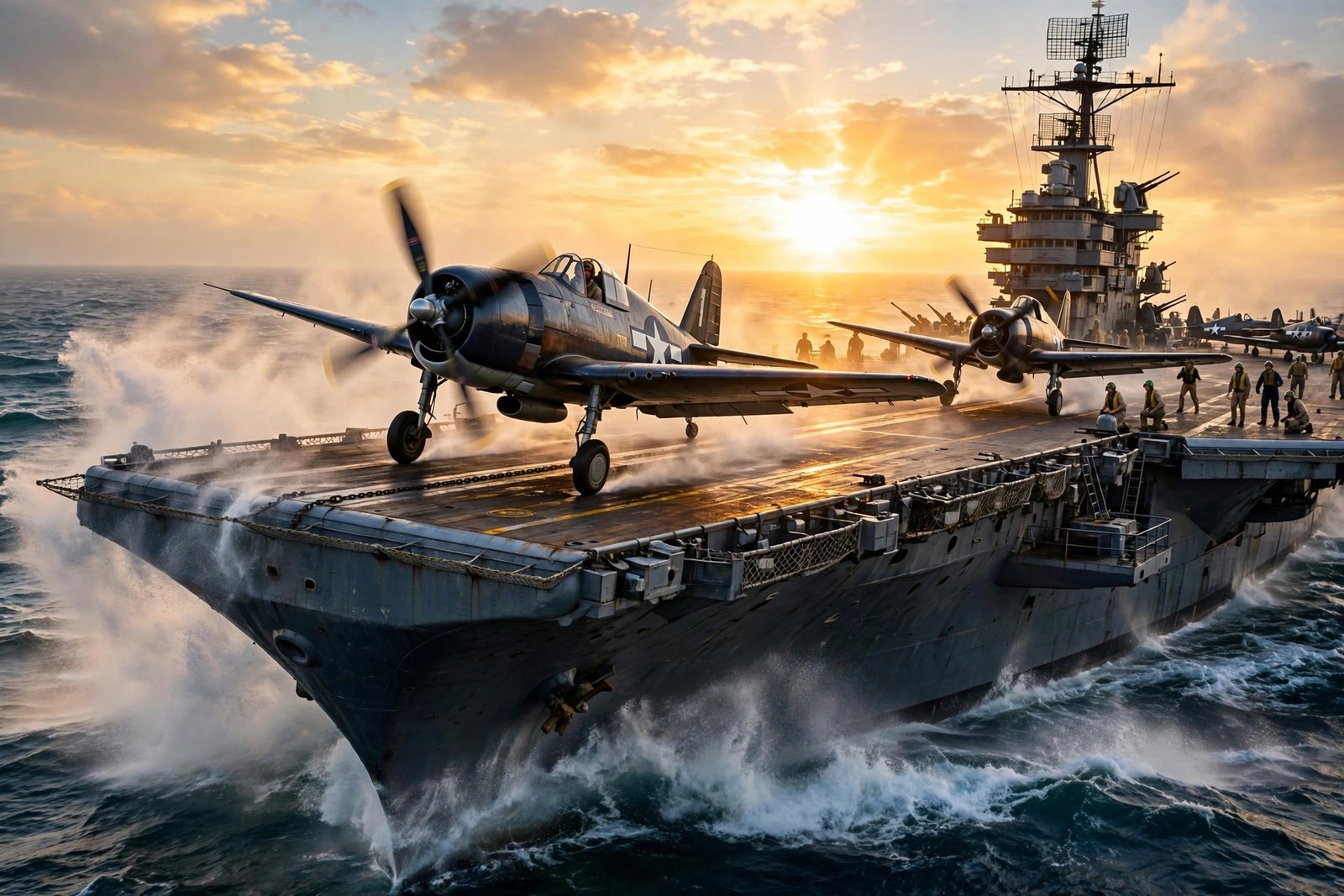
In the first six months of the Pacific War, the Imperial Japanese Navy seemed unstoppable. It had crippled the American fleet at Pearl Harbor, swept across Southeast Asia, and won battle after battle. American forces were outnumbered, on the defensive, and short of ships. Then, in three days in June 1942, everything changed. Off a tiny atoll in the middle of the Pacific Ocean, American carrier planes sank four Japanese aircraft carriers, the heart of Japan’s naval striking force, and the balance of power in the Pacific shifted for good. The Battle of Midway is remembered today as the turning point of the Pacific War, and it was won before the first bomb fell, in a basement full of codebreakers at Pearl Harbor.
This is the story of those three days: the secret intelligence that made the victory possible, the gamble taken by Admiral Chester Nimitz, the dive-bombers that found their targets at the perfect moment, and the price both sides paid. It is also the story of how a battle fought over a speck of land most Americans had never heard of decided the future of the Pacific.
After Pearl Harbor: A Navy on the Ropes
To understand Midway, you have to start six months earlier, on December 7, 1941, when Japanese carrier aircraft attacked the American naval base at Pearl Harbor in Hawaii. The attack sank or damaged much of the American battleship fleet, and the United States was suddenly at war with Japan. In the months that followed, Japanese forces seized the Philippines, Malaya, Singapore, and the Dutch East Indies, and their carriers ranged across the Pacific almost unchallenged.
The months that followed were grim for the Allies. Japanese forces seized the Philippines, Malaya, Singapore, and the Dutch East Indies. Their carriers ranged across the Pacific and the Indian Ocean almost unchallenged. The American Navy, by contrast, had only three operational aircraft carriers in the Pacific, and its commanders knew that losing even one of them could be fatal to the defense of Hawaii and the West Coast. Every decision carried enormous risk, and every mistake could mean disaster.
But the Japanese had a weakness they did not fully appreciate. Their commanders, led by Admiral Isoroku Yamamoto, the architect of the Pearl Harbor attack, believed the American carriers had to be destroyed to secure Japan’s new empire. Yamamoto planned a grand operation to lure the remaining American carriers into a decisive battle and sink them. The bait would be Midway Atoll, a tiny American outpost in the central Pacific, about 1,300 miles northwest of Hawaii. If Japan seized Midway, it would threaten Hawaii itself and force the American fleet to come out and fight. Yamamoto was confident his fleet would win that fight. He did not know that the Americans were reading his mail.
The Codebreakers of Station HYPO
The real first battle of Midway was fought in silence, in a windowless basement at Pearl Harbor. There, a small team of American intelligence analysts, linguists, and codebreakers worked around the clock under the code name Station HYPO. Their leader was Commander Joseph Rochefort, who had spent years studying Japanese naval communications. His team was charged with breaking JN-25, the Japanese Navy’s main operational code, and turning intercepted radio messages into useful intelligence.
Breaking JN-25 was painstaking work. The code used thousands of five-digit number groups, each standing for a word or phrase, and the numbers were further scrambled with an additive cipher. Before Pearl Harbor, the Americans could read only a small fraction of the messages. But by the spring of 1942, Rochefort’s team had made enough progress to read parts of Japanese traffic within hours of interception, and the picture that emerged was alarming: Japan was preparing a major operation against a target identified only by the code letters “AF.”
Rochefort and his staff were convinced that “AF” meant Midway. The evidence pointed that way: a Japanese weather plane had mentioned “AF” near the islands, and the scale of the operation matched an assault on Midway. But many officers in Washington disagreed. Some believed the target was Hawaii again, others the West Coast, and still others the Aleutian Islands. Admiral Chester Nimitz, commander of the Pacific Fleet, could not commit his last three carriers on a hunch. He needed proof, and Rochefort’s team devised a plan to get it.
The trick was beautifully simple. The Navy instructed the garrison on Midway to send a radio message in the clear, unencrypted, reporting that the island’s fresh-water evaporators had broken down and the base was running short of drinking water. If “AF” really was Midway, Japanese intelligence would pick up the message and report the water shortage in their own coded traffic. Two days later, an intercepted Japanese message reported that “AF” was running out of fresh drinking water. On May 22, 1942, the translation of that message confirmed it beyond doubt: “AF” was Midway. As the Navy’s own history of the episode explains, the ruse gave Washington a document it could not argue with, and Nimitz knew where and when the Japanese would arrive.
Armed with that knowledge, Nimitz made a bold decision. He positioned his three carriers, USS Enterprise, USS Hornet, and USS Yorktown, northeast of Midway in a spot called Point Luck, lying in wait in ambush while the Japanese sailed in believing they held the element of surprise. The Yorktown had been badly damaged a month earlier at the Battle of the Coral Sea, the first carrier battle in history, and repair crews in Pearl Harbor had worked around the clock to make her battle-worthy in a matter of days. As one Navy history puts it, the victory at Midway was “essentially a victory of intelligence.”
The Opposing Fleets
The forces that met near Midway were uneven in numbers but not in resolve. The Japanese strike force, commanded by Vice Admiral Chuichi Nagumo, centered on four large fleet carriers: Akagi, Kaga, Soryu, and Hiryu. Together they carried 229 aircraft, escorted by battleships, cruisers, and destroyers. Admiral Isoroku Yamamoto himself followed behind aboard the battleship Yamato, expecting to finish off the American fleet once Nagumo had drawn it out.
The American force was far smaller. Nimitz had only three carriers, Enterprise, Hornet, and Yorktown, with 234 aircraft afloat between them, plus about 110 fighters, bombers, and patrol planes based on Midway itself. He had no battleships in the battle at all. What he had was knowledge: he knew the Japanese were coming, he knew roughly when, and he knew their target.
The battle began in the early morning of June 4, 1942. At 6:16 a.m., Marine Corps pilots from Midway engaged an approaching formation of Japanese bombers escorted by Zero fighters just 30 miles from the island. The first bomb fell on Midway at 6:30 a.m. American aircraft from Midway, including Marine dive-bombers, Navy torpedo bombers, and Army Air Force B-17 Flying Fortress bombers, launched repeated attacks against the Japanese carriers. These early attacks caused little damage and suffered heavy losses, but they kept the Japanese carriers busy and forced Admiral Nagumo into fateful decisions about how to arm his planes.
Five Minutes That Changed the War
As the morning wore on, Nagumo faced a dilemma. His bombers had returned from striking Midway and needed to be refueled and rearmed, but American ships had now been spotted nearby. Should his planes be armed with bombs to strike the island again, or with torpedoes to attack the American carriers? He ordered the change from bombs to torpedoes, then changed his mind again as reports came in. Below decks, the Japanese carriers were crowded with fueled and armed aircraft, bombs and torpedoes stacked on hangar decks, and fuel lines running everywhere. The ships were, in effect, floating bombs waiting for a spark.
The spark came from the air. American torpedo bombers from the carriers attacked first, flying low and slow against fierce fighter opposition, and most of them were shot down. But their sacrifice had an unintended consequence: the Japanese combat air patrol had been drawn down to sea level to deal with the torpedo planes, leaving the skies above the carriers empty. And at that precise moment, American dive-bombers arrived overhead. As the U.S. Navy’s own history describes it, land-based and carrier-based planes surprised and attacked Nagumo’s force at the precise time his carriers were rearming and refueling, and the carrier Akagi was immolated by a single direct hit that exploded among the armed and fueled aircraft on her deck.
Within minutes, three of the four Japanese carriers were burning wrecks. Dive-bombers from the Enterprise crippled Akagi and Kaga, while aircraft from the Yorktown struck Soryu. The Japanese carriers, loaded with fuel and explosives, erupted into fires that their crews could not control. It was one of the most dramatic reversals in naval history, a victory won in the space of about five minutes by pilots who had found their targets at exactly the right moment. The fourth carrier, Hiryu, was still afloat, and she struck back hard. Her aircraft attacked the Yorktown and damaged her so severely that her crew had to abandon ship. That afternoon, however, dive-bombers from the Enterprise found Hiryu and mortally damaged her as well. By nightfall on June 4, all four Japanese fleet carriers were out of the battle, and the invasion of Midway was abandoned.
The fighting was not quite over. The Yorktown, crippled but still afloat, was taken under tow, and a Japanese submarine found her on June 6 and sank her with torpedoes. She went down at dawn on June 7, the last American ship lost in the battle. When the battle ended, the Japanese had lost four fleet carriers, a heavy cruiser, and nearly 250 aircraft. The Americans had lost one carrier, the Yorktown, one destroyer, and about 150 aircraft. The human cost was heavy on both sides, with more than 3,000 Japanese sailors and airmen killed and around 300 Americans.
Why Midway Was the Turning Point
The Battle of Midway is widely considered a turning point in the Pacific War, alongside the Guadalcanal campaign that followed it. The reasons are clear. Japan had lost the core of its carrier striking force, the four carriers that had attacked Pearl Harbor, along with many of its best-trained and most experienced naval aviators, men who could not easily be replaced. Japan’s shipyards could eventually build new carriers, but training new pilots to the same standard would take years the empire did not have. The Japanese Navy never fully recovered from the defeat, and its offensive in the Pacific was derailed.
The American position, by contrast, was transformed. Before Midway, the United States had been fighting a defensive war, husbanding its few carriers and hoping to survive until American industry could produce the ships and planes needed to go on the offensive. After Midway, the balance of sea power in the Pacific began to shift toward the United States. As the Navy’s history of the battle notes, the battle marked the start of a shift in the balance of sea power in the Pacific Theater, making it one of the most significant conflicts of World War II. Within two months, American forces landed on Guadalcanal and began the long island-hopping campaign that would end in Tokyo Bay in 1945.
Midway also proved that the aircraft carrier, not the battleship, was now the decisive weapon at sea. The opposing fleets never came within gun range of each other. The battle was fought entirely by aircraft launched from carriers hundreds of miles apart, and it was decided by the side that found the enemy first and struck hardest. The age of the battleship was over, and the age of the carrier had begun.
The Men of Midway
Remembering Midway Today
For Americans, Midway remains one of the proudest chapters in the history of the United States Navy. It was the moment the tide turned, the moment a Navy that had been knocked down at Pearl Harbor stood back up and won the battle that mattered most. Three days in June 1942 decided the future of the Pacific, and the world has lived with the consequences ever since.
Related reading
To understand the full sweep of the Pacific War and American naval power, read more from Famus News:
- Pearl Harbor: December 7, 1941 — A Date Which Will Live in Infamy
- The Flag Raising at Iwo Jima, 1945
- U.S. Navy Aircraft Carriers: American Power at Sea
Frequently Asked Questions
When was the Battle of Midway fought?
The Battle of Midway was fought from June 4 to June 7, 1942, near Midway Atoll in the central Pacific Ocean. The decisive carrier fighting took place on June 4, when American dive-bombers sank three Japanese carriers in a matter of minutes and a fourth later that afternoon. The Yorktown was sunk by a Japanese submarine on June 7, the final day of the battle.
Which Japanese carriers were sunk at Midway?
All four Japanese fleet carriers present at the battle were sunk: Akagi, Kaga, Soryu, and Hiryu. They were the same carriers that had attacked Pearl Harbor six months earlier. The Japanese also lost the heavy cruiser Mikuma, and nearly 250 aircraft were destroyed. The Americans lost one carrier, the Yorktown, and one destroyer.
How did codebreakers help win the Battle of Midway?
American codebreakers at Station HYPO, led by Commander Joseph Rochefort, had partly broken the Japanese Navy’s JN-25 code and learned that Japan planned a major operation against a target identified only as “AF.” To confirm that “AF” was Midway, the Navy had the Midway garrison send an unencrypted message reporting a fresh-water shortage, and an intercepted Japanese message soon reported that “AF” was running out of water. With the target confirmed, Admiral Nimitz was able to position his three carriers in ambush northeast of Midway.
Why is Midway considered the turning point of the Pacific War?
Midway destroyed the core of Japan’s carrier striking force and killed many of its best-trained naval aviators, losses Japan could not easily replace. The battle ended Japan’s offensive in the Pacific and began a shift in the balance of sea power toward the United States. It also proved that the aircraft carrier, not the battleship, was the decisive weapon in naval warfare. Within two months, American forces went on the offensive at Guadalcanal.
What happened to the USS Yorktown at Midway?
The Yorktown was heavily damaged by aircraft from the Japanese carrier Hiryu during the battle on June 4, and her crew was forced to abandon ship. While under tow, she was torpedoed by a Japanese submarine and sank at dawn on June 7, 1942. She was the only American carrier lost in the battle.
Sources: U.S. Navy, Naval Aviation History: The Battle of Midway; HISTORY, How Codebreakers Helped Secure U.S. Victory in the Battle of Midway; U.S. Navy CHIPS, The Battle of Midway and a Water Shortage; Battle of Midway overview.