
Every American city has a founding story, but only one can claim to be the oldest. St. Augustine, Florida, was founded on September 8, 1565, by the Spanish admiral Pedro Menendez de Aviles, making it the oldest continuously occupied European-established settlement in the continental United States. It predates Jamestown by 42 years and Plymouth Rock by 55, and it has been continuously inhabited ever since. When the Pilgrims were still a generation away from boarding the Mayflower, St. Augustine already had streets, a church, and a fort.
Today, St. Augustine is a small coastal city on Florida’s Atlantic shore, in St. Johns County, where the past is not locked in a museum but built into the streets themselves. Visitors walk on a town plan laid out in the 1500s, past coquina stone walls, Spanish colonial houses, and a fort that has never been taken by force. It is a place where four and a half centuries of American history can be explored in a single afternoon on foot.
This is the story of St. Augustine: how it was founded, how it survived sieges and fires and changes of flag, what is true and what is legend about the Fountain of Youth, and what to see when you visit America’s oldest city.
September 8, 1565: The Founding
The story of St. Augustine begins with a rivalry between Spain and France. In the 1560s, French Huguenots had built Fort Caroline near the mouth of the St. Johns River, in what is now Jacksonville, and Spain saw the French presence as a threat to its treasure fleets sailing home from the Caribbean. King Philip II of Spain ordered Pedro Menendez de Aviles, a tough and experienced admiral, to remove the French and establish a permanent Spanish settlement on the Florida coast.
Menendez arrived on the northeast coast of Florida with about 600 soldiers and settlers on September 8, 1565, the feast day of St. Augustine of Hippo. He named the new settlement San Agustin in honor of the saint, and he landed at a Timucua village called Seloy, whose people had lived on the site long before any European arrived. Within days, Menendez’s forces attacked and destroyed Fort Caroline, securing Spain’s hold on the coast. The settlement he founded that September day has never been abandoned, which is what makes St. Augustine’s claim to being the oldest city in the country so specific and so durable.
It is worth being precise about that claim. St. Augustine is the oldest continuously occupied settlement of European origin in the continental United States. Indigenous peoples, including the Timucua, had lived in the region for thousands of years before Menendez arrived, and other places in the Americas, such as San Juan in Puerto Rico and Santo Domingo in the Dominican Republic, were founded by Europeans earlier. But within the borders of the continental United States, no European-founded city is older, and none has been continuously inhabited as long.
The Castillo de San Marcos: A Fort That Never Fell
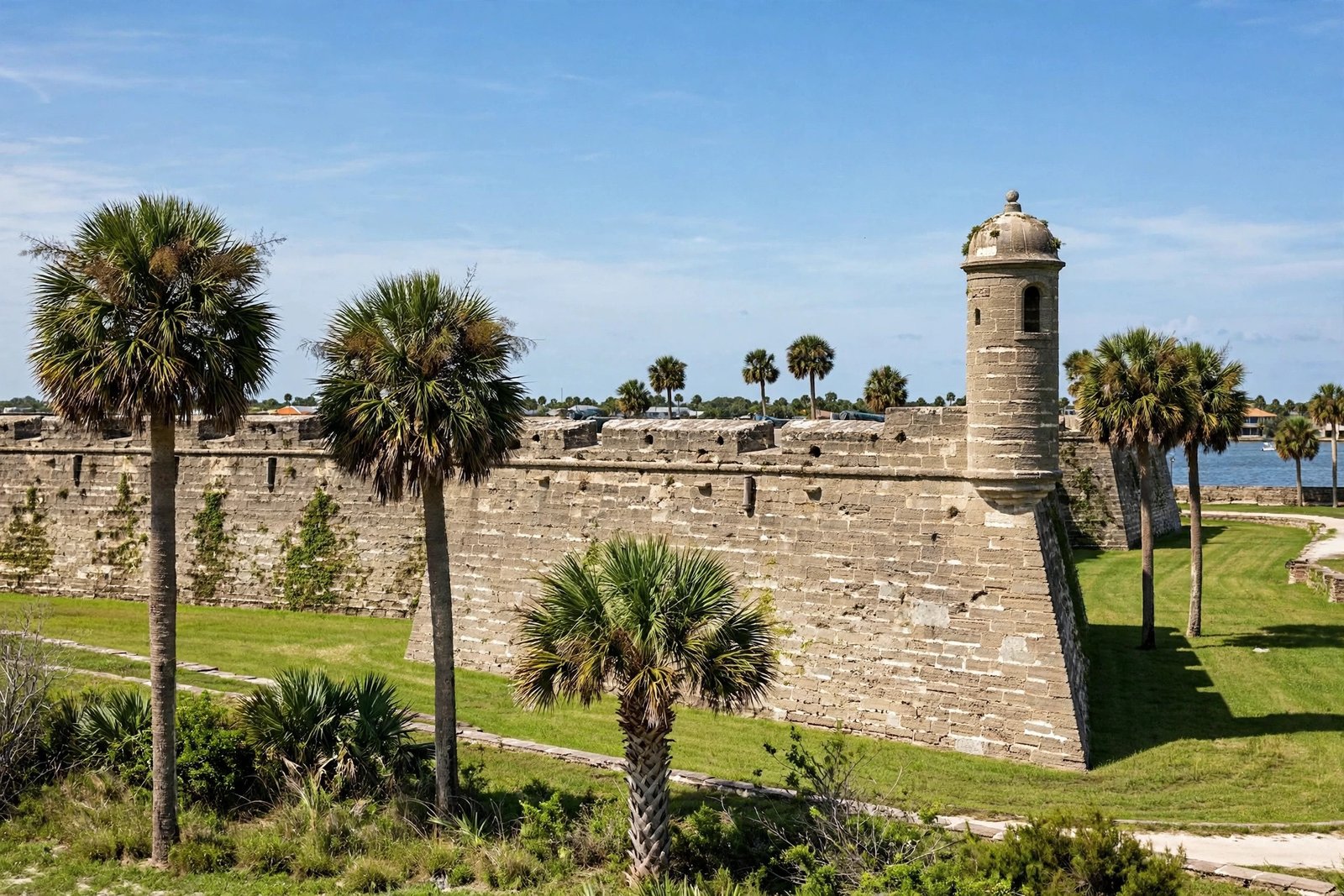
The most famous building in St. Augustine is also its most stubborn. The Castillo de San Marcos, the great stone fort that guards the entrance to Matanzas Bay, was built because the town kept burning. For more than a century after its founding, St. Augustine was defended by wooden forts that were easy targets. Sir Francis Drake raided and burned the town in 1586, pirates plundered it in 1668, and the wooden defenses could not hold against a determined attack.
In 1672, Spain began building a permanent fortress of stone, and the work continued until the Castillo was completed in 1695. The fort was built from coquina, a soft limestone made of cemented seashells quarried from Anastasia Island across the bay. Coquina seems like an odd choice for a fort, but it turned out to be brilliant: instead of shattering under cannon fire, the porous stone absorbed the impact of cannonballs. The Castillo is the oldest masonry fortification in the continental United States, and it was never taken by force.
That record was tested twice. In 1702, British forces from Carolina under Governor James Moore besieged the fort for about two months, burned the town around it, and still could not take it. In 1740, General James Oglethorpe of Georgia tried again with a larger force, and again the Castillo held. The fort later served as a prison, including for captured Seminole leaders during the Seminole Wars, and it became a national monument in 1924. Today it is operated by the National Park Service, and visitors can walk its gun deck, look out over the bay from the same walls that faced down two sieges, and see the coquina stone up close.
The Fountain of Youth: Legend vs. Fact
No story is more closely tied to St. Augustine than the Fountain of Youth, and no story is more misunderstood. The legend says that the Spanish explorer Juan Ponce de Leon came to Florida in 1513 searching for a magical spring whose waters would restore youth. The Fountain of Youth Archaeological Park in St. Augustine claims to stand on the site where Ponce de Leon landed, and visitors can still drink from a spring there today.
The facts are more complicated, and more interesting. Ponce de Leon did reach the Florida coast in 1513, and he did claim the land he called La Florida for Spain. But there is no evidence in his own records that he was searching for a fountain of youth. The earliest telling of the legend appears in a Spanish chronicle by Gonzalo Fernandez de Oviedo, written in 1535, more than twenty years after the voyage. Historians now believe the fountain story was spread by Ponce de Leon’s rivals to damage his reputation among the Spanish nobility, not by the explorer himself.
What is real is the ground itself. Archaeological excavations at the Fountain of Youth Park since 1934 have uncovered the shell mounds of the area’s earliest inhabitants, traces of the Timucua village of Seloy, and evidence of the first Spanish settlement. The park is a genuine archaeological site, and the legend, even if it is not literally true, has become part of the city’s identity. The honest version of the story is better than the myth: a real explorer, a real landing, and a real city that grew from it, with a tall tale attached along the way.
Three Flags: Spanish, British, and American
St. Augustine changed hands more than once, and each change left a mark on the city. Spain ruled St. Augustine from its founding in 1565 until 1763, when the Treaty of Paris ended the French and Indian War. Under that treaty, Spain gave Florida to Britain in exchange for the return of Havana, Cuba, which British forces had captured. The British period lasted from 1763 to 1784, and during the American Revolution, St. Augustine served as a loyalist stronghold and a base for British operations in the South.
Britain returned Florida to Spain in 1784, under the treaty that recognized American independence, and the second Spanish period ran from 1784 to 1821. Finally, under the Adams-Onis Treaty of 1819, Spain ceded Florida to the United States, and the transfer took place in 1821. Florida became a U.S. territory, and in 1845 it became the 27th state. In less than 260 years, St. Augustine had flown the flags of Spain, Britain, Spain again, and the United States, and the city’s architecture still shows all of those layers.
The city also played a role in the Civil War and in the civil rights movement. Union forces occupied St. Augustine in 1862, early in the Civil War, and the city remained under Union control for the rest of the conflict. A century later, in 1964, St. Augustine became a major battleground of the civil rights movement, when protests over segregation at the city’s beaches and businesses, including the Monson Motor Lodge, drew national attention and helped build support for the Civil Rights Act of 1964. The city’s long history includes chapters of courage as well as chapters of injustice, and both are part of what visitors see today.
Fort Mose: America’s First Free Black Settlement
One of the most important and least-known chapters in St. Augustine’s history is Fort Mose, founded in 1738. Under Spanish policy, enslaved people who escaped from the British colonies to the north and converted to Catholicism could be granted freedom in Spanish Florida. In 1738, the colonial governor established Fort Mose, a fortified town just north of St. Augustine, as a home for these freed people. It was the first legally sanctioned free Black settlement in what is now the United States, and its residents served in the Spanish colonial militia, defending St. Augustine against British attacks.
Fort Mose was led by Francisco Menendez, a man of African origin who had escaped slavery in South Carolina and risen to become a military leader in Spanish Florida. The settlement was destroyed during the British siege of 1740 and later rebuilt, and it remained a free Black community until the British took Florida in 1763, when its residents left with the Spanish for Cuba. Today, Fort Mose is a state park and historic site, and it is recognized as a precursor to the Underground Railroad. For visitors to St. Augustine, it is an essential stop, a reminder that the story of freedom in America began in places like this, long before the founding of the republic.
Flagler and the Gilded Age
After the Civil War, St. Augustine was a quiet, somewhat faded town. That changed in the 1880s, when Henry Flagler, a co-founder of Standard Oil and one of the richest men in America, decided to turn the city into a winter resort for the wealthy. Flagler built the Ponce de Leon Hotel in 1888, a grand Spanish Renaissance palace that was one of the most luxurious resorts of its day, and he followed it with the Alcazar Hotel across the street. His Florida East Coast Railway, headquartered in St. Augustine, helped open up the entire Florida coast to development.
The Ponce de Leon Hotel is now Flagler College, a private liberal arts college founded in 1968, and its grand dining hall and courtyards are still among the most beautiful rooms in Florida. The Alcazar Hotel is now the Lightner Museum, filled with Gilded Age art and antiques. Flagler’s building boom gave St. Augustine its second great architectural era, and the city’s historic district today blends Spanish colonial buildings with the grand hotels of the Gilded Age. Walking the streets, you can read the city’s history in its buildings, from coquina walls to Tiffany stained glass.
What to See Today
A visit to St. Augustine starts with the Castillo de San Marcos, the fort that anchors the city’s waterfront. From there, the historic district is best explored on foot. St. George Street, the city’s main pedestrian thoroughfare, is lined with shops, restaurants, and historic homes, including the Oldest Wooden School House, a small timber building that dates to the early 1700s. The Cathedral Basilica of St. Augustine, whose current building dates to the late 1700s, stands on the Plaza de la Constitucion, the city’s historic central square.
The St. Augustine Lighthouse, whose current tower was built in the 1870s, stands on Anastasia Island and offers views across the city and the Atlantic from its observation deck. The Fountain of Youth Archaeological Park, on the site of the original 1565 settlement, combines the legend with real archaeology. Fort Mose Historic State Park, just north of the city, tells the story of America’s first free Black settlement. And the city’s beaches, including St. Augustine Beach and Vilano Beach, offer a reminder that this is still a Florida coastal town, not just an open-air museum.
Each winter, the city glows during its Nights of Lights celebration, when millions of small white lights decorate the historic district, a tradition that has become one of Florida’s most popular seasonal events. It is a fitting image for a city that has survived so much: a town founded in the age of sail, still shining after more than four and a half centuries.
Related reading
If you enjoyed this look at America’s oldest city, keep exploring American history with why America has 50 states, the story of the American flag’s stars and stripes, and the history of the first Thanksgiving at Plymouth in 1621.
Frequently Asked Questions
When was St. Augustine founded?
St. Augustine was founded on September 8, 1565, by the Spanish admiral Pedro Menendez de Aviles. It is the oldest continuously occupied European-established settlement in the continental United States, founded 42 years before Jamestown and 55 years before the Pilgrims landed at Plymouth Rock.
What is the Castillo de San Marcos?
The Castillo de San Marcos is a stone fort in St. Augustine, built by Spain from coquina stone between 1672 and 1695. It is the oldest masonry fortification in the continental United States, and it was never taken by force, surviving British sieges in 1702 and 1740. It became a national monument in 1924 and is now operated by the National Park Service.
Did Ponce de Leon really search for the Fountain of Youth?
There is no evidence that Juan Ponce de Leon was searching for a Fountain of Youth when he reached Florida in 1513. The legend first appears in a Spanish chronicle written in 1535, more than twenty years after his voyage, and historians believe it was spread by his rivals. The Fountain of Youth Archaeological Park in St. Augustine is a real archaeological site, with excavations since 1934 uncovering evidence of the Timucua village of Seloy and the first Spanish settlement.
What is Fort Mose?
Fort Mose, founded in 1738 near St. Augustine, was the first legally sanctioned free Black settlement in what is now the United States. It was home to people who had escaped slavery in the British colonies and been granted freedom in Spanish Florida. Its military leader was Francisco Menendez, and its residents helped defend St. Augustine against British attack.
What should you see on a first visit to St. Augustine?
Start with the Castillo de San Marcos, then walk St. George Street and the historic district, visit the Cathedral Basilica and the Plaza de la Constitucion, climb the St. Augustine Lighthouse, and make time for the Fountain of Youth Archaeological Park and Fort Mose Historic State Park. The historic district is compact and best explored on foot.