
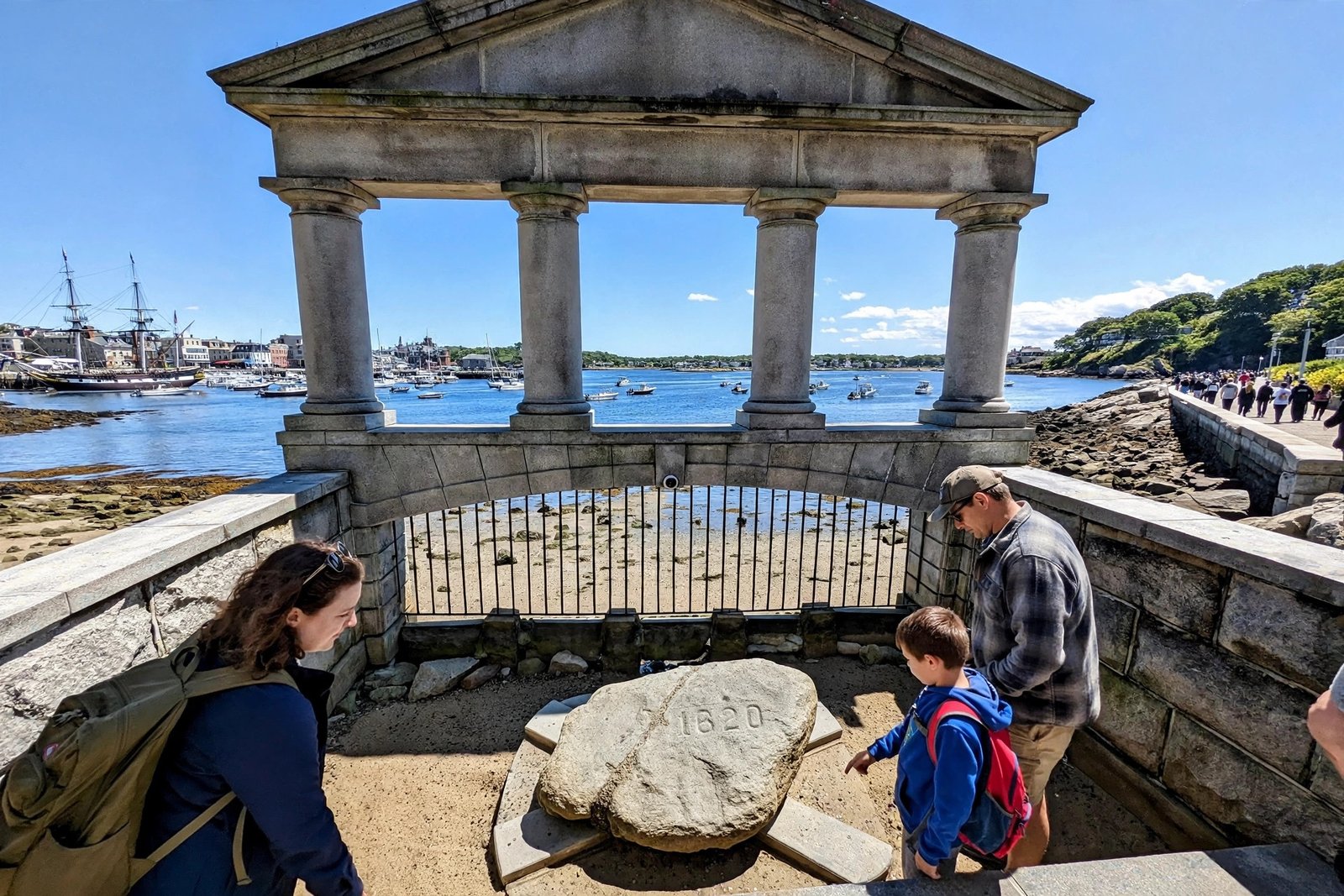
Stand on the Plymouth waterfront and you will find it: a boulder tucked under a granite portico at the edge of the harbor. First-time visitors almost always have the same reaction. They expect something monumental, a great slab of stone worthy of a national origin story, and instead they find a rock that is, frankly, small. And yet this unassuming boulder is one of the most famous stones in America, the supposed first foothold of the Pilgrims in the New World.
That is the legend, anyway. The real story is stranger, because it is a story about how a nation remembers. No one who sailed on the Mayflower ever wrote a word about stepping onto a rock. The stone was not identified as the Pilgrims’ landing place until 1741, more than a century after the fact, by a 94-year-old man relying on stories he had heard as a boy. Since then the rock has been split in two, hauled around town by oxen, chipped away by souvenir hunters, reunited, carved with a date, and sheltered under a temple-like portico far grander than the stone it protects.
This is the real story of Plymouth Rock: what the historical record actually supports, where the legend came from, and why a boulder that probably never felt a Pilgrim’s boot still matters.
The Legend Everyone Knows
Ask most Americans what happened at Plymouth Rock and you will get a confident answer. In 1620 the Pilgrims sailed across the Atlantic on the Mayflower, stepped ashore onto a great rock at Plymouth, and founded a colony that became the seed of New England. Schoolroom paintings show the scene in warm light: grateful settlers, one foot on the rock, the other on the shore of a new world. The image is so familiar that it feels like history itself.
The legend even has its own holiday. Forefathers’ Day, observed on December 21, marks the traditional date of the landing. The date 1620 is carved right into the stone, as if to remove all doubt, but the carving was added in 1880, two hundred and sixty years after the event it commemorates.
None of this makes Plymouth Rock a fraud. It makes it something more revealing: a symbol America built for itself, piece by piece, long after the Pilgrims were gone. To understand the rock, separate two questions that are usually tangled together: what actually happened in the winter of 1620, and how a boulder on a harbor shore became sacred. The answers are very different.
What Actually Happened in 1620
The Mayflower sailed from Plymouth, England, in September 1620 carrying 102 passengers and a crew of about thirty: a congregation of religious Separatists who had been living in exile in Leiden, in the Netherlands, alongside other settlers recruited by the London merchants financing the voyage. Their destination was the mouth of the Hudson River, in territory covered by their patent from the Virginia Company. They never got there.
After a rough Atlantic crossing of about two months, the ship sighted land on November 9, 1620, at the tip of Cape Cod. Storms and dangerous shoals made the southward passage impossible, so the Mayflower turned back and anchored in what is now Provincetown Harbor on November 11. That same day, 41 adult male passengers signed the Mayflower Compact, agreeing to form a civil body politic and obey laws made for the good of the colony. It happened on board the ship, not on any rock.
For the next several weeks, exploring parties went ashore to look for a place to settle. They found Plymouth Harbor in December, and the company began building its first common house on December 25, 1620. The settlement that became Plymouth Colony was planted on the site of Patuxet, a Wampanoag village whose inhabitants had been devastated by disease before the Mayflower arrived, leaving cleared fields the settlers could use. The first winter was brutal, and roughly half of the company died before spring.
Here is the detail that undoes the legend: neither William Bradford, the colony’s governor and the author of Of Plymouth Plantation, nor Edward Winslow, whose account survives in Mourt’s Relation, ever mentions a rock. As HISTORY’s account of the real story behind Plymouth Rock notes, the Pilgrims made no written reference to setting foot on a rock as they came ashore. These are the two great firsthand chroniclers of the voyage, men who recorded the landing, the weather, the deaths, and the negotiations with the Wampanoag in careful detail. If the Pilgrims had stepped onto a particular boulder, and if that moment had seemed important to them, it is hard to explain why neither man wrote it down. The rock does not appear in any contemporary account at all.
That silence does not prove the Pilgrims never touched the stone. Plymouth Harbor is rocky, and the settlers certainly came ashore somewhere along that shore. What it proves is that the rock meant nothing to the people of 1620. Its fame came later, from people who needed a monument.
The 121-Year Silence
For more than a century after the landing, Plymouth Rock was simply part of the landscape. The town of Plymouth grew up around the harbor, and the stone sat at the water’s edge, unmarked and unremarked. The descendants of the Pilgrims knew the stories of the first winter, the first harvest, and the treaty with the Wampanoag leader Massasoit, but they attached no special meaning to any particular rock.
That silence is itself evidence. In a culture that loved to commemorate its founders, a genuine landing stone would have been hard to forget, yet the historical record for those 121 years contains nothing about the rock at all. The stone only became important when it was about to disappear: in 1741, the town planned to build a wharf over the spot where the boulder lay, and the prospect of losing it stirred Plymouth’s oldest residents. It was then, with the rock threatened, that an old man came forward with a memory.
Thomas Faunce and the Day the Rock Got Its Name
Thomas Faunce was 94 years old in 1741, an elder of Plymouth’s First Church and one of the town’s living links to its founding generation. His father had arrived in Plymouth in 1623, just three years after the Mayflower, and Faunce said his father and several original Mayflower passengers had told him, when he was a boy, that this boulder was the stone on which the Pilgrims first stepped ashore.
When Faunce heard that a wharf was to be built over the rock, he asked to be carried to the harbor for a final look. According to tradition, he was carried by chair to the shore, where he gave the stone a tearful goodbye and repeated what the Forefathers had told him. The townspeople were moved. The wharf plan was changed, and the rock was left in place. Archaeology Magazine’s interview with Plimoth Plantation’s curator tells the same story: the evidence for the landing on the rock comes from oral history, and Faunce’s protest saved it.
Was Faunce right? The honest answer is that nobody knows. His father came in 1623, and as a young man Faunce could plausibly have talked with surviving Mayflower passengers, so a real memory could have crossed a century by word of mouth. But he was 94, recalling boyhood conversations about an event that happened before he was born, and a century is a long time for a story to drift from one stone to another.
What matters is not whether Faunce was right but what happened next. Once the stone had a name and a story, Plymouth began to treat it as sacred. The identification of 1741 was the moment Plymouth Rock stopped being a boulder and became a relic.
A Rock in Two Pieces: 1774, 1834, 1867, and 1880
The rock’s troubles began almost as soon as it became famous. In 1774, as the American Revolution was gathering, the townspeople of Plymouth decided to move the stone to the Town Square, where it could stand as a symbol of liberty near the town’s meeting house. They hitched it to teams of oxen, thirty teams by one account, and hauled. The historical marker at Pilgrim Memorial State Park records what happened next: the rock split in two.
The accident began a long fragmentation. The bottom half stayed where it was, embedded in the wharf. The top half was carried on to the Town Square and displayed as a monument to independence. Over the following decades, souvenir hunters chipped pieces off both halves, and by the time the top half was moved again in 1834, to the grounds of Pilgrim Hall on Court Street, the stone had already lost a good deal of itself to visitors who wanted a piece of history to take home.
The legend, meanwhile, was growing faster than the rock was shrinking. In 1820, at the two-hundredth anniversary of the landing, Daniel Webster delivered a famous oration in Plymouth declaring that beneath the audience lay the rock on which New England received the feet of the Pilgrims. Widely reprinted, the speech fixed the story in the national imagination, and Plymouth Rock became the visual shorthand for the founding of New England.
Back in Plymouth, the two halves lived separate lives. The lower half was sheltered in 1867 under a monumental granite canopy designed by Hammatt Billings, while the upper half sat fenced in at Pilgrim Hall. It was not until 1880 that the halves were reunited at the waterfront, the top half brought down the hill and joined to its base, and the date 1620 was carved into the stone. The visible crack running across the rock today is the mark of that reunion: two pieces of one boulder, fitted back together after more than a century apart.
The Temple on the Shore
The rock’s current home dates to the three-hundredth anniversary of the landing. In 1920, the waterfront was redesigned, the old wharves were removed, and the rock was excavated and relocated so that it would sit at water level, as it supposedly had in 1620. A new granite portico was then built over it, designed by the celebrated firm of McKim, Mead and White, the architects behind New York’s original Pennsylvania Station.
The portico, dedicated in 1921, is a small classical temple of Roman Doric columns standing open to the harbor, deliberately grander than its contents. It was erected by the National Society of the Colonial Dames of America for the tercentenary of the landing, and it has sheltered the rock ever since.
In 1970, Plymouth Rock and its portico were listed in the National Register of Historic Places. Today the site is Pilgrim Memorial State Park, managed by the Massachusetts Department of Conservation and Recreation. Admission is free, and the rock sits behind a protective grate at the water’s edge on Water Street.
What the Rock Is, and What It Is Not
So what is Plymouth Rock, really? The rock is a genuine piece of Plymouth’s shoreline, a boulder that was certainly there in 1620, and it is possible that some of the Pilgrims stepped on it or near it when they came ashore. But there is no evidence that they did, no contemporary record mentions it, and the identification rests on a single oral tradition first voiced 121 years after the fact. As historians put it, the rock is a symbol of the landing, not a proven artifact of it.
Today the stone is estimated to be only about a third of its original size, and only about a third of what remains is visible above the sand and the grate. The rest has been lost to the moves, the splits, and the souvenir hunters. Pieces of it are scattered in museums and private collections, including a fragment held by the Pilgrim Hall Museum in Plymouth.
None of this diminishes the rock. Plymouth Rock is not important because the Pilgrims stepped on it. It is important because generations of Americans decided it mattered, and built a story, a holiday, a portico, and a national memory around it. The stone is small. The idea attached to it is enormous. That is how founding myths work: they need a place to stand, and Plymouth gave the American story a rock to stand on.
Visiting Plymouth Rock Today
A visit to Plymouth Rock works best as part of a day in Plymouth, rather than as a destination on its own. The rock itself takes only a few minutes to see. The experience is in the setting: the harbor, the portico, and the historic sites within walking distance.
Start at Pilgrim Memorial State Park on Water Street, where the rock sits under its portico at the harbor’s edge. The Mayflower II, a full-scale reproduction of the original ship, is berthed nearby, and the Pilgrim Hall Museum on Court Street holds the town’s collection of Pilgrim artifacts, including a fragment of the rock itself. A short drive away, Plimoth Patuxet Museums recreates the seventeenth-century English village and a Wampanoag homesite.
Related reading
For more on the Pilgrims and the first Thanksgiving, see The First Thanksgiving at Plymouth in 1621, The Mayflower Compact of 1620, and Why Thanksgiving Falls on the Fourth Thursday.
Frequently Asked Questions
Did the Pilgrims really step on Plymouth Rock?
There is no proof either way. No contemporary account, including William Bradford’s history of Plymouth Colony, mentions a rock. The identification comes from Thomas Faunce in 1741, 121 years after the landing, based on stories he heard as a boy. Historians treat the rock as a symbol of the landing, not a proven artifact of it.
When was Plymouth Rock first identified?
In 1741, when the town planned to build a wharf over the boulder. Thomas Faunce, a 94-year-old church elder whose father had arrived in Plymouth in 1623, said the stone was the Pilgrims’ landing place, and the wharf plan was changed.
Why is Plymouth Rock in two pieces?
In 1774, townspeople tried to move the rock to Plymouth’s Town Square as a symbol of liberty, and it split in two during the move. The top half went to the square and later to Pilgrim Hall in 1834, while the bottom half stayed at the waterfront. The halves were reunited in 1880, and the visible crack is the mark of that split.
Where is Plymouth Rock today?
Under a granite portico at Pilgrim Memorial State Park on Water Street in Plymouth, Massachusetts, managed by the Massachusetts Department of Conservation and Recreation. The portico was designed by McKim, Mead and White and dedicated in 1921, and the site is free to visit.
How big is Plymouth Rock?
Smaller than most visitors expect. The stone is estimated to be only about a third of its original size, after centuries of moves, splits, and souvenir hunting, and only about a third of what remains is visible above the ground.