
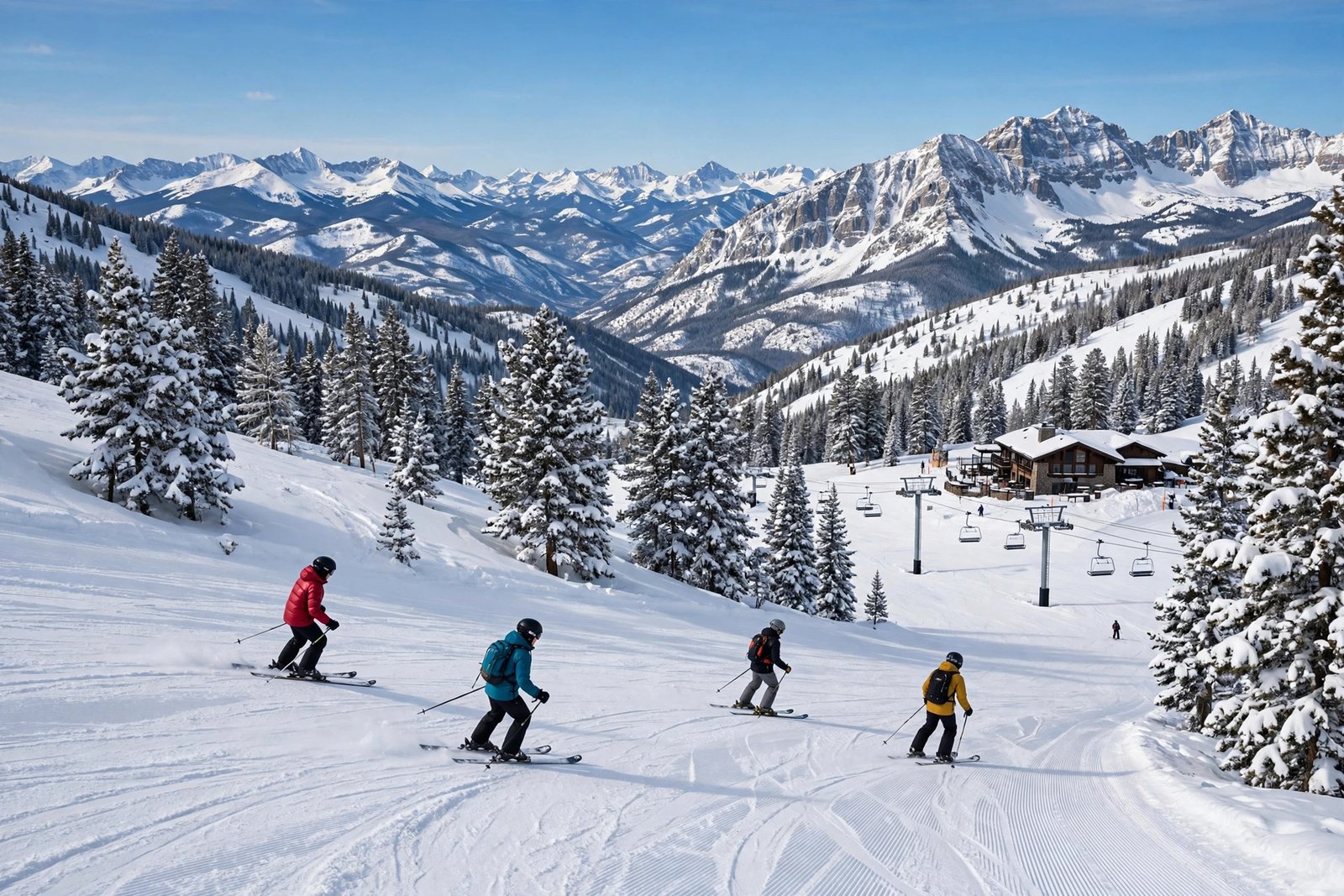
The lifts are spinning, the first storms have dusted the high peaks, and the 2026-27 ski season is underway across the United States. America is home to some of the biggest and most varied ski terrain on the planet, from the wide-open bowls of Colorado to the steep chutes of Wyoming and the high, dry powder of Montana and Utah. The hard part is picking the right resort for your group, your ability, and your budget.
This guide covers the resorts that matter most for the 2026-27 season: Vail, Park City, Breckenridge, Jackson Hole, Big Sky, and Aspen Snowmass, plus two more worth a place on your shortlist. For each one, you will find verified mountain statistics, planned opening dates, what the terrain is really like, and who it suits best. Prices are left out, because lift ticket prices now change by the day. Check the resort’s own site before you book.
The 2026-27 Season at a Glance
The big story this season is El Niño. After a La Niña winter last year, the Pacific has flipped, and NOAA’s Climate Prediction Center said in its October 8 discussion that a strong to very strong El Niño is likely through late winter, with better than 83 percent odds. El Niño tends to tilt the odds toward a warmer north and a wetter southern tier, from California across to the Southeast.
What does that mean on the mountain? The Sierra and the southern Rockies have the better odds of a wetter winter, while the Pacific Northwest and the northern Rockies lean warmer and drier than normal. Colorado and Utah sit in the equal-chances zone, with no strong lean either way. Treat this as a nudge, not a promise. As OnTheSnow’s long-range winter forecast points out, seasonal outlooks track total precipitation, not snowfall, and a wet winter can still fall as rain at lower elevations.
Opening dates are also worth watching. Most major western resorts open between mid-November and early December, and every opening depends on snow. Vail is scheduled to open November 13, Big Sky on November 25, Aspen Snowmass and Telluride on November 26, Jackson Hole on November 27, and Deer Valley on December 5. Breckenridge targeted early November. Confirm on the resort’s snow report before you travel.
Vail, Colorado: The Best All-Rounder
Vail is the benchmark against which other American ski resorts are measured. The mountain covers 5,317 skiable acres served by 32 lifts and 278 trails, with a summit of 11,570 feet, a vertical drop of 3,450 feet, and average annual snowfall around 354 inches. Front-side groomers, the vast Back Bowls, and the gladed terrain of Blue Sky Basin add up to a mountain that can absorb a holiday crowd without feeling crowded.
What makes Vail work for mixed groups is the range. Beginners have gentle terrain at the front of the mountain, intermediates get mile after mile of cruisers, and experts get the Back Bowls, wide-open alpine terrain. The village at the base is pedestrian-only, with restaurants, shops, and lodging steps from the lifts.
The trade-offs are familiar. Lift tickets are among the priciest in the country, lodging in the village is expensive, and the resort sits about two hours from Denver International Airport. The Epic Pass covers Vail with unlimited days, so if you plan more than a few days on the mountain, the pass is usually the better deal.
Park City, Utah: The Biggest Ski Area in America
Park City Mountain is the largest ski area in the United States, with 7,300 acres of linked terrain across the Park City and Canyons sides, more than 330 trails, and 41 lifts. The summit reaches 10,026 feet, with a vertical drop of 3,226 feet. A week here still leaves runs unskied.
Access is Park City’s superpower. The resort sits about a 40-minute drive from Salt Lake City International Airport, making it the easiest major western resort to reach from the East Coast. You can land in the morning and be on the snow by lunch. The town of Park City is a former mining town with a real main street, and the resort is woven into it.
Park City suits intermediates and families best, with a huge amount of groomed, rolling terrain and plenty of green and blue runs. Experts will find steeps and bowls, particularly on the Canyons side, but this is not the resort for the steepest terrain in America. It is the resort for a group that wants variety, convenience, and a lively town at the end of the day. Like Vail, Park City is on the Epic Pass with unlimited days. One change for 2026-27: the Sundance Film Festival held its last Utah edition in January 2026 and moves to Boulder, Colorado.
Breckenridge, Colorado: High Altitude and a Real Town
Breckenridge, or Breck as regulars call it, is spread across five peaks of the Tenmile Range, with 2,908 skiable acres, 187 trails, and 35 lifts. The summit sits at 12,998 feet on Peak 8, and the base at 9,600 feet, making it one of the highest ski resorts in North America. The Imperial Express SuperChair tops out at 12,840 feet, which the resort calls the highest chairlift in North America.
Altitude is the defining fact of a Breckenridge trip. The height means reliable snow and a long season: the resort targeted an early November opening for 2026-27 and typically skis into May. It also means thin air, so if you are coming from sea level, plan a slow first day and drink plenty of water. The town at the base is a former mining town with Victorian storefronts, breweries, and restaurants, connected to the slopes by a gondola from downtown.
Each of the five peaks has its own character. Peaks 7 and 8 hold much of the beginner and intermediate terrain, Peak 9 suits progressing intermediates, and Peak 6 and the high bowls off the Imperial lift hold the expert terrain. Breckenridge is on the Epic Pass, about an hour and three quarters from Denver by car. For a full picture of the five peaks, this Breckenridge resort guide is a useful pre-trip read.
Jackson Hole, Wyoming: The Steepest Skiing in the Country
Jackson Hole Mountain Resort is the one on this list that experts talk about in reverent tones. The mountain covers 2,500 acres, with 131 trails and a vertical drop of 4,139 feet, served by the famous aerial tram to the summit of Rendezvous Mountain. About half the runs are rated for advanced skiers.
Jackson Hole is not a resort for tentative skiers. The tram ride alone, rising more than 4,000 vertical feet in about nine minutes, is a statement of intent, and the bowls and chutes at the top are among the most demanding lift-served terrain in the United States. Beginners get groomed runs lower on the mountain, but anyone booking Jackson Hole should be honest about their ability, because the mountain will find out.
The setting is part of the appeal. The resort sits in Teton Village, about 12 miles from the town of Jackson, with Grand Teton National Park next door. Jackson Hole is on the Ikon Pass, with seven days included, and it is scheduled to open November 27 for the 2026-27 season.
Big Sky, Montana: Space, Snow, and Lone Peak
Big Sky is the biggest mountain on this list by acreage, covering 5,850 skiable acres around Lone Peak, with 320 named runs, 40 lifts, and a vertical drop of 4,350 feet. The summit of Lone Peak reaches 11,166 feet, and average snowfall runs around 400 inches a year.
What sets Big Sky apart is space. With nearly 6,000 acres and far fewer visitors than resorts of similar size in Colorado or Utah, lift lines are rare and the slopes feel empty even on busy days. The terrain is genuinely varied: wide groomers for intermediates and serious steeps and chutes off Lone Peak for experts.
Big Sky is about an hour from Bozeman, Montana, and its airport. You will want a rental car, and you should book lodging early. The resort is on the Ikon Pass with seven days, and it is scheduled to open November 25, running daily into mid-April with additional weekends after that if conditions allow.
Aspen Snowmass, Colorado: Four Mountains, One Ticket
Aspen Snowmass is not one mountain but four: Aspen Mountain, Snowmass, Aspen Highlands, and Buttermilk, together offering more than 5,700 acres on a single ticket. Snowmass alone covers 3,342 acres, with a summit of 12,510 feet and a vertical drop of 4,400 feet. Aspen Mountain, known locally as Ajax, rises straight out of the town of Aspen. Aspen Highlands holds the hike-to Highland Bowl for experts, and Buttermilk is the gentle mountain, home to the beginner areas and the ski school.
The four-mountain setup is the best reason to come. A family can spend a day at Buttermilk and Snowmass, then the strong skiers can head to Highlands the next day, all on the same pass. The town of Aspen is the most upscale ski town in America, and the airport sits just three miles away.
Aspen Snowmass is on the Ikon Pass, with seven days across the four mountains. For the 2026-27 season, Aspen Mountain and Snowmass are scheduled to open November 26, with Aspen Highlands and Buttermilk following on December 12, and Aspen Mountain is scheduled to stay open until April 18. Lift tickets here are among the most expensive in the country, so this is the splurge option on this list.
Two More Worth Your Shortlist
Deer Valley, Utah, is the resort for skiers who hate crowds and do not snowboard. It is skiers only, it limits the number of lift tickets it sells each day, and it is famous for immaculate grooming and attentive service. The mountain covers 4,500 acres after a major expansion, with 209 runs, 32 lifts, and a vertical drop of 3,120 feet. It sits about 38 miles from Salt Lake City’s airport, is scheduled to open December 5, and is on the Ikon Pass.
Telluride, Colorado, is the connoisseur’s pick. The resort covers more than 2,000 acres, with 148 trails, 17 lifts, and a vertical drop of about 3,790 feet, set in a box canyon in the San Juan Mountains. The town is a former mining town with a free gondola connecting it to the Mountain Village. Telluride is scheduled to open November 26 and close April 4. It is smaller and harder to reach than the resorts above, and that is exactly why its fans love it.
Epic or Ikon: Which Pass Fits Your Winter?
For most skiers, the pass decision comes before the resort decision. The Epic Pass covers Vail, Park City, and Breckenridge with unlimited days. The Ikon Pass includes seven days each at Aspen Snowmass, Big Sky, Deer Valley, and Jackson Hole.
The rule of thumb is simple. If you plan to ski five or more days at one Epic resort, or hop between Vail, Park City, and Breckenridge on one trip, Epic is usually the better buy. If your trip centers on Jackson Hole, Big Sky, or Aspen, Ikon fits better. Either way, buy early: both passes are sold in tiers, and prices rise as the season approaches.
When to Go
Early season, from opening day through mid-December, brings the lowest prices and the thinnest crowds, but also the least terrain: only a fraction of runs are usually open. If you book early season, pick a high resort with strong snowmaking, such as Breckenridge or Vail, and keep your expectations modest.
The heart of the season runs from mid-January through early March, when the most terrain is open and the snowpack is deepest. This is the best window for most skiers, and it avoids the two busiest stretches: the Christmas and New Year holidays, and the Presidents’ Day week in February. Travel midweek in January for the best combination of snow, space, and value.
Spring skiing, from March into April, is the sleeper pick. The days are longer, the sun is warmer, the snow softens by midday, and prices fall. Big Sky runs daily into mid-April with extra weekends after that, Aspen Mountain is scheduled to stay open until April 18, and Breckenridge typically skis into May. Spring is also the best time for beginners, who will appreciate the softer snow and warmer weather. Ski.com’s explainer on El Niño and La Niña is a good primer on the pattern.
Planning Tips for a Smooth Trip
A few practical points will save you trouble. First, altitude: every resort on this list sits above 8,000 feet at the base, and several top out above 12,000 feet. Arrive a day early if you can, drink water, and take it easy on your first day. Second, book lodging and rental cars early, especially for the holiday weeks. Third, reserve ski lessons in advance, because ski schools sell out on peak weekends. Finally, check the numbers yourself. Vail’s published mountain statistics and this comparison of the major resorts for 2026-27 are good places to confirm acreage, lifts, and opening dates, and this overview of the best ski resorts in the USA is a useful cross-check on the figures in this guide.
Related reading
For more winter ideas, see The Best Ice Skating Rinks in the USA, America’s Best Christmas Markets for 2026, and The Best Christmas Light Displays in the USA for 2026.
Frequently Asked Questions
Which is the biggest ski resort in the USA?
Park City Mountain in Utah, with 7,300 acres of linked terrain, more than 330 trails, and 41 lifts. Big Sky in Montana is next among the resorts in this guide at 5,850 acres, followed by Vail at 5,317 acres.
When do US ski resorts open for the 2026-27 season?
Most major western resorts open between mid-November and early December, depending on snow. For 2026-27, Vail is scheduled to open November 13, Big Sky on November 25, Aspen Snowmass and Telluride on November 26, Jackson Hole on November 27, and Deer Valley on December 5.
Which US ski resort is best for beginners?
Breckenridge and Park City are the strongest picks for beginners and families, thanks to large beginner areas, good ski schools, and plenty of gentle groomed terrain. Buttermilk, one of Aspen’s four mountains, is also built for learning.
What is the difference between the Epic Pass and the Ikon Pass?
Epic covers Vail, Park City, and Breckenridge with unlimited days. Ikon includes seven days each at Aspen Snowmass, Big Sky, Deer Valley, and Jackson Hole. Pick Epic if your trip centers on the Vail Resorts mountains, and Ikon if it centers on the Ikon mountains.
Will El Niño mean a good ski season in 2026-27?
Not necessarily. NOAA expects a strong El Niño, which tilts the odds toward a wetter southern tier and a warmer north, but seasonal outlooks track total precipitation, not snowfall, and they are probabilities, not promises. Pick a resort with elevation, terrain variety, and strong snowmaking.