
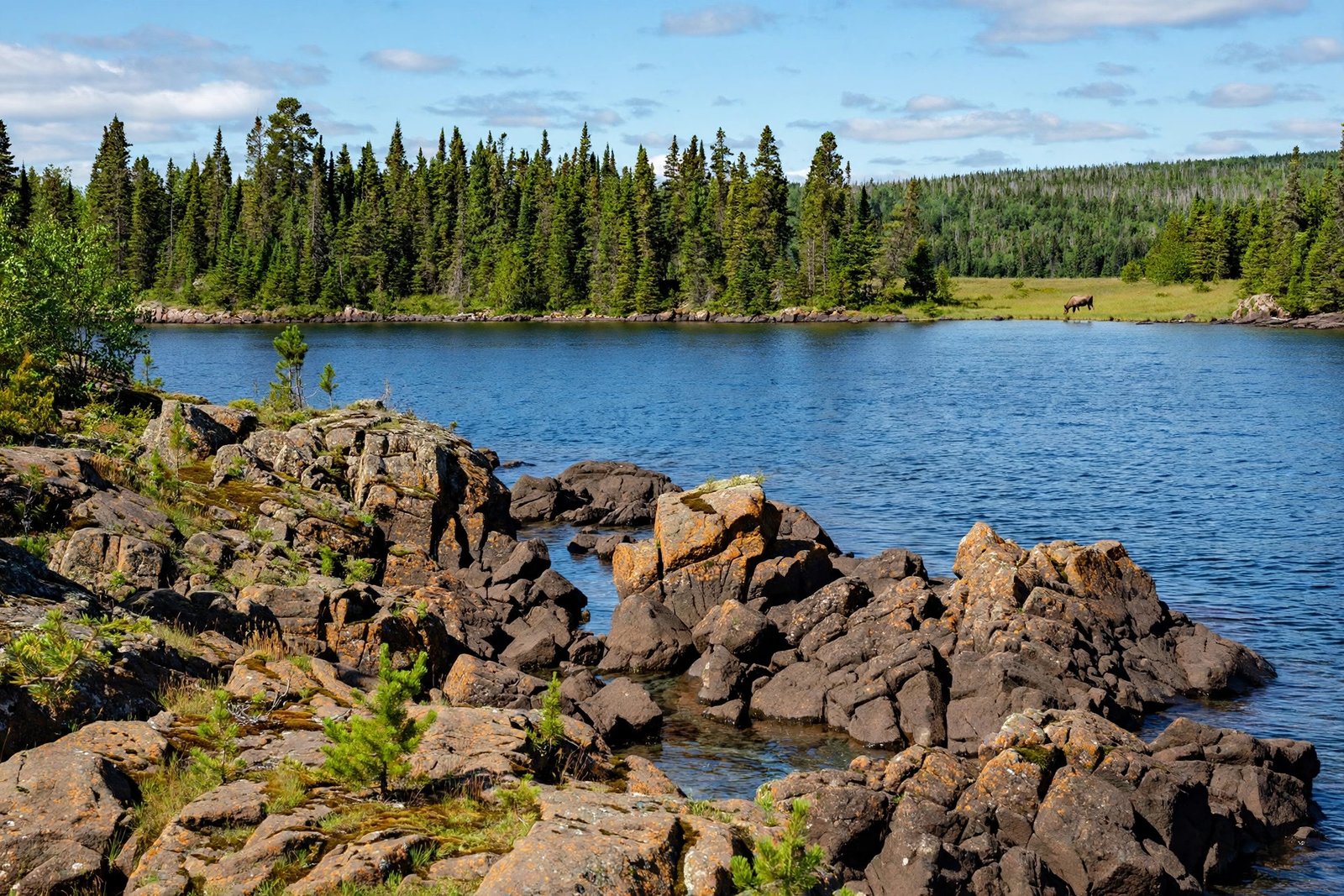
There is a place in America where the loudest sound at night is the wind moving through the trees, where the only traffic is a moose crossing a trail, and where getting there is half the adventure. Isle Royale National Park sits alone in the cold, clear water of Lake Superior, a long, forested island that belongs to Michigan but lies closer to Canada and Minnesota than to the Michigan mainland. It is one of the least-visited national parks in the country, and that is exactly what makes it special.
Isle Royale is not a park you stumble into on a road trip. There are no roads here, no cars, and no towns. The only way in is by ferry, seaplane, or private boat, and the park is open only from mid-April through the end of October. The rest of the year, the island closes completely, and the only people left are the scientists who spend the winter studying its famous wolves and moose. For travelers who love wild places, that remoteness is the whole point. Isle Royale is America at its most untouched, a wilderness island where nature runs the show.
This guide covers everything you need to know about Isle Royale National Park: how to get there, what makes its wolf and moose story so important, where to hike and camp, and when to plan your trip. If you have ever dreamed of a national park without crowds, traffic, or cell service, this island is waiting.
An Island You Can Only Reach by Water
Isle Royale is the largest island in Lake Superior and the fifth-largest lake island in the world. The main island runs about 45 miles long and 9 miles across at its widest point, and it is surrounded by more than 400 smaller islands. Together, the island, its neighbors, and the surrounding waters make up the national park, which covers roughly 571,790 acres in total, most of it water. The park boundary reaches 4.5 miles out into the lake from the shore.
Although Isle Royale is part of Michigan, geography tells a different story. The island lies about 56 miles from Michigan’s Upper Peninsula shore but only about 15 miles from the Canadian shore, and it sits within sight of Minnesota’s North Shore on a clear day. That in-between location is part of its character. It feels like a place apart, a piece of wilderness that belongs to the lake as much as to any state.
There is no bridge and no causeway, and there never will be. The park is accessible only by ferry, seaplane, or private boat. Four ferry services and one seaplane service carry passengers to the island during the visitor season. The Ranger III, operated by the National Park Service, sails from Houghton, Michigan, to Rock Harbor on the island’s eastern end, a crossing that takes about six hours. The Isle Royale Queen IV runs from Copper Harbor, Michigan, to Rock Harbor in about three hours. From Grand Portage, Minnesota, ferries serve Windigo on the island’s western end and Rock Harbor. Isle Royale Seaplanes flies from Houghton to both Rock Harbor and Windigo in about 35 minutes.
Because the crossing takes planning, most visitors treat the trip as a real expedition rather than a day out. Ferries run only during the season, generally from May through September, and schedules change every year, so checking the National Park Service website before booking is essential. A per-person entrance fee applies to visitors aged 16 and older, and an overnight permit is required for anyone staying in the backcountry.
From Copper Mines to National Park
Long before it was a national park, Isle Royale was known for its copper. Native peoples mined copper on the island thousands of years ago, and in the 1800s, commercial mining companies arrived, along with fishermen and a few hardy settlers. The island’s rugged ridges and deep harbors attracted people who were willing to live far from the mainland, but the work was hard and the winters were brutal, and most of those communities eventually faded away.
The idea of protecting the island gained support in the early 1900s, and Congress authorized Isle Royale National Park on March 3, 1931. It was formally established on April 3, 1940, by President Franklin D. Roosevelt. In 1976, the park was designated a wilderness area, and in 1980 it became a UNESCO International Biosphere Reserve. Today, the park has no permanent residents, and the small communities of fishermen who once lived there are gone, leaving the island to the forest, the lakes, and the wildlife.
That history is still visible if you know where to look. Old mine pits dot the ridges, lighthouses stand at the island’s harbors, and the waters around Isle Royale hold some of the best-preserved shipwrecks in the Great Lakes, popular with scuba divers. The island’s past as a working place makes its present as a wilderness even more remarkable. In less than a century, a mined and settled island became one of the wildest corners of the national park system.
Wolves and Moose: The World’s Longest Predator-Prey Study
Isle Royale’s most famous residents are its wolves and moose, and their story is one of the great sagas of American wildlife science. Moose swam to the island from Canada in the early 1900s, when the lake froze solid enough for them to cross the ice. For decades they lived without predators, and their numbers grew until they were stripping the island’s balsam fir forests bare. Then, in the winter of 1949, a small group of wolves, probably only a mated pair, crossed an ice bridge from Ontario to the island, and the island’s ecology changed forever.
In 1958, ecologist Durward Allen of Purdue University began a study of the island’s wolves and moose that became the longest-running predator-prey study in the world. Allen saw Isle Royale as a natural laboratory, a place where wolves and moose could be counted and their interactions studied over time, largely free from human interference. The project later moved to Michigan Technological University, where researcher Rolf Peterson led it for decades, and it continues today.
The study has never followed a simple pattern. Wolf numbers have risen and crashed, sometimes because of disease, sometimes because of inbreeding on an isolated island. By the mid-2010s, the wolf population had fallen to just two animals, and the moose population had exploded to about 2,000 by 2019. The National Park Service later brought in new wolves from the mainland to restore the population and its genetic diversity, and the recovery has been dramatic. A winter survey in early 2026 estimated 37 wolves on the island, the highest count since the late 1970s, while the moose population had fallen to about 524 animals.
For visitors, the study is a reminder that Isle Royale is not a zoo. Seeing a wolf is rare and never guaranteed, but moose are a common sight along the trails, especially near inland lakes and beaver ponds in the early morning. The best approach is to keep a respectful distance, stay quiet, and let the animals be wild. The island’s wildlife is the reason the park exists in its current form, and watching a moose wade through a misty lake at dawn is an experience few national parks can match.
Hiking the Greenstone Ridge and Beyond
Isle Royale has about 165 miles of hiking trails, and the most famous is the Greenstone Ridge Trail, which runs roughly 40 miles along the island’s central backbone from Windigo to Rock Harbor. Most backpackers take five to seven days to complete the full traverse, staying at campgrounds along the way. The ridge offers sweeping views across Lake Superior, and on a clear day you can see the Canadian shore. It is a challenging route, with rocky climbs and long stretches without water, but it is also the classic Isle Royale experience.
Shorter hikes are just as rewarding. Day hikers based at Rock Harbor can walk to Scoville Point, a rocky headland with views of the lake and the harbor, or to Suzy’s Cave, a sea cave carved into the rock by the waves. From Windigo, trails lead to Huginnin Cove, a quiet beach where moose sometimes feed at dusk, and to the historic Washington Harbor area. Every trail on the island is a foot trail. There are no paved paths, no bike rentals, and no shuttles, so every mile is earned on foot.
The island’s inland lakes add another dimension to exploring. Canoe and kayak routes connect the lakes through portages, and paddling across a calm, forest-ringed lake at sunrise is one of the quietest experiences in the park system. Anglers come for lake trout and northern pike, and the park’s waters are famously clear. Whether you hike, paddle, or simply sit on a dock and watch the lake, Isle Royale rewards a slow pace.
Camping Under the Stars
Isle Royale has 36 designated wilderness campgrounds, and camping is the way most visitors experience the island. Campgrounds are first come, first served for small parties, and each one has tent sites, an outhouse, and access to a water source. Some campgrounds have three-sided wooden shelters, which are popular with backpackers, and several have docks for boaters. Campfires are not allowed at most campgrounds, so visitors cook on camp stoves.
An overnight permit is required for anyone staying in the park, and backpackers pick one up when they arrive. Because the island is so remote, preparation matters more here than at most parks. There is no store on the island, no restaurant, and no place to buy supplies, so visitors must bring all their food and gear with them. Water from lakes and streams must be treated before drinking, and food must be stored carefully to keep it away from wildlife.
The reward for all that preparation is a night sky unlike anything most Americans ever see. With no towns and no light pollution, Isle Royale is one of the darkest places in the eastern United States, and on a clear night the stars are so bright they seem close enough to touch. The northern lights sometimes appear over the lake in the fall, and the sound of loons calling across the water is the park’s signature soundtrack. For many visitors, the nights are the best part of the trip.
When to Go and What to Know Before You Go
The park’s public season runs from April 16 through October 31, and the island is completely closed from November 1 through April 15 because of extreme winter weather and dangerous lake conditions. Most visitors come in the summer, when the ferries run most often and the weather is warmest. July and August are the busiest months, though even then the island feels empty compared with other national parks. In 2025, the park recorded about 29,000 recreation visits, making it the least-visited national park in the contiguous United States.
September is a favorite time for experienced visitors. The crowds thin out, the mosquitoes fade, and the fall colors turn the island’s birch and maple forests gold and red. The weather can be unpredictable, though, and Lake Superior is famous for sudden storms, so layers and rain gear are essential no matter when you visit. The lake’s water is cold year-round, and swimming is only for the very brave.
A few practical tips make the trip smoother. Book ferry or seaplane tickets well in advance, especially for summer weekends, and build an extra day into your plans in case bad weather delays your return crossing. Pack light but bring sturdy boots, because the trails are rocky and often muddy. Treat all water, carry a map, and tell someone your plans before you go. Cell service is limited or nonexistent on the island, so download maps and ferry schedules before you arrive. Most of all, remember that Isle Royale is a wilderness. The island does not have the safety nets of a front-country park, and that is precisely why people love it.
Isle Royale is not for everyone. It takes effort, patience, and a willingness to be uncomfortable. But for travelers who make the crossing, the island offers something increasingly rare in America: a place where the wild is still wild, where wolves and moose shape the forest, and where the journey matters as much as the destination. That is why, more than 85 years after it became a national park, Isle Royale remains one of America’s great hidden gems.
Related reading
If you enjoyed this guide to Isle Royale, keep exploring America’s wild places with our guide to all 63 national parks, a look at the sea caves of the Apostle Islands in Wisconsin, and the fiery desert landscapes of Valley of Fire in Nevada.
Frequently Asked Questions
How do you get to Isle Royale National Park?
The only ways to reach Isle Royale are by ferry, seaplane, or private boat. Ferries run from Houghton and Copper Harbor in Michigan and from Grand Portage in Minnesota, and seaplanes fly from Houghton. There are no roads, bridges, or car ferries to the island.
When is Isle Royale National Park open?
The park is open to visitors from April 16 through October 31 each year and is completely closed from November 1 through April 15 because of extreme winter weather and unsafe lake conditions. Ferry service generally runs from May through September.
Why is Isle Royale the least-visited national park in the lower 48 states?
Its remoteness is the main reason. The island can only be reached by boat or seaplane, it has a short visitor season, and it has no roads, cars, or towns. In 2025, the park recorded about 29,000 recreation visits, the fewest of any national park in the contiguous United States.
Can you see wolves on Isle Royale?
Wolf sightings are rare and never guaranteed, because the animals are shy and range across the whole island. Moose are much easier to spot, especially near inland lakes in the early morning. Visitors should keep a respectful distance from all wildlife and never approach or feed animals.
Do you need a permit to camp on Isle Royale?
Yes. An overnight permit is required for anyone staying in the park, and backpackers obtain one on arrival. The park has 36 designated campgrounds, most of them first come, first served for small parties, and campfires are not allowed at most of them.