
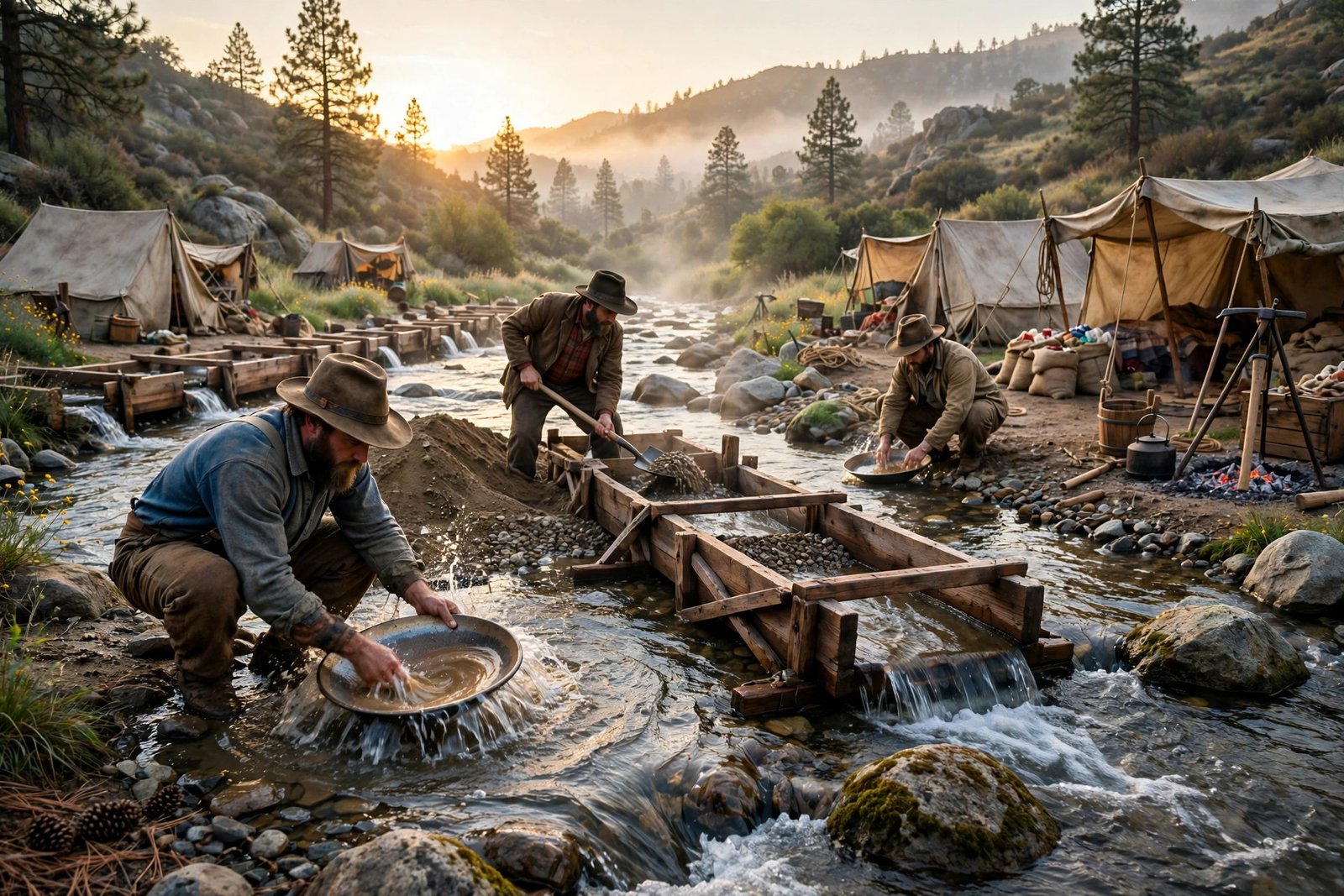
On a cold January morning in 1848, a carpenter named James Marshall walked down to the tailrace of a sawmill he was building on the American River and noticed something glittering in the water. He picked up a few bright flakes, tested them, and realized he was holding gold. Neither Marshall nor the mill’s owner, John Sutter, could have imagined what would follow: within two years, hundreds of thousands of people from around the world would pour into California, a sleepy Mexican territory would become the 31st state of the Union, and the map of the United States would be redrawn forever.
California Before the Gold
To understand how dramatic the Gold Rush was, it helps to picture California as it stood in early 1848. The region had just changed hands. The Mexican-American War had effectively ended with the capture of Mexico City the previous September, and California was under United States military administration, though the treaty formally transferring it to the United States would not be signed until February 2, 1848, just nine days after Marshall’s discovery.
California was a distant, thinly populated province. At the end of the Mexican War, there were about 150,000 Native Americans and only around 12,000 non-Native residents, most of them Californios ranching and farming in a quiet corner of what had been Mexico. San Francisco was a small town of roughly 1,000 people. There were no railroads, no telegraph lines to the East, and no real government beyond military rule. Few people outside the region paid it much attention.
That isolation is part of what makes the story so remarkable. In the space of a few years, this remote province would become one of the most talked-about places on earth, drawing ships from every port and travelers from every continent.
The Discovery at Sutter’s Mill
James Wilson Marshall was a master carpenter from New Jersey who had been hired by John Sutter, a Swiss immigrant who had built a small empire around his fort near present-day Sacramento. Sutter called his colony New Helvetia, the Latin name for Switzerland, and he had hired Marshall to build a sawmill on the South Fork of the American River at Coloma, about 40 miles northeast of the fort, to supply lumber for his growing settlement.
On the morning of January 24, 1848, Marshall went to inspect the mill’s tailrace, the channel that carried water away from the waterwheel. Scattered among the gravel were several bright yellow flakes unlike anything in the surrounding stone. He picked one up and examined it. According to accounts of the discovery, Marshall later said he found the glittering particle caught behind a stone beneath the water. A young worker named Henry William Bigler recorded the moment in his diary that same day: “This day some kind of mettle was found in the tail race that looks like gold first discovered by James Marshall, the Boss of the Mill.”
Marshall carried the flakes to Sutter, who tested them and reportedly declared the metal at least twenty-three-carat gold. Both men understood immediately that the discovery could ruin Sutter’s agricultural plans. Sutter tried to keep the find a secret, swearing his workers to silence, but secrets of this size do not keep. Within weeks, laborers were slipping away to the river with pans and shovels, and word began to travel.
Marshall later speculated he had made the discovery on or about January 19, but Bigler’s diary entry fixes it at January 24, the date historians use today. The site is now Marshall Gold Discovery State Historic Park.
The Secret Gets Out
The first published accounts of the discovery appeared in San Francisco’s two weekly newspapers in March 1848. At first, few people believed them. Gold in California sounded like a tall tale, the kind of rumor that drifted up from the frontier and vanished just as fast. Then, in May 1848, a San Francisco merchant named Sam Brannan settled the question in dramatic fashion. Brannan, who ran a store and published a newspaper, walked through the streets of San Francisco waving a bottle of gold dust and shouting, “Gold! Gold! Gold from the American River!”
The effect was immediate. Within days, much of San Francisco emptied as men abandoned shops, ships, and jobs to head for the goldfields. The town’s population, already small, dropped sharply as residents left to try their luck.
The East Coast took longer to believe it. It was not until December 1848, when President James K. Polk confirmed the discovery in his annual message to Congress, that the news became official in Washington. Polk’s announcement, backed by a shipment of gold from California that was displayed in the capital, set off the great migration. The story of Marshall and Sutter shows how a discovery that neither man wanted public became the most famous news in the world within a single year.
1849: The Forty-Niners Arrive
The year 1849 gave the Gold Rush its most famous name: the forty-niners. That year, roughly 80,000 people arrived in California from around the world, and over the whole course of the rush, from 1848 to 1855, the total reached approximately 300,000. They came from every part of the United States and from Europe, Latin America, China, and Australia, drawn by the same hope that had emptied San Francisco a year earlier.
Getting there was an adventure in itself. Some sailed around Cape Horn at the tip of South America, a voyage of months. Others crossed the Isthmus of Panama, braving tropical disease on the overland leg between oceans. The hardiest, and often the poorest, walked the overland trails across the plains and the Sierra Nevada, following routes like the Oregon and California Trails in wagon trains that took most of a summer to cross the continent.
What they found was harder than the stories had promised. The easy surface gold along the rivers was quickly claimed, and most miners found only enough dust to get by, or nothing at all. A few struck it rich, but for most, the real money went to the merchants who sold them picks, shovels, flour, and boots. Brannan himself became one of the richest men in California, not by mining, but by selling supplies to miners. Levi Strauss arrived in San Francisco in 1853 and built a business selling sturdy work clothing to miners, including the riveted denim trousers that would become blue jeans.
The camps themselves were rough, crowded, and overwhelmingly male. Saloons, gambling halls, and boarding houses sprang up overnight along the rivers, and towns with names like Hangtown, Rough and Ready, and Whiskey Flat appeared almost as fast as they could be painted on a sign. The history of the rush captures how quickly a wilderness of scattered ranches became a crowded, noisy, polyglot society.
Boomtowns, Ships, and a New Society
No place changed faster than San Francisco. The little town of about 1,000 people that had emptied out in 1848 came roaring back as the gateway to the goldfields. By the early 1850s, it had grown into a bustling city of about 25,000 inhabitants, and by 1852 its population was roughly 36,000. Ships crowded the harbor, many of them abandoned by crews who had deserted to the mines. Warehouses, hotels, banks, and theaters rose where mud flats had been, and the city burned down and rebuilt itself several times in the space of a few years.
California’s overall population exploded just as fast. The first United States census of the new state counted 92,597 people in 1850. By 1860, the number had grown to 379,994, and by 1852, the non-Native population alone had reached roughly 250,000. The rush had turned a remote province into a crowded, diverse society in less than five years.
That diversity was one of the rush’s most lasting features. Chinese miners arrived in large numbers, as did immigrants from Mexico, Chile, Peru, Britain, France, Germany, and Ireland. They brought their languages, foods, religions, and customs, and California’s culture has carried that mix ever since. But the new society was also harsh and unequal. Foreign miners faced heavy taxes and open hostility, including a foreign miners’ tax passed by the state legislature, and Chinese immigrants in particular endured discrimination that would harden into law in the decades that followed.
The Rush to Statehood
California’s population boom created a political problem: the territory had no real government. Congress had provided no legal form of government for California, and with hundreds of thousands of newcomers arriving, the vacuum could not last. In September 1849, impatient Californians assembled a constitutional convention in Monterey, meeting in Colton Hall, where 48 delegates drafted a state constitution.
The convention’s work was shaped by the great national argument of the day: slavery. California’s delegates chose to enter the Union as a free state, a decision that threw the delicate balance between free and slave states into crisis and forced Congress into the long, bitter negotiations that became the Compromise of 1850.
On September 9, 1850, less than three years after Marshall’s discovery, President Millard Fillmore signed the bill admitting California as the 31st state in the Union. California was unusual in that it went directly to statehood without first being organized as a territory, a shortcut made possible only by the sheer speed and scale of the Gold Rush. The date is still celebrated in California as Admission Day. The path from discovery to statehood remains one of the fastest transformations in American history.
The Devastating Cost for Native Californians
For all the fortunes made and cities built, the Gold Rush was a catastrophe for the Native peoples of California. Before the arrival of the Spanish in the late 18th century, the region had been home to an estimated 300,000 Native Americans from more than 200 tribes, including the Nisenan, Maidu, Miwok, and Wintu peoples, who had managed the land for thousands of years. By 1848, that number had already fallen to about 150,000 after decades of Spanish mission rule and Mexican-era disruption. What followed was far worse.
As miners flooded the rivers and valleys, Native villages were driven from their lands, food sources were destroyed, and disease spread rapidly through communities with no immunity. Violence was widespread and often organized. The state’s first governor, Peter Burnett, openly declared in 1851 that a war of extermination would continue to be waged against Native peoples until they became extinct, and between 1850 and 1852, the California legislature authorized more than $1 million for militia campaigns against Native communities. Historian Benjamin Madley has documented how state and federal governments spent at least $1.7 million on campaigns against California Indians, and how the killings were carried out by vigilantes, militias, and settlers, often with official encouragement.
By 1870, only about 30,000 Native Californians survived. In roughly a single generation, the Native population had fallen by about 80 percent, from around 150,000 to around 30,000, through murder, starvation, disease, and displacement. The impact on Native communities is now recognized by historians as a genocide, and the state of California formally acknowledged it: in 2019, Governor Gavin Newsom issued a formal apology for the state’s role in the violence against Native Californians.
This is the part of the Gold Rush story that was left out of the storybooks for more than a century. The same rush that built San Francisco and carried California to statehood destroyed entire communities, and any honest account of 1849 has to hold both truths at once. The darker history of the rush is essential reading for anyone who wants to understand what the gold really cost.
The Legacy That Remains
The Gold Rush ended, as all rushes do. By 1855, the easy gold was gone, the surface diggings were exhausted, and mining had become an industrial business of deep shafts and hydraulic operations that blasted whole hillsides apart with jets of water. Most of the forty-niners had moved on, gone home, or settled into farming, ranching, and town life. But the California they left behind was unrecognizable from the one Marshall had walked into in 1848.
The rush gave California its cities, its diversity, its railroads, and its place in the Union, and it gave the nation one of its most enduring myths: that anyone, with luck and a shovel, could start over and get rich in the West.
That myth is only half the story. The other half belongs to the people who paid for it, the Native Californians whose communities were shattered, the Chinese miners who were taxed and driven out, and the laborers who found that the gold belonged mostly to someone else. Today, visitors can walk the river at Coloma, pan for gold in the same waters Marshall worked, and visit the towns the rush built. The gold is mostly gone. The story, in all its glory and its grief, is still there.
Related Reading
Keep exploring the history of the American West:
- The Oregon Trail: America’s Great Westward Migration
- The Transcontinental Railroad and the Golden Spike
- The Homestead Act of 1862: Free Land and a New West
Frequently Asked Questions
Who discovered gold in California?
James Wilson Marshall, a master carpenter building a sawmill for John Sutter, discovered gold on January 24, 1848, in the tailrace of Sutter’s Mill on the South Fork of the American River at Coloma, California. A worker named Henry William Bigler recorded the discovery in his diary the same day.
Who were the forty-niners?
The forty-niners were the roughly 80,000 people who arrived in California in 1849, the peak year of the Gold Rush, after President James K. Polk confirmed the discovery in December 1848. Over the whole rush, from 1848 to 1855, about 300,000 people came to California from the United States and around the world.
When did California become a state?
California became the 31st state on September 9, 1850, when President Millard Fillmore signed the admission bill as part of the Compromise of 1850. Californians had drafted a constitution at a convention in Monterey in September 1849 and chose to enter the Union as a free state.
How did the Gold Rush affect Native Americans?
The impact was devastating. California’s Native population fell from about 150,000 in 1848 to about 30,000 by 1870, through violence, disease, starvation, and displacement. Historians now describe the period as a genocide, and in 2019 Governor Gavin Newsom formally apologized for the state’s role in the violence.
Can you still visit Sutter’s Mill today?
Yes. The site is preserved as Marshall Gold Discovery State Historic Park in Coloma, California, where visitors can see a replica of the mill and try panning for gold.