
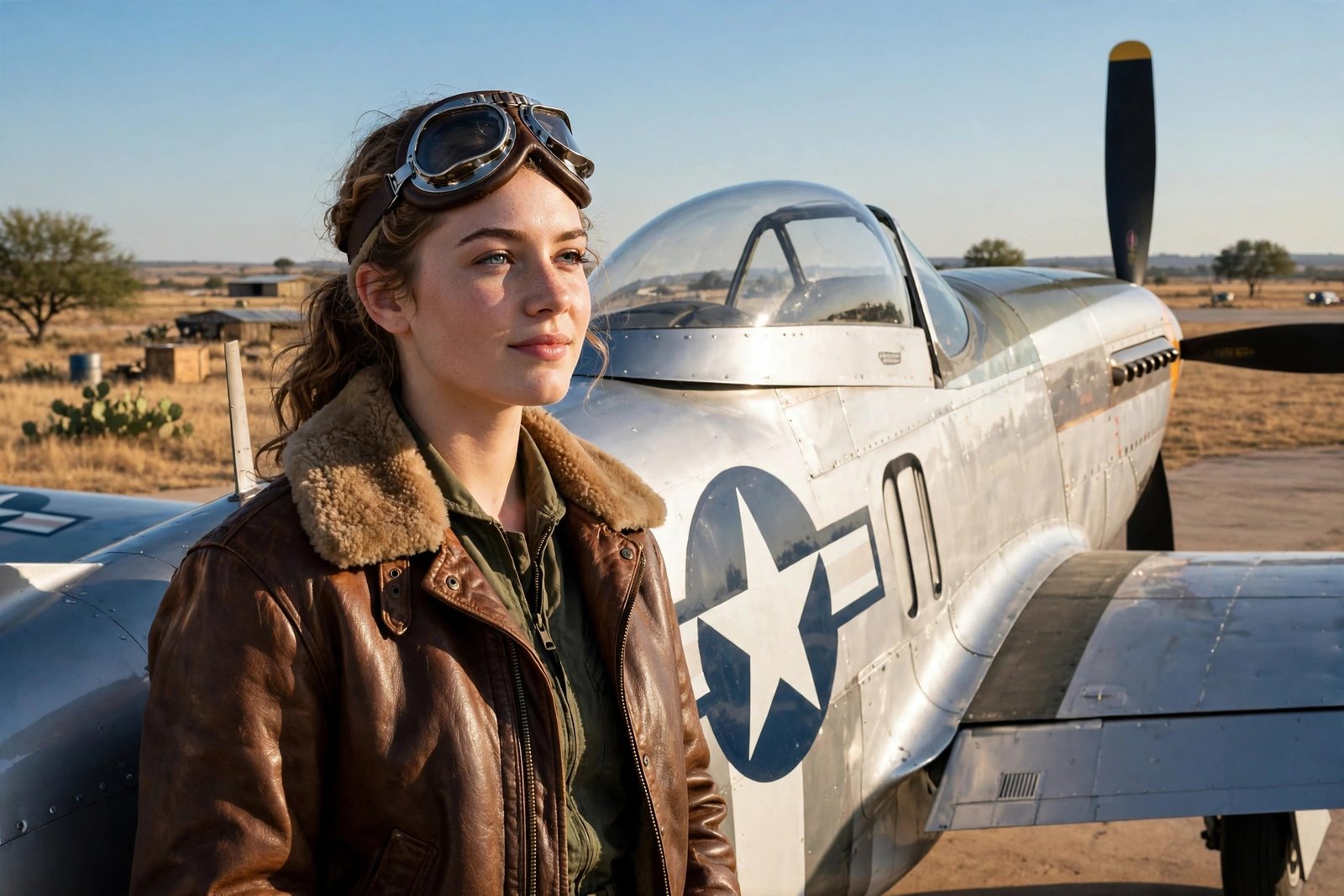
In the spring of 1943, a young woman climbed into the cockpit of a brand-new fighter plane at a factory in California, ran through her checks, and took off alone. The plane had never flown before. No man had tested it. She was not officially a soldier, and if anything went wrong, her family would have to pay to bring her body home. She flew it anyway, because that was her job. She was a WASP — a Women Airforce Service Pilot — and over the next year and a half, more than a thousand women like her would fly some of the most demanding non-combat missions of World War II, freeing male pilots for the fighting overseas.
Today the WASP are remembered as pioneers, the first women in history to fly American military aircraft. Their story was nearly lost: their records were sealed and their service went unrecognized for more than three decades. Yet without them, the American air war would have looked very different. This is the story of who they were, what they flew, what it cost them, and how long it took America to say thank you.
America Needed Pilots — and Two Women Had a Plan
When the United States entered World War II after the attack on Pearl Harbor in December 1941, the Army Air Forces faced a crushing problem. The country needed tens of thousands of pilots, and it needed them fast. Factories were turning out bombers and fighters at a remarkable pace, but every new airplane had to be flown from the factory to a base, tested, and delivered — work that tied up trained male pilots who were desperately needed in combat overseas.
Two experienced women pilots saw the answer before almost anyone else did. Jacqueline Cochran was one of the most famous aviators in America, a racing pilot who had set speed and altitude records and who knew General Henry “Hap” Arnold, the chief of the Army Air Forces, personally. Nancy Harkness Love was a quieter figure, a licensed commercial pilot with thousands of hours in the air. Both women believed the same thing: trained women pilots could fly the stateside missions, and the men could go to war. Cochran had already proved the point in 1941, when she took American women pilots to Britain to ferry aircraft for the Royal Air Force. Back home, Love pressed the Army to let women ferry planes within the United States, and in the autumn of 1942 the Army approved two separate women’s flying programs.
Two Programs, One Mission
The first program was the Women’s Auxiliary Ferrying Squadron, known as the WAFS, created in September 1942 under Nancy Love. Its pilots were already experienced: they needed a commercial license and hundreds of hours of flying time just to apply. Their job was to pick up new aircraft at factories and fly them to military bases across the country, and within weeks of reporting for duty they were ferrying planes across the eastern United States.
The second program was the Women’s Flying Training Detachment, or WFTD, run by Jacqueline Cochran. Where the WAFS took only seasoned pilots, the WFTD trained women from scratch, in the Army way. Its first class of 29 women reported to Houston Municipal Airport in November 1942 and began the same military flight training male cadets received. The school soon outgrew Houston, and in early 1943 it moved to Avenger Field in Sweetwater, Texas. Then, on August 5, 1943, General Arnold merged the two programs into a single organization: the Women Airforce Service Pilots, the WASP. Cochran became its director, and Love remained in charge of the ferrying division under her.
Avenger Field: Training the Army Way
Life at Avenger Field was no finishing school. The women who arrived in Sweetwater, Texas, had already beaten extraordinary odds just to get there. More than 25,000 women applied to the program. Only about 1,830 were accepted. And of those, only 1,074 earned their silver wings.
Training lasted about seven months. Each trainee completed roughly 560 hours of ground school and 210 hours of flight training, learning Morse code, meteorology, military law, physics, aircraft mechanics, and navigation. They drilled, marched, and took an oath of allegiance, flying in Texas heat and dust, in open-cockpit trainers and then in heavier, faster aircraft. They paid their own way to Texas, bought their own uniforms at first, and received civilian pay — because, astonishingly, they were classified as civilians, not soldiers. The women came from every part of the country and every walk of life: teachers, nurses, office workers, college students, and mothers, all between 21 and 35 years old.
Ferrying: The Workhorse Mission
The WASP’s biggest job was ferrying. Every week, American factories rolled out new fighters, bombers, and trainers, and every one of them had to reach a base, a port, or a training field. The WASP flew about 80 percent of the nation’s military ferrying missions, delivering 12,650 aircraft of 78 different types, and flew more than 60 million miles on operational flights from about 120 Army air bases across the United States.
Ferrying sounds routine until you think about what it actually involved. A WASP pilot might arrive at a factory in the morning, pick up a plane she had never flown before, study its manual for an hour, and then fly it hundreds of miles — alone — to a base she had never visited. There was no co-pilot and often no radio worthy of the name. Weather could close in, engines could fail, and landing fields could be little more than dirt strips. It was unglamorous, relentless work — and it was the backbone of the American air effort at home.
Test Pilots, Target Towers, and the B-29
Ferrying was only part of the story. As the program matured, the WASP took on missions that were more dangerous and more skilled. They flight-tested aircraft that had been repaired after damage, taking planes other pilots refused to fly up to check whether they were safe. They towed targets behind their aircraft while gunners practiced live fire at the sleeves trailing behind them. They flew tracking and searchlight missions at night, simulated strafing runs, laid smoke screens, and served as instructors training male pilots. And they flew the bombers: the B-17 Flying Fortress, the B-24 Liberator, and eventually the enormous B-29 Superfortress.
The B-29 story shows how much trust the Army eventually placed in them. In 1944, male pilots were refusing to fly the B-29 because of a string of fatal crashes caused by engine fires. Colonel Paul Tibbetts, who would later command the atomic bombing mission, asked for WASP pilots to demonstrate the plane. Two WASP, Dorthea Johnson and Dora Dougherty, trained on the B-29 and flew it from base to base, showing skeptical male crews that the aircraft could be flown safely and helping restore confidence in the bomber that would become central to the air war against Japan.
The Women Themselves
Behind the numbers were individual women whose lives tell the story better than any statistic. Cornelia Fort was a flight instructor giving a lesson near Pearl Harbor on December 7, 1941, when Japanese planes attacked, and she later joined the WAFS. She died in a mid-air collision in Texas in March 1943, the first WASP to lose her life in service.
Hazel Ying Lee was the first Chinese American woman to fly for the American military, and she died in November 1944 from injuries suffered in a landing collision — the last WASP to die on active duty. Ola Mildred Rexroat, a member of the Oglala Lakota Nation, also flew as a WASP. The program accepted very few women of color — only a handful in total — and no Black pilots at all, despite applications from accomplished Black aviators such as Willa Brown and Janet Bragg, who had trained white women who were accepted. It is a painful part of the record: these women broke a barrier of gender while the barrier of race still held.
Thirty-Eight Who Never Came Home
The work was dangerous, and the cost was real. During their service, 38 WASP died — 11 in training accidents and 27 on missions, in crashes, collisions, and mechanical failures. Gertrude Tompkins Silver disappeared in 1944 while ferrying a P-51 Mustang along the Pacific coast; her plane and her body were never found, and she remains the only WASP still listed as missing.
Because the WASP were classified as civilians, their deaths carried a cruelty that still shocks people today. Their families received no military death benefits, no flag for the coffin, and no gold star for the window. When a WASP died, her fellow pilots often took up a collection to pay for her body to be sent home, because the Army would not cover the cost. The women escorted each other’s coffins home themselves, on their own time and at their own expense. They buried their friends as civilians who had died in uniform, and they never forgot it.
Sent Home Without Thanks
By late 1944, the war was turning in the Allies’ favor, and the need for the WASP was fading. Male pilots were returning from combat, and a political fight was brewing in Congress over whether the WASP should be made part of the military. General Arnold supported militarization and asked Congress to grant the WASP military status. Congress refused.
On December 20, 1944, the WASP were deactivated. There was no ceremony, no parade, no thank-you from the nation they had served. The women were told to go home, and their records were sealed for more than 30 years. They paid their own way back, just as they had paid their own way to Texas. For decades afterward, the WASP were nearly forgotten, and many of the women rarely spoke of their service, even to their own families, because there was no official record to point to and no one had ever thanked them.
The Long Fight for Veteran Status
Recognition came slowly, and only because the women themselves fought for it. At a reunion in 1972, WASP veterans resolved to seek the veteran status they had earned. They gathered records, lobbied Congress, and told their stories to anyone who would listen. Their cause gained powerful allies, including Senator Barry Goldwater, himself a wartime pilot.
The fight was not easy — the Air Force opposed the move, and the legislation faced stiff resistance — but the women persisted, and in 1977, 33 years after they were disbanded, Congress passed legislation granting the WASP retroactive veteran status. President Jimmy Carter signed the bill into law on November 23, 1977. It was a victory, but a quiet one: the women were not invited to the signing ceremony, and when their service medals finally arrived, they came in the mail in plain brown envelopes, seven years later. In 2016, after another long campaign, they were granted permission for their cremated remains to be placed in the columbarium at Arlington National Cemetery.
The Congressional Gold Medal and a Legacy That Endures
The highest honor came in 2010. In 2009, Congress passed legislation awarding the WASP the Congressional Gold Medal, the nation’s highest civilian honor, and President Barack Obama signed it into law on July 1, 2009. On March 10, 2010, more than 200 surviving WASP gathered at the U.S. Capitol for the ceremony. The medal itself was presented to the Smithsonian’s National Air and Space Museum, where it remains part of the national collection.
Today the WASP are remembered in museums, books, and films, and their story is taught to new generations of pilots. The National WASP WWII Museum in Sweetwater, Texas, stands in a hangar at Avenger Field, preserving their uniforms, logbooks, and aircraft. And every woman who flies a military aircraft for the United States today follows a path the WASP helped to open. They flew 60 million miles, delivered thousands of aircraft, and proved, in the most practical way possible, that women could fly anything the military owned — while being paid less than male pilots, denied military status, and sent home without thanks, and then spending decades fighting to have their service recognized.
Related reading
If this story caught your interest, keep exploring American military history on Famus News:
- The Tuskegee Airmen: The Red Tails Who Changed the Air War
- Women in the U.S. Army: Milestones That Changed Military History
- Audie Murphy: America’s Most Decorated Soldier
Frequently Asked Questions
Who were the WASP in World War II?
The Women Airforce Service Pilots were civilian women who flew American military aircraft on non-combat missions during World War II. Formed on August 5, 1943, by merging the Women’s Auxiliary Ferrying Squadron and the Women’s Flying Training Detachment, they ferried aircraft, flight-tested planes, towed targets for gunnery practice, and trained male pilots, freeing men for combat duty overseas.
How many women served as WASP?
More than 25,000 women applied to the program. About 1,830 were accepted, and 1,074 earned their wings after completing training at Avenger Field in Sweetwater, Texas. They flew more than 60 million miles and delivered 12,650 aircraft of 78 different types.
Why were the WASP not considered military veterans during the war?
The WASP were classified as civilian employees of the Army Air Forces, not members of the military. Congress voted against granting them military status in 1944, and the program was deactivated on December 20, 1944. They were not granted retroactive veteran status until 1977, under legislation signed by President Jimmy Carter.
How many WASP died in service?
Thirty-eight WASP died in service, including 11 in training accidents and 27 on missions. Because they were civilians, their families received no military death benefits and had to pay to bring their bodies home. One WASP, Gertrude Tompkins Silver, disappeared in 1944 and remains listed as missing.
When did the WASP receive the Congressional Gold Medal?
Congress passed legislation awarding the WASP the Congressional Gold Medal in 2009, and President Barack Obama signed it into law on July 1, 2009. The medal was presented at a ceremony at the U.S. Capitol on March 10, 2010, attended by more than 200 surviving WASP, and is now held by the Smithsonian’s National Air and Space Museum.
To learn more, visit the Smithsonian National Air and Space Museum’s WASP history, the National WWII Museum’s account of the WASP, the Bullock Texas State History Museum’s WASP story, the National Museum of the Pacific War’s WASP exhibit, and the text of Public Law 111-40 awarding the Congressional Gold Medal.