
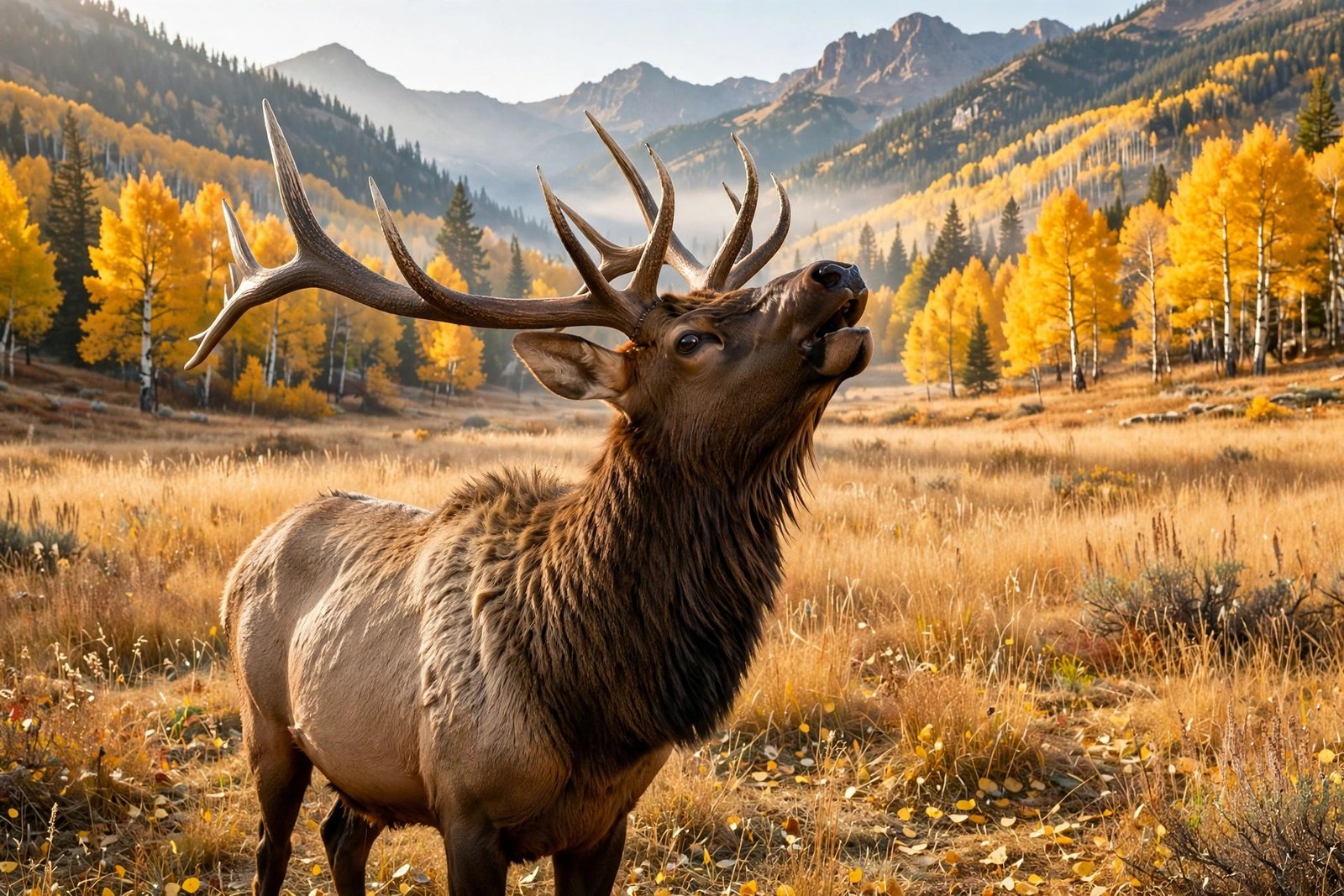
There is a sound in the Colorado Rockies every fall that stops people in their tracks. It starts as a low grunt, rises into a high, piercing whistle, and then breaks into a series of sharp chuckles that echo across the meadow and off the mountains. It is the bugle of a bull elk, and for a few weeks each autumn it is the soundtrack of Rocky Mountain National Park. The meadows fill with herds, the bulls square off against each other, and thousands of visitors gather at dawn and dusk to watch one of the great wildlife shows in America. It is called the elk rut, and it is the most popular wildlife season in the park for a reason: there is nothing else in the American outdoors quite like it.
What Is the Elk Rut?
The rut is the annual breeding season for elk, when mature bulls compete for the right to mate with groups of cows. For most of the year, bull elk and cow elk live largely separate lives. Bulls spend the summer in bachelor groups in the high country, growing the antlers they will need in the fall. Cows stay in herds with their calves in the meadows and valleys. As summer ends and the days shorten, that changes. Testosterone rises in the bulls, the velvet peels away from their antlers, and the bulls come down from the high country to the lower meadows where the cows have gathered.
Once the bulls arrive, the meadows become a contest. A dominant bull will gather a group of cows, called a harem, and try to keep them together while other bulls circle, challenge him, and try to steal cows away. The competition is constant and physical. Bulls posture, display their antlers, chase rivals, and when neither will back down, they lock antlers and push against each other in tests of strength that can last for minutes. The winner keeps his harem. The loser moves off to try again somewhere else, or waits for a younger bull to make a mistake.
When Does the Rut Happen?
In Rocky Mountain National Park, the elk rut generally runs from mid-September through mid-October, with the peak usually falling in the last two weeks of September and the first week of October. The earliest signs appear earlier than that. Around the second week of August, bulls begin shedding the velvet from their antlers, a sign that the antlers have finished growing and testosterone is rising. The bulls sharpen and smooth their antlers by rubbing them against trees, branches, and shrubs, and as August turns into September, the bugling begins in earnest.
The National Park Service closes the key viewing meadows to foot traffic from September 1 through October 31 each year, which covers the whole rut and the weeks on either side of it. By mid-October, as cows are bred and testosterone levels in the bulls begin to fall, the activity winds down. By early November, many bulls have gathered back into bachelor herds and moved out of sight to rest and recover. The meadows go quiet, the bugling fades, and the snow begins to settle over the dried grasses.
The Sound of the Rut: Why Elk Bugle
The bugle is the sound most people remember longest after a rut trip, and it is stranger than most first-time visitors expect. It is not a roar or a bellow. It usually starts with a series of low grunts, rises into a high-pitched whistle or scream, and finishes with a run of short grunts and chuckles.
Bulls bugle for more than one reason. The main purpose is to advertise dominance and attract cows, but bugling also warns rival bulls to stay away and helps bulls keep track of each other across the meadow. The sound carries information: a deep, strong bugle suggests a large, healthy bull, and younger bulls learn to read those signals before deciding whether to challenge. Cows listen too, and a bull that bugles often and holds his ground is more likely to keep his harem together. Elk also bugle at other times of year, including in the summer, when the calls are used to locate each other, but the fall bugle is different: louder, more frequent, and charged with the urgency of the mating season.
Bulls, Harems, and the Contest for Dominance
The social drama of the rut centers on the harem. A mature bull, usually one with a large rack of antlers and several years of experience, will gather a group of cows and try to hold them together as a unit. He patrols the edges of his group constantly, bugling to warn rivals, chasing off younger bulls that come too close, and herding any cow that wanders away back into the group. The work never stops, and the bull does it while barely eating or resting.
The challengers are usually younger bulls, sometimes called satellite bulls, that hang around the edges of a harem looking for an opening. A satellite bull may try to slip in and breed with a cow while the dominant bull is busy elsewhere, or he may challenge the herd bull directly. When two bulls decide to settle it, they lower their heads, lock antlers, and push. These fights are tests of strength and endurance, and they can be violent, but they are also ritualized: the bulls are built for this, with thick necks and heavy skulls, and most contests end with one bull giving ground rather than with serious injury. Antlers do break, and bulls do get hurt, but the system has worked for thousands of years.
Where to Watch: Moraine Park, Horseshoe Park, and Beyond
Rocky Mountain National Park has several meadows where the rut plays out, and three of them do most of the work. Moraine Park, reached by Bear Lake Road, is the most productive viewing spot in the park, with large herds gathering in the open meadow where they are easy to see from the roadside. Horseshoe Park, on U.S. Highway 34 near the Fall River entrance, is the other classic location, with wide views across the meadow and good pullouts for parking. Upper Beaver Meadows, also on the east side of the park, is a third prime spot, and the Kawuneeche Valley on the west side of the park offers a quieter alternative with fewer crowds.
Each meadow has its own character. Moraine Park tends to have the largest numbers of animals and the most bugling, which is why it also has the largest crowds. Horseshoe Park offers big open views and is a good place to watch the herds from a distance with binoculars. Upper Beaver Meadows is smaller and can feel more intimate. The Kawuneeche Valley, on the west side of the Continental Divide, is worth the drive for visitors who want to escape the east-side crowds, though the herds there are smaller. Elk can also be seen in many other parts of the park, including along Trail Ridge Road and around Sheep Lakes, so it pays to keep your eyes open wherever you are driving.
The Rules: Meadow Closures, 75 Feet, and No Calling
The park protects both the elk and the visitors during the rut with a set of rules that are simple, strict, and worth knowing before you go. The most important is distance. The National Park Service requires visitors to stay at least 75 feet from elk, about the length of two school buses. That is a minimum, not a target. If an elk notices you, stops what it is doing, changes direction, or turns its attention toward you, you are too close and should back away. Many experienced watchers stay much farther back and use binoculars or a camera with a zoom lens instead of moving closer.
From September 1 through October 31, five meadows are closed to all foot travel from 5 p.m. to 10 a.m. daily: Horseshoe Park, Moraine Park, Upper Beaver Meadows, Harbison Meadow, and Holzwarth Meadow. During those hours, visitors must stay on designated roads and established trails and watch from the roadside or pullouts. The closures cover exactly the hours when elk are most active, which is the point: the meadows belong to the elk at dawn and dusk. Fishing spots along the Fall River, Big Thompson River, and Colorado River that are reached by walking through the closed meadows are also closed to anglers from 5 p.m. to 7 a.m. during the same period.
A few other rules catch visitors by surprise. Elk calling, imitating a bugle to attract or challenge a bull, is prohibited in the park, and so is using spotlights or vehicle headlights to spot wildlife after dark. Approaching, harassing, or feeding wildlife is illegal, and feeding elk is also illegal under Colorado law. When you park to watch, turn off your car lights and engine, shut doors quietly, and keep conversations low. The park’s own advice is simple: let wildlife be wild, and observe from a distance. Rangers staff viewing areas on busy weekends to help visitors find the elk and to keep everyone at a safe distance.
Planning Your Trip to the Rut
A little planning goes a long way during the rut, because it is one of the busiest times of year in the park. Local guides to watching elk safely in Estes Park are worth reading before you go. Rocky Mountain National Park uses a timed-entry reservation system during much of the season. For the Bear Lake Corridor, which includes Moraine Park, a timed-entry reservation is required from 5 a.m. to 6 p.m. through mid-October. For the rest of the park, including Horseshoe Park, Upper Beaver Meadows, and Trail Ridge Road, timed entry is required from 9 a.m. to 2 p.m. through mid-October. Driving onto Bear Lake Road after 6 p.m. does not require a timed-entry reservation, which suits evening elk watchers, but check the park’s current rules before your trip, since dates and hours can change from year to year.
Arrive early or stay late. The meadows are busiest at dawn and dusk, which are also the best times to see elk, so the roadside pullouts fill up fast on weekend evenings. If you can visit on a weekday, you will have more room and quieter viewing. Dress in layers, because mornings in the park in September and October are cold, often near freezing at dawn, even when the afternoon is warm. Bring binoculars or a spotting scope, since the best viewing is from a distance, and a camera with a zoom lens if you want photographs. Bring water, snacks, and patience: the elk set the schedule, and the most memorable mornings are often the ones where you waited an hour for a bull to step out of the trees and bugle.
Think about where you will stay, too. Estes Park, on the east side of the park, is the main gateway town, with lodging, restaurants, and the Elk Fest in early October. Grand Lake, on the west side, is quieter and gives easy access to the Kawuneeche Valley. Both towns fill up during the rut, so book lodging well ahead if you are visiting on a weekend. If you are driving Trail Ridge Road, remember that it is the highest continuous paved road in the United States and can close for weather even in early fall, so check road conditions before you set out.
Elk Beyond the Rut: A Colorado Icon
The rut is the most dramatic season for elk, but it is worth remembering that these animals are a Colorado icon all year round. Elk are the most visible large animal in Rocky Mountain National Park, and they are a central part of the park’s ecosystem, grazing the meadows, shaping the vegetation, and providing food for predators and scavengers. Colorado Parks and Wildlife manages elk across the state, and the herds in and around the park are among the most watched in the country.
Related reading
Keep exploring America’s wildlife and national parks with these related articles from Famus News:
- Bison in Yellowstone: America’s Largest Land Animal
- Grizzly Bears in Yellowstone: A Wildlife Guide
- Gray Wolves: The Yellowstone Comeback Story
Frequently Asked Questions
When is the elk rut in Rocky Mountain National Park?
The rut generally runs from mid-September through mid-October, with the peak usually in the last two weeks of September and the first week of October. Bulls begin shedding the velvet from their antlers in mid-August, and by mid-October the activity winds down as the bulls return to bachelor herds to recover.
Where is the best place to watch the elk rut?
Moraine Park, Horseshoe Park, and Upper Beaver Meadows are the most popular viewing spots, with large herds gathering in the open meadows at dawn and dusk. The Kawuneeche Valley on the park’s west side is a quieter alternative. Elk can also be seen around the town of Estes Park, especially along Fish Creek Road.
How far away should I stay from elk?
The National Park Service requires visitors to stay at least 75 feet from elk, about the length of two school buses. During the rut, it is wise to stay even farther back, since bulls are aggressive and unpredictable. If an elk notices you or changes its behavior because of you, you are too close and should move away.
Can I imitate an elk bugle to attract them?
No. Elk calling is prohibited in Rocky Mountain National Park, and using spotlights or vehicle headlights to spot wildlife is also prohibited. Imitating a bugle can be interpreted by a bull as a challenge and can put you and the elk in danger. Use binoculars and a zoom lens instead.
Do I need a reservation to visit during the rut?
Rocky Mountain National Park uses a timed-entry reservation system during the rut season. A reservation is required for the Bear Lake Corridor, which includes Moraine Park, from 5 a.m. to 6 p.m. through mid-October, and for the rest of the park from 9 a.m. to 2 p.m. Driving onto Bear Lake Road after 6 p.m. does not require a timed-entry reservation. Check the park’s website for current dates and hours before your visit.