
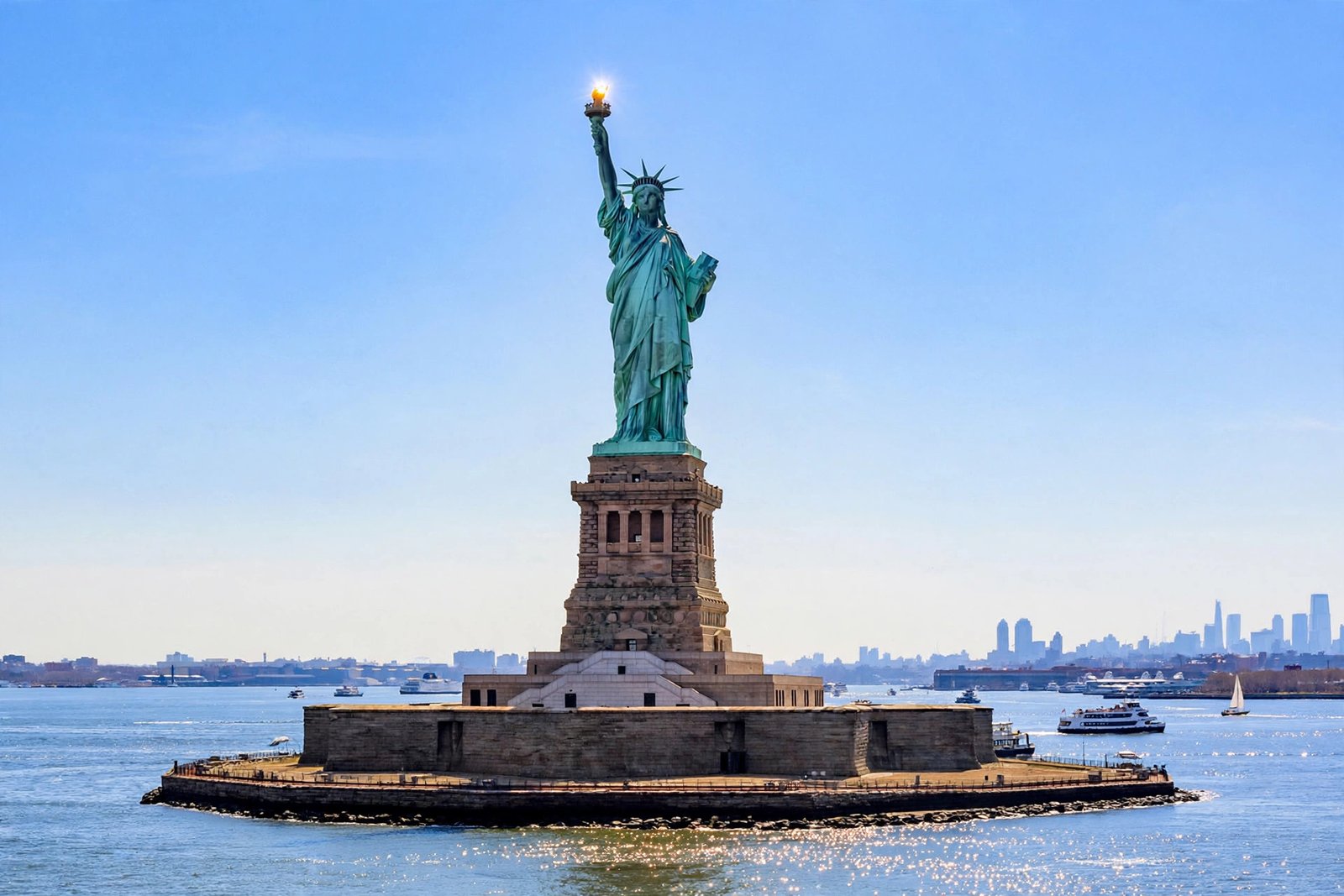
Ask almost anyone in America what color the Statue of Liberty is, and the answer comes back instantly: green. It is one of the most famous colors in the country, as recognizable as the red of a fire truck or the blue of the flag. But here is the twist that surprises nearly everyone who learns it. The Statue of Liberty was not built green. When she was dedicated on October 28, 1886, she was the color of a shiny new penny, a warm reddish brown. The green we know today arrived slowly, over decades, and it was never painted on. It is the result of chemistry, weather, and time, and it tells a story that runs from a Paris workshop to a New York harbor island.
The short answer is that the statue is covered in copper, and copper turns green when it reacts with air and water over many years. The green coating is called a patina, and it is the same kind of change you can see on an old copper roof or a weathered penny left outside. The change took about thirty years to cover the whole statue, and the result is a layer that now protects the copper underneath. The green is not damage. It is armor, and it is one of the reasons the statue has survived more than a century of harbor weather.
A Gift From France
The Statue of Liberty was a gift from the people of France to the people of the United States, and it was meant to celebrate the friendship between the two countries, a friendship that went back to the American Revolution. The statue’s full name is Liberty Enlightening the World, and it was designed to mark the centennial of the Declaration of Independence. The French sculptor Frédéric Auguste Bartholdi created the design, a robed figure of Libertas, the Roman goddess of liberty, holding a torch high in her right hand and a tablet in her left.
Building the statue was an international project. The copper figure was built in France, taken apart, packed into crates, and shipped across the Atlantic to New York. The pedestal it stands on was built in the United States, paid for by American donations after a fundraising campaign. When the pieces arrived in New York Harbor, they were reassembled on Liberty Island, then known as Bedloe’s Island, and the statue was dedicated on October 28, 1886, in a ceremony attended by thousands of people. The National Park Service FAQ has the full story of the statue’s origins and its construction.
Bartholdi’s Design: A Figure Full of Meaning
Bartholdi packed the statue with symbols, and nearly every part of it means something. The torch in her raised right hand is a symbol of enlightenment, lighting the way to freedom. The tablet in her left arm is inscribed with the date of the Declaration of Independence in Roman numerals, July 4, 1776. The crown on her head has seven spikes, representing the seven seas and seven continents, a sign that liberty is meant for the whole world. The broken chain at her feet, partly hidden by her robe, represents freedom from oppression.
Bartholdi decided early on that the statue would be made of copper, a choice that shaped everything that followed. Copper is light for its strength, it can be hammered into thin sheets, and it weathers well outdoors. The sculptor had the copper sheets shaped using a technique called repoussé, in which the metal is hammered from the back to create the curves of the figure. The result was a statue that looks solid and monumental from a distance but is actually a thin copper skin, shaped by hand, piece by piece, in a Paris workshop.
Gustave Eiffel’s Iron Framework
A statue that tall cannot stand on copper alone. The copper skin is only 3/32 of an inch thick, about the same as two American pennies placed together, and it needs a strong skeleton to hold it up. That skeleton was designed by Gustave Eiffel, the French engineer who would later build the Eiffel Tower in Paris. Eiffel created an iron framework, a kind of internal tower, that carries the weight of the statue and lets it flex in the wind.
The framework is one of the cleverest parts of the whole statue. The copper skin is not bolted rigidly to the iron. It is attached with flexible iron straps, which let the skin move slightly as the metal expands and contracts with temperature and as the wind pushes against the figure. The statue can sway up to 3 inches in strong winds, and the torch can sway even more. That flexibility is what keeps the thin copper from cracking. It was a new idea at the time, and it is one of the reasons the statue has lasted so long. The National Park Service statistics page lists the statue’s measurements and materials in detail.
How Much Copper Are We Talking About?
The numbers behind the statue are impressive. The copper used in the statue weighs about 176,000 pounds, according to Bartholdi, and the total weight of the structure is almost 440,000 pounds. The copper figure itself, measured from the top of its base to the tip of the torch, stands 151 feet 1 inch tall. With the pedestal and foundation included, the height from ground level to the tip of the torch is 305 feet 1 inch. When it was completed in 1886, the statue was the tallest structure in New York City.
Those numbers help explain why the color change was so visible and so slow. The statue has an enormous surface area, and every inch of it was exposed to the same harbor air, the same rain, and the same salt spray. The change did not happen all at once. It crept across the surface, patch by patch, over decades, until the whole figure had turned the pale green we know today. A small copper roof turning green is a curiosity. A 151-foot statue turning green is a landmark changing color in front of the whole world.
How Copper Turns Green: The Chemistry
The green coating on the Statue of Liberty is the result of a slow chemical process called oxidation. When copper is exposed to air and moisture, it reacts with oxygen and forms a dark layer on its surface. Over time, that layer reacts further with water, carbon dioxide, and other substances in the air, and the color shifts from brown to a blue-green. The final coating is a mixture of copper compounds, and its common name is verdigris, though the National Park Service usually just calls it a patina.
The process took about thirty years on the Statue of Liberty. The first signs of green appeared shortly after 1900, and by 1906 the patina had covered the entire statue. The change was so striking that it worried people at the time. Some believed the green was a sign that the statue was corroding and falling apart, and Congress authorized money for repairs and even considered painting the statue. The Army Corps of Engineers studied the patina and concluded that it was not harming the statue at all. In fact, the opposite was true. The statue was painted only on the inside, and the green outside was left alone.
Why the Green Actually Protects the Statue
The patina is not just a color. It is a protective shell. The National Park Service explains that the patina is as thick, in many places, as the copper behind it, and it protects the copper from naturally wearing away. The green layer seals the surface, slowing further chemical reactions and shielding the metal from rain, salt spray, and pollution. Without it, the thin copper skin would wear away far faster in the harsh harbor environment.
This is the same reason old copper roofs and church domes turn green and stay green for centuries. The patina is stable, it sticks tightly to the metal, and it stops the corrosion from going deeper. Cleaning it off would do more harm than good, because it would expose fresh copper to the air and start the whole process over again, wearing the statue down a little more each time. That is why the green has been left in place for more than a century, and why the statue’s caretakers now see it as part of the statue itself, not as something to fix.
The Torch: The One Part That Shines Gold
If you look closely at the Statue of Liberty today, one part does not match the rest. The torch is not green. It is gold. That is because the torch you see now is not the original. The first torch’s interior support structure corroded beyond repair over the decades, and during the statue’s major restoration in the 1980s, it was replaced with a new torch built to Bartholdi’s original design. The replacement torch was installed in 1986, and it is a copper flame covered in 24-karat gold leaf, which reflects sunlight during the day and is lit by floodlights at night.
The original torch was removed in 1984 and is now on display in the Statue of Liberty Museum on the island, where visitors can see it up close. The restoration that produced the new torch was an enormous project. Workers repaired holes in the copper skin, removed layers of paint from the interior, and replaced the rusting iron armature bars that joined the copper skin to the internal skeleton with stainless steel bars that will not corrode. The work was completed in time for the statue’s centennial in 1986, and the restored statue reopened to the public on July 5, 1986. The National Park Service restoration page describes the project in detail.
The Statue Through the Years
The Statue of Liberty has been cared for by the National Park Service since 1933, when it became part of the Statue of Liberty National Monument. Before that, it was administered by the United States Lighthouse Board and then by the Department of War. The statue was designated a National Monument in 1924, and in 1984, at the start of the centennial restoration, the United Nations designated it a World Heritage Site, recognizing it as a place of outstanding value to all of humanity.
The statue has also changed with the times around it. Its torch was extinguished during the blackout regulations of the Second World War, and the island’s name was changed from Bedloe’s Island to Liberty Island in 1956. Through it all, the green figure has stayed the same, a fixed point in a harbor that has changed around her. The National Park Service history pages trace that story from the dedication in 1886 to the present day.
Visiting the Statue of Liberty Today
Seeing the statue in person is the best way to understand the green. From a ferry in the harbor, the color looks soft and pale, almost blue in some light and more green in others. Up close, from the island, the patina has a texture you can see, a slightly rough surface that catches the light differently than a painted wall would. The green is not uniform. It shifts with the weather, the time of day, and the angle of the sun, which is part of why photographs of the statue never quite look the same twice.
Visitors can tour Liberty Island, visit the museum, and climb to the pedestal and the crown, though the crown requires a separate reservation and the torch itself has never been open to the public. The ferry from Battery Park in Manhattan or Liberty State Park in New Jersey is the only way to reach the island, and tickets should be booked ahead, especially in the summer. The National Park Service fact sheet has the essential details on the monument, including its location on a 12-acre island in New York Harbor and its history as a gift of friendship from France.
Why the Green Still Matters
The green of the Statue of Liberty has become more than a chemical accident. It is part of how America pictures itself. The color appears on postcards, stamps, souvenirs, and schoolbooks, and it is the color children draw when they draw the statue. The statue’s green was not chosen by an artist. It was made by air, water, and time, and it turned out to be one of the most beautiful accidents in American history.
There is a lesson in that for anyone who visits. The statue was built to celebrate liberty, and the green that covers it is a sign of endurance. The next time you see the statue, whether in person or in a photograph, remember that you are looking at two stories at once: the story of a gift from France, and the story of a metal that learned to protect itself by turning green.
Frequently Asked Questions
Why is the Statue of Liberty green? The statue is covered in copper, and copper naturally oxidizes when exposed to air and water over many years. The green coating is called a patina. It took about thirty years to cover the whole statue, and by 1906 the green had spread across the entire figure.
Was the Statue of Liberty always green? No. When the statue was dedicated on October 28, 1886, it was the reddish-brown color of shiny copper, like a new penny. The green appeared gradually, starting shortly after 1900, and it was never painted on.
Who designed the Statue of Liberty? The statue was designed by the French sculptor Frédéric Auguste Bartholdi. Its metal framework was engineered by Gustave Eiffel, the French engineer who later built the Eiffel Tower in Paris. The statue was a gift from the people of France to the people of the United States.
How tall is the Statue of Liberty? The copper statue itself measures 151 feet 1 inch from the top of its base to the tip of the torch. Including the pedestal and foundation, the height from ground level to the tip of the torch is 305 feet 1 inch.
Why is the torch gold instead of green? The torch you see today is a replacement installed in 1986 during the statue’s centennial restoration. It is a copper flame covered in 24-karat gold leaf. The original torch was removed in 1984 and is now on display in the Statue of Liberty Museum.
Related reading
Keep exploring American history and landmarks: Ellis Island: America’s Immigration Gateway, The American Flag: Stars, Stripes, and Meaning, and Route 66: Facts About the Mother Road.