
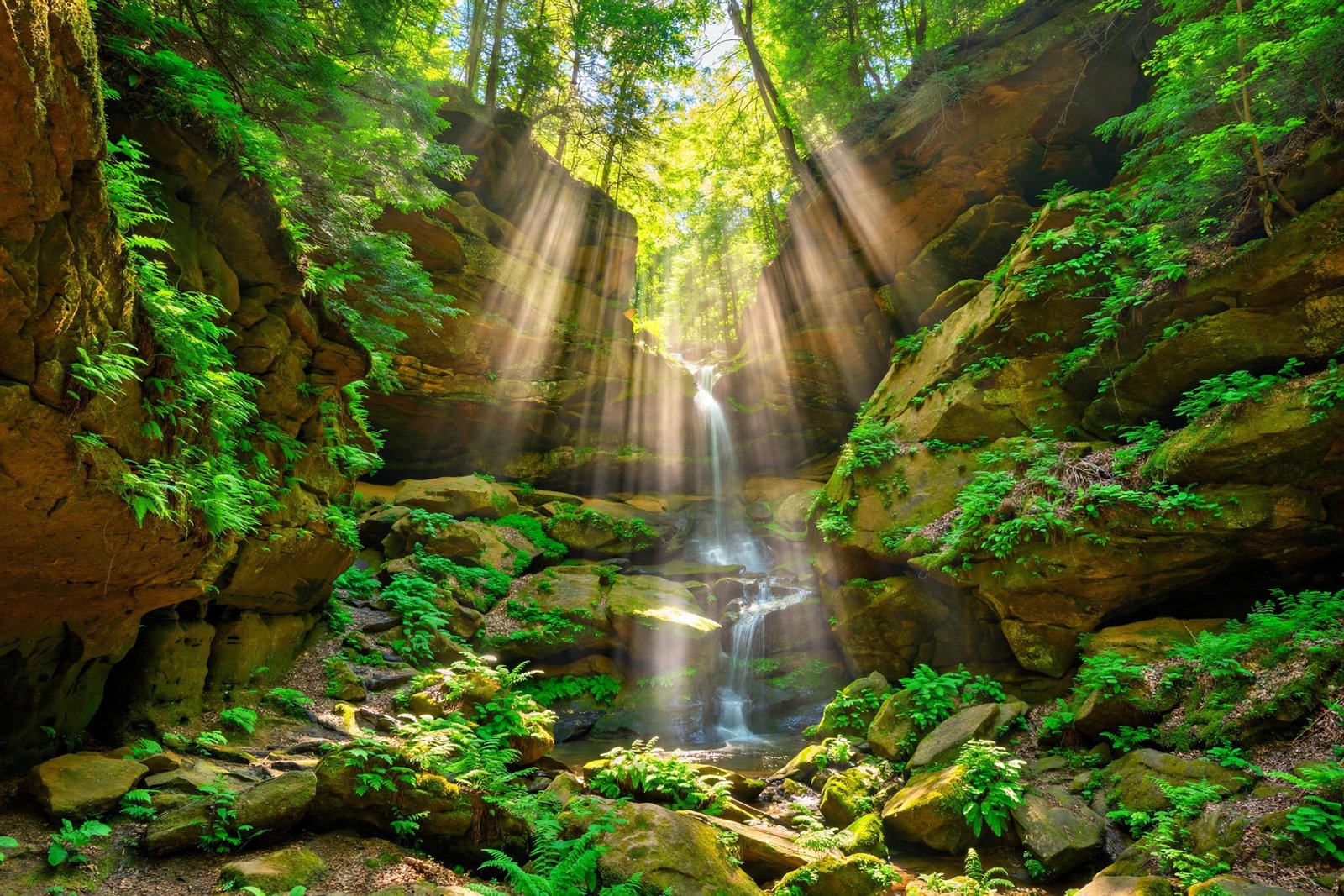
Drive south from Columbus, Ohio, and the landscape starts to change. The flat farmland gives way to rolling hills, the road dips into wooded valleys, and suddenly you are standing at the edge of a gorge so deep and green it feels like it belongs in another state entirely. This is Hocking Hills State Park, a 2,356-acre pocket of sandstone cliffs, recess caves, and waterfalls tucked into Hocking County in southeastern Ohio. It is one of the most beautiful places in the Midwest. People arrive expecting a pleasant walk in the woods and leave talking about the place for years.
The park is not one single valley but a collection of separate areas, each with its own character. Old Man’s Cave has the waterfalls and the gorge. Ash Cave has the enormous sandstone amphitheater. Cedar Falls has the widest cascade. Rock House has the only true cave in the park. Cantwell Cliffs has the narrow passages and the rugged climbs. Together they add up to more than 25 miles of hiking trails, all managed by the Ohio Department of Natural Resources. There is no entrance fee, the trails are open year-round from dawn to dusk, and the scenery changes completely with the seasons, which is why so many Ohio families return again and again.
Why Hocking Hills Feels Like a Secret
Ohio is not the first state most Americans associate with canyons and waterfalls, and that is exactly why Hocking Hills feels like a discovery. The park sits in the unglaciated hill country of southeastern Ohio, a region the glaciers never flattened. While much of northern Ohio was smoothed by ice, this corner kept its ancient hills, and water spent millions of years carving Blackhand sandstone into gorges, recess caves, and cliffs. The result is a landscape that looks far older and wilder than the farmland around it.
The name comes from the Hocking River, which flows through the region. Walk into one of the gorges on a summer afternoon and the temperature drops noticeably. Hemlock trees shade the gorge floors, ferns and mosses cover the rocks, and waterfalls feed clear, cold streams. It is a pocket of cool, damp forest that feels more like the Appalachians than the Midwest, and on a hot July day that shade is one of the park’s greatest gifts. Its six main hiking areas are spread across the region, each with its own parking lot, so the park feels less like a single attraction and more like a region to explore, one gorge at a time.
How the Canyons and Caves Were Formed
The story of Hocking Hills begins hundreds of millions of years ago, when this part of Ohio lay beneath a shallow sea. Sand settled on the sea floor and slowly hardened into Blackhand sandstone, a rock that is strong in some layers and soft in others. When the sea retreated, streams and weather went to work on the softer layers, carving them away while the harder rock above held its shape. That uneven erosion created the park’s signature features: deep gorges, overhanging cliffs, and recess caves that look like giant stone amphitheaters.
A recess cave is not a cave you crawl into. It is a huge, curved hollow worn into the face of a cliff, open to the sky on one side, with a waterfall often spilling over the rim. Ash Cave is the most dramatic example, a horseshoe of sandstone roughly 700 feet across. Old Man’s Cave is a gorge rather than a single cave, a winding canyon carved by Old Man’s Creek. Rock House is the exception: the only true cave in the park, a tunnel-like corridor with window-like openings. The hemlocks that shade the gorges thrive in the cool, moist air of the canyon floors, keeping the gorge environment damp and lush even in summer.
A Short History: From Private Land to State Park
For much of the nineteenth century, the land that is now Hocking Hills State Park was in private hands, used for farming and timber. The scenic gorges were known locally, but there was no public park and no protection for the caves and waterfalls. That began to change in the early 1920s, when a growing movement for state parks reached Ohio. In 1924, the state made its first land purchase in the Hocking Hills, a parcel of 146 acres that included Old Man’s Cave. It was a modest beginning, but it was the start of something that would grow for a century.
More land was added piece by piece, and the areas were managed as state forest parks under the Department of Forestry. The modern park took its current shape in 1949, when the Ohio Department of Natural Resources was created and its new Division of Parks took over the Hocking Hills complex. The ODNR park page is the best place to check current conditions, maps, and alerts before a visit. One beloved trail carries history in its name: the six-mile Grandma Gatewood Trail links Old Man’s Cave to Cedar Falls to Ash Cave, honoring Emma Gatewood, an Ohio grandmother who became the first woman to hike the Appalachian Trail alone, at age 67.
Old Man’s Cave: The Heart of the Park
If you only visit one area of Hocking Hills, make it Old Man’s Cave. It is the most popular site in the park, and for good reason. The trail winds through a deep gorge carved by Old Man’s Creek, passing a sequence of waterfalls and rock formations that reads like a greatest-hits tour of the park. You will pass Upper Falls, where the creek drops over a wide ledge, then the Devil’s Bathtub, a swirling pool worn into the rock, then Middle Falls and Lower Falls, each with its own character. Stone bridges and staircases carry the trail through the gorge, and tunnels cut through the rock in places.
The cave itself is a massive recess cave, an enormous natural alcove gouged into the sandstone cliff, believed to be named for Richard Rowe, an eighteenth-century hermit said to have lived in the gorge. Old Man’s Cave is also where you will find the park’s visitor center, near the main parking area. Stop there first for a map. The trails here now run one-way in places for safety, so follow the directional signs, and arrive early on weekends, because the main parking lot fills up fast.
Ash Cave: The Giant Amphitheater
Ash Cave sits in the southern reaches of the park, and it is the single most spectacular feature in Hocking Hills. It is the largest recess cave in the state, a horseshoe-shaped cliff roughly 700 feet across, with a seasonal waterfall spilling over the rim into the sandy floor below. Stand in the middle of it and the scale is hard to take in. The cliff curves around you on three sides, the sky opens above, and your voice comes back to you as an echo. It is less a cave than a natural cathedral, and it is the one stop in the park that leaves almost every visitor speechless.
The walk to Ash Cave is also the easiest in the park. The gorge trail is about a quarter of a mile, mostly flat and wheelchair accessible, a good choice for families with small children or older visitors. A longer rim trail loops above the cave for hikers who want a workout. The waterfall is seasonal, running strongest after rain and in the spring. Visit in winter if you get the chance: the waterfall freezes into a column of ice, and icicles hang from the rim like a chandelier.
Cedar Falls: The Park’s Greatest Waterfall
Cedar Falls is the greatest waterfall in the Hocking Hills in terms of water volume, and it is also one of the most beautiful. The falls spill over a broad sandstone ledge into a pool below, surrounded by hemlock trees and ferns. The setting is quieter than Old Man’s Cave, which is exactly why many regular visitors call it their favorite. It is a place to sit on a rock, listen to the water, and take your time.
The name is a mistake that stuck. Early settlers called the hemlock trees in the area cedars, and the falls took their name from the trees. There are no cedars at Cedar Falls, only hemlocks, but the name has survived for generations. The Grandma Gatewood Trail connects Cedar Falls to Old Man’s Cave and Ash Cave, so strong hikers can walk between all three areas on a single six-mile route. Cedar Falls is at its best after rain, when the water spreads across the full width of the ledge, but the gorge is worth the walk even in dry spells.
Rock House: The Only True Cave
Rock House is the one place in Hocking Hills that is a genuine cave rather than a recess or an alcove. It is a tunnel-like corridor worn through a cliff of Blackhand sandstone, roughly 25 feet high, 200 feet long, and 20 to 30 feet wide, with window-like openings carved by erosion along its length. Walking through it feels completely different from standing in a recess cave. The light changes as you move, the openings frame views of the valley below, and the rock overhead makes the passage feel like a hidden hallway.
The cave has a colorful past. It is said to have been used as a shelter by Native peoples, and later as a hideout by outlaws, earning it the nickname Robber’s Roost. The trail to Rock House is steep in places, with stone steps leading up the cliff, so wear sturdy shoes. Rock House is less visited than Old Man’s Cave or Ash Cave, and it is one of the best places in the park for photography, because the window openings create natural frames for the forest outside.
Cantwell Cliffs: The Rugged Side of the Park
Cantwell Cliffs sits in the northern reaches of the park, about 17 miles from Old Man’s Cave by road, and it is the most rugged of the six main areas. The cliffs here are steep, the gorge is deep, and the trail is more demanding than the walks at Ash Cave or Cedar Falls. The reward is a wilder, quieter experience, with narrow passages, sheer rock walls, and views that feel earned rather than given. It is named for the Cantwell family, who settled in the region.
The most famous feature at Cantwell Cliffs is a narrow passage known as Fat Man’s Squeeze, a slot between two rock walls that hikers pass through on the trail. The trail also includes stone staircases, a deep gorge, and a waterfall in the valley below. The loop is about two miles and is rated difficult, so this is the area to choose when you want a real hike. Because it is farther from the main cluster of areas, it draws fewer visitors, and that is part of its appeal. Just be prepared for the climb, bring plenty of water, and stay on the marked trail, because the cliffs here are steep and the footing can be slippery after rain.
Planning Your Visit: Seasons, Trails, and Rules
Hocking Hills is a year-round park, and each season offers something different. Spring brings the strongest waterfalls and the first wildflowers. Summer brings deep green shade in the gorges and the busiest trails. Autumn brings fall color in the hardwood forest above the cliffs, and it is many people’s favorite season. Winter brings frozen waterfalls, icicles, and a quiet you will not find in any other season. There is no bad time to visit, but there are better ways to plan for each one.
Start early, especially on weekends, when the main parking areas fill up by late morning. Wear sturdy shoes with good grip, because the stone steps can be slippery after rain, and bring water, as there are no drinking fountains on the trails. Swimming and wading are not permitted in any waterfalls, creeks, or streams. Stay on the marked trails and behind railings at overlooks. Pets are welcome on a leash in most areas, except Conkle’s Hollow, a nearby nature preserve. The America’s State Parks guide has a useful overview of visitor information, and the Hocking Hills tourism site lists the region’s cabins, lodges, and campgrounds.
Where to Stay and What Else to Do
Most visitors base themselves in or around Logan, the small city nearest the park, where the park address is 19852 State Route 664 South. The park itself has a lodge and cabins, and there are two campgrounds within the park, along with many private cabins and lodges in the surrounding hills. Booking ahead is wise in the busy seasons, especially for weekends in autumn, when the fall color draws visitors from across Ohio and beyond.
A long weekend is enough to see the main areas, but the region rewards coming back, with canoeing on the Hocking River, horseback riding, and miles of trails in the surrounding Hocking State Forest.
Frequently Asked Questions
Where is Hocking Hills State Park? Hocking Hills State Park is in Hocking County in southeastern Ohio, near Logan. The park’s address is 19852 State Route 664 South, Logan, Ohio, and its six hiking areas are spread across the region, so plan on driving between trailheads.
How much does it cost to visit Hocking Hills State Park? Entry to the park is free, as it is for all Ohio state parks. There is no admission fee for the trails, caves, or waterfalls. The park does have a lodge, cabins, and campgrounds, which charge for overnight stays, so book those ahead in busy seasons.
How many acres is Hocking Hills State Park? The park covers 2,356 acres, including 17 acres of water. It is surrounded by Hocking State Forest and by state nature preserves, so the protected landscape around it is much larger than the park itself.
When was Hocking Hills State Park established? The state made its first land purchase in the Hocking Hills in 1924, a 146-acre parcel that included Old Man’s Cave. The park came under the Ohio Department of Natural Resources in 1949, when the department was created and its Division of Parks took over the complex.
What is the best area to visit first? Start at Old Man’s Cave, the most popular area, with its gorge, waterfalls, and visitor center. Ash Cave is the easiest walk and the most dramatic single sight, while Cedar Falls is the quietest and Rock House is the most unusual.
Related reading
Keep exploring America’s wild places: America’s 63 National Parks: The Complete Guide, Antelope Canyon: Arizona’s Slot Canyon Wonder, and Watkins Glen State Park: New York’s Hidden Gorge.