
In the first three days of July 1863, a small Pennsylvania crossroads town became the stage for the bloodiest battle ever fought on American soil. The Battle of Gettysburg, fought from July 1 to July 3, 1863, pitted the Union Army of the Potomac, commanded by Maj. Gen. George G. Meade, against the Confederate Army of Northern Virginia under Gen. Robert E. Lee. When the guns finally fell silent, about 51,000 men had been killed, wounded, captured, or reported missing. No other single battle of the Civil War cost so much, and no other battle changed the course of the war so decisively. Gettysburg ended Lee’s second invasion of the North, broke the offensive power of his army, and set the stage for the speech Abraham Lincoln would give there four months later — a speech that redefined what the war was about.
Today the battlefield is preserved as Gettysburg National Military Park, and more than a century and a half later, visitors still walk the ground where the fate of the nation was decided. This is the story of those three days: how the armies met by accident, how the fighting unfolded hill by hill, and why historians still call Gettysburg the turning point of the Civil War.
Why Lee Marched North
By the summer of 1863, the Civil War was in its third year, and the Confederacy was under growing strain. In the West, Union forces under Maj. Gen. Ulysses S. Grant were tightening their grip on Vicksburg, Mississippi, the last major Confederate stronghold on the Mississippi River. In the East, Lee had won a string of victories, most recently at Chancellorsville in May 1863, but each win had cost him men he could not easily replace. The South’s manpower and supplies were dwindling, while the North’s factories and farms kept producing.
Lee believed the answer was a bold stroke: take the war into the North. A successful invasion of Pennsylvania could relieve pressure on Virginia’s war-torn farms, gather desperately needed supplies, and — most importantly — deliver a victory on Northern soil that might shake Northern morale and encourage European powers to recognize the Confederacy. It was a gamble, but Lee had won gambles before, and his army’s confidence in him was sky-high.
Neither commander planned to fight at Gettysburg. The town was simply where the two armies collided. Its network of roads made it a natural meeting point, and on the morning of July 1, Confederate infantry marching east met Union cavalry holding the ridges west of town.
The Armies and Their Commanders
The numbers alone tell part of the story. According to the National Park Service, more than 165,000 soldiers fought at Gettysburg — roughly 94,000 Union troops and about 71,000 Confederates, though estimates vary slightly by source. The NPS battle record lists 158,343 men engaged, with about 83,289 Union and 75,054 Confederate soldiers. Either way, it was the largest battle ever fought in North America.
Meade, a career soldier known for his temper and his careful, methodical style, had been in command of the Army of the Potomac for just three days when the fighting began. He was not the charismatic figure his men loved, but he was competent, and his first instinct at Gettysburg — to take up a strong defensive position on the high ground south of town — would prove decisive.
Lee, by contrast, was the most revered general in America. His Army of Northern Virginia had beaten larger Union armies again and again, and his men believed he could not lose. But at Gettysburg, Lee was operating without his most trusted subordinate, Lt. Gen. Thomas “Stonewall” Jackson, who had been killed after Chancellorsville. His cavalry chief, Maj. Gen. J.E.B. Stuart, was also absent for much of the battle, riding on a raid that left Lee without reliable information about where the Union army was. That blindness shaped everything that followed.
Day One: July 1, 1863 — A Chance Meeting
The battle opened on the morning of July 1, when Confederate infantry advancing from the west ran into Union cavalry under Brig. Gen. John Buford, holding the ridges west of Gettysburg. Buford’s troopers, fighting dismounted with rapid-firing carbines, held off the Confederates for hours — long enough for Union infantry to arrive and take up positions north and west of town.
But the Confederates kept coming. By afternoon, two Confederate corps were pressing the Union line from the west and the north, and the Union position began to crumble. Union troops were driven back through the streets of Gettysburg in a chaotic retreat, taking heavy losses, including the death of Maj. Gen. John Reynolds, one of the Union army’s best corps commanders, killed early in the fighting while directing troops into line.
The day ended with the Union army holding the high ground south of town — Cemetery Hill, Cemetery Ridge, and Culp’s Hill — a strong, fishhook-shaped defensive line. The Confederates held the town itself but had failed to take the hills. That failure mattered enormously. Lee’s subordinate, Lt. Gen. Richard Ewell, chose not to press the attack on Cemetery Hill that evening, a decision historians have debated ever since. By the time the sun set on July 1, both armies were rushing reinforcements toward Gettysburg, and Meade had decided to fight there.
Day Two: July 2 — Little Round Top and the Flanks
July 2 was the longest and most desperate day of the battle. Lee, convinced the Union line could be broken, ordered attacks on both Union flanks. On the Union left, Confederate troops under Lt. Gen. James Longstreet slammed into the Peach Orchard, the Wheatfield, and Devil’s Den — names that would become famous in American history — and pushed Union defenders back through a savage, close-quarters fight.
The most famous action of the day took place on Little Round Top, a rocky hill at the far southern end of the Union line. When Union engineers realized the hill was undefended, Col. Joshua Lawrence Chamberlain and the 20th Maine Volunteer Infantry rushed to occupy it just as Confederate troops under Col. William Oates were climbing the slope. The fighting was brutal and hand-to-hand. Running low on ammunition, Chamberlain ordered a bayonet charge downhill that surprised the Confederates and drove them off the hill. Had Little Round Top fallen, the Confederates could have rolled up the entire Union line. Chamberlain’s stand — later awarded the Medal of Honor — became one of the most celebrated moments of the war.
On the Union right, Confederate attacks on Culp’s Hill and Cemetery Hill continued into the night, but the Union line held. By the end of July 2, the Union army had suffered terrible losses, but its position was intact. Lee, however, believed one more push would break it. He was wrong about the Union center’s strength, and his faith in his men’s ability to carry any position would lead him to the most fateful decision of the battle.
Day Three: July 3 — Pickett’s Charge
The morning of July 3 began with Union troops driving Confederates from their foothold on Culp’s Hill. Then, around 1:00 p.m., the largest artillery bombardment of the war erupted. Some 150 Confederate guns opened fire on the Union center on Cemetery Ridge, trying to soften it for an infantry assault. Union guns answered. For nearly two hours, the ground shook.
Then came the assault known ever since as Pickett’s Charge. About 12,500 Confederate infantrymen, including the division of Maj. Gen. George Pickett, stepped out of the woods on Seminary Ridge and marched across nearly a mile of open ground toward the Union center, where a small copse of trees marked their target. Union artillery tore gaps in their ranks, and as they neared the stone wall on Cemetery Ridge, Union infantry poured volley after volley into them.
A few hundred Confederates briefly broke through at the Angle, the low stone wall that marked the Union line, in a hand-to-hand struggle remembered as the “high-water mark of the Confederacy.” But there were no reinforcements behind them, and the breakthrough collapsed. Of the roughly 12,500 men who made the charge, more than half were killed, wounded, or captured. Pickett’s division alone lost about two-thirds of its men. When Lee rode out to meet the survivors, he told them, “It was all my fault.”
The battle was over. On July 4, as the nation celebrated Independence Day, Lee’s battered army began its long retreat to Virginia in a driving rainstorm. Meade, criticized then and since for not pursuing more aggressively, followed cautiously. The invasion was over.
The Cost: 51,000 Casualties
The butcher’s bill at Gettysburg was staggering. The National Park Service puts total casualties at about 51,000 — roughly 23,000 Union and 28,000 Confederate. Those figures include killed, wounded, captured, and missing. About 7,800 men were killed outright, and thousands more died of their wounds in the days and weeks that followed. The small town of Gettysburg, home to about 2,400 people, was overwhelmed with the wounded. Nearly every house, barn, and church became a hospital, and the task of burying the dead went on for months.
The Confederate losses were the more damaging. Lee’s army lost roughly a third of its men, including a large number of experienced officers who could not be replaced. The Army of Northern Virginia would fight on for nearly two more years, but it would never again launch a major invasion of the North. It would never again have the offensive strength it had possessed on the morning of July 1.
For the Union, the cost was also enormous, but the North could replace its losses. Meade’s army absorbed the blow and remained in the field. On the very same day Pickett’s Charge failed, July 4, 1863, Vicksburg surrendered to Grant in the West, giving the Union control of the Mississippi River. The twin victories of Gettysburg and Vicksburg are why historians point to early July 1863 as the war’s great turning point.
Why Gettysburg Was the Turning Point
Calling Gettysburg “the turning point” does not mean the war ended there — it ground on for almost two more years, through the Wilderness, Atlanta, and Appomattox. But the direction of the war changed at Gettysburg. Before July 1863, Lee’s army had repeatedly humiliated larger Union forces and seemed capable of winning the war outright. After Gettysburg, the Confederacy was on the defensive for good. European powers, which had watched the war closely, took note as well: after Gettysburg and Vicksburg, the prospect of British or French recognition of the Confederacy faded for good, and the South would have to win on its own — which, after Gettysburg, it no longer had the strength to do.
The Gettysburg Address
Four months after the battle, on November 19, 1863, President Abraham Lincoln traveled to Gettysburg to dedicate the Soldiers’ National Cemetery, where the Union dead were being reburied. He was not the main speaker — that honor belonged to Edward Everett, the famous orator, who spoke for two hours. Lincoln followed with a speech of just 272 words that lasted about two minutes.
“Four score and seven years ago our fathers brought forth on this continent, a new nation, conceived in Liberty, and dedicated to the proposition that all men are created equal.” With that opening, Lincoln tied the war to the Declaration of Independence and the nation’s founding ideals. He called on the living to finish “the unfinished work” of the fallen and to ensure that the dead “shall not have died in vain.”
The Library of Congress holds two of the five known manuscript copies of the address in Lincoln’s own hand — the Nicolay Copy and the Hay Copy, named for his two private secretaries. The Library’s exhibition gathers the key documents linked to Lincoln’s Gettysburg Address, including the invitation that brought him to the dedication. The address was not widely recognized as a masterpiece at the time, but it has since become one of the most famous speeches in American history, memorized by generations of schoolchildren and quoted by presidents ever since. It is fitting that the words that best defined the meaning of the Civil War were spoken on the ground where its turning point was fought.
Visiting Gettysburg Today
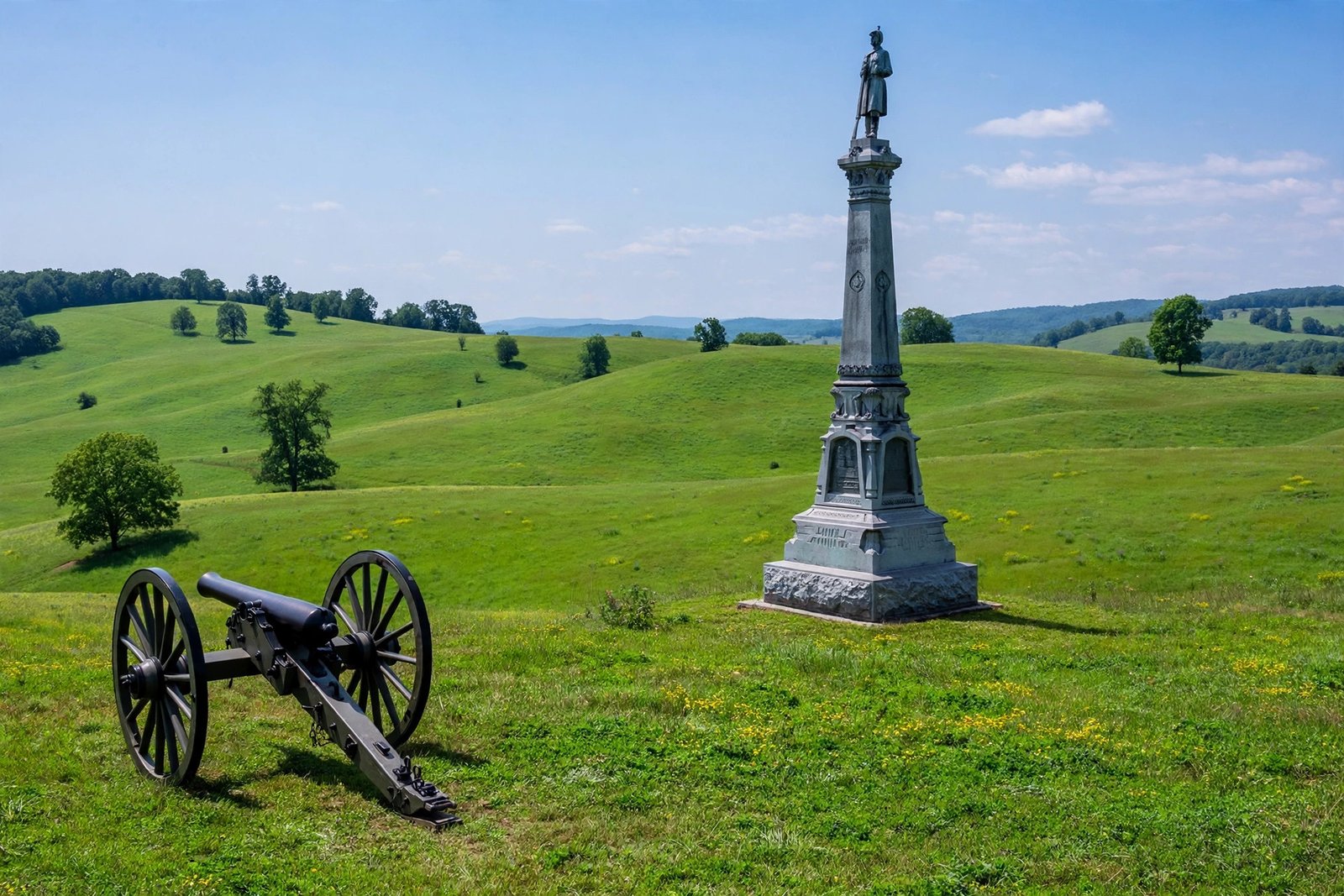
For a deeper account of the fighting, the National Park Service’s own historical handbook on Gettysburg remains a classic introduction. Gettysburg National Military Park now preserves nearly 6,000 acres of the battlefield, with more than 1,300 monuments, markers, and memorials — one of the largest collections of outdoor sculpture anywhere in the world. Visitors can walk Little Round Top, stand at the Angle where Pickett’s Charge reached its farthest point, and look out over the open fields the Confederates crossed on July 3.
The park’s museum and visitor center holds artifacts from the battle, including weapons, uniforms, and personal items carried by the soldiers. The Gettysburg National Cemetery, where Lincoln spoke, remains an active burial ground and a place of quiet reflection.
FAQ
When was the Battle of Gettysburg fought?
The battle was fought over three days, July 1–3, 1863, in and around Gettysburg, Pennsylvania. The first shots were fired on the morning of July 1, and the climactic Pickett’s Charge took place on the afternoon of July 3.
How many casualties were there at Gettysburg?
The National Park Service estimates about 51,000 total casualties — roughly 23,000 Union and 28,000 Confederate — including killed, wounded, captured, and missing. It was the bloodiest single battle of the Civil War.
Who commanded the armies at Gettysburg?
The Union Army of the Potomac was commanded by Maj. Gen. George G. Meade, who had taken command just three days before the battle. The Confederate Army of Northern Virginia was commanded by Gen. Robert E. Lee.
What was Pickett’s Charge?
Pickett’s Charge was the Confederate infantry assault on the afternoon of July 3, 1863, when about 12,500 men marched across open ground against the Union center on Cemetery Ridge. The attack failed with more than half the attackers killed, wounded, or captured, and it marked the climax of the battle.
Why is Gettysburg considered the turning point of the Civil War?
Gettysburg ended Lee’s last invasion of the North and cost the Confederacy men and officers it could not replace. Combined with the fall of Vicksburg on July 4, 1863, it shifted the war’s momentum to the Union for good, and it set the stage for Lincoln’s Gettysburg Address that November.