
Every day, millions of Americans slide into the left seat of their car, pull out of the driveway, and keep to the right side of the road without a second thought. It feels as natural as breathing, as if roads were simply built that way. But step off a plane in London, Sydney, or Tokyo, and the whole picture flips: traffic flows on the left, drivers sit on the right, and roundabouts spin the other way. So why did the United States end up driving on the right when the country it broke away from, Great Britain, still drives on the left?
The answer has nothing to do with cars. Automobiles did not arrive until the late 1800s, but Americans were already keeping right for more than a century before the first engine sputtered down a dirt road. The real story begins with horses, heavy freight wagons, and a practical problem: how do you steer a team of six horses down a narrow, muddy road without crashing into the wagon coming the other way?
The Short Answer: It Started With Wagons, Not Cars
If you want the one-sentence version, here it is: Americans drive on the right because the heavy freight wagons of colonial Pennsylvania were driven from the left side, and keeping to the right gave those drivers the best view of oncoming traffic.
That may sound like a small detail, but in the 1700s it was the difference between a safe journey and a wrecked wagon. Roads in colonial America were rough, narrow tracks of dirt and mud, often flanked by deep drainage ditches. There were no lane markings, no traffic lights, and no rules of the road in the modern sense. Drivers had to work out passing each other on the fly, and the way their wagons were built pushed them toward the right.
Over time, that practical habit hardened into custom, then into law, and finally into the layout of every car on American roads today. The story is a reminder that some of the most everyday things about American life were decided by people who never saw an automobile at all.
Colonial America Already Kept Right
One of the most surprising findings in this story comes from Albert C. Rose, who served as the unofficial historian of the U.S. Bureau of Public Roads for much of his long career, from 1919 to 1950. Rose dug into the question of why Americans drive on the right, and his conclusion was clear: right-hand travel was already the norm in colonial America from the time of the earliest settlements.
According to Rose, whose research is preserved by the Federal Highway Administration, the ox-team driver, the horseback rider, the handler of the lead horse, and even the pedestrian all traveled to the right. Travelers who carried handguns kept them in the hollows of their left arms and traveled to the right, the better to be ready if an oncoming stranger proved dangerous. In a world where most people were right-handed, keeping right put the weapon hand toward the center of the road, where a threat would appear.
This was not a rule anyone had written down. It was a habit that grew out of how people moved, what they carried, and how they defended themselves. And because the American colonies were settled by people from many different European countries, not just England, there was never a strong reason to import the English custom of keeping left. As Rose put it, no valid reason existed for transplanting the English left-hand rule to America.
The Conestoga Wagon: The Vehicle That Sealed the Deal
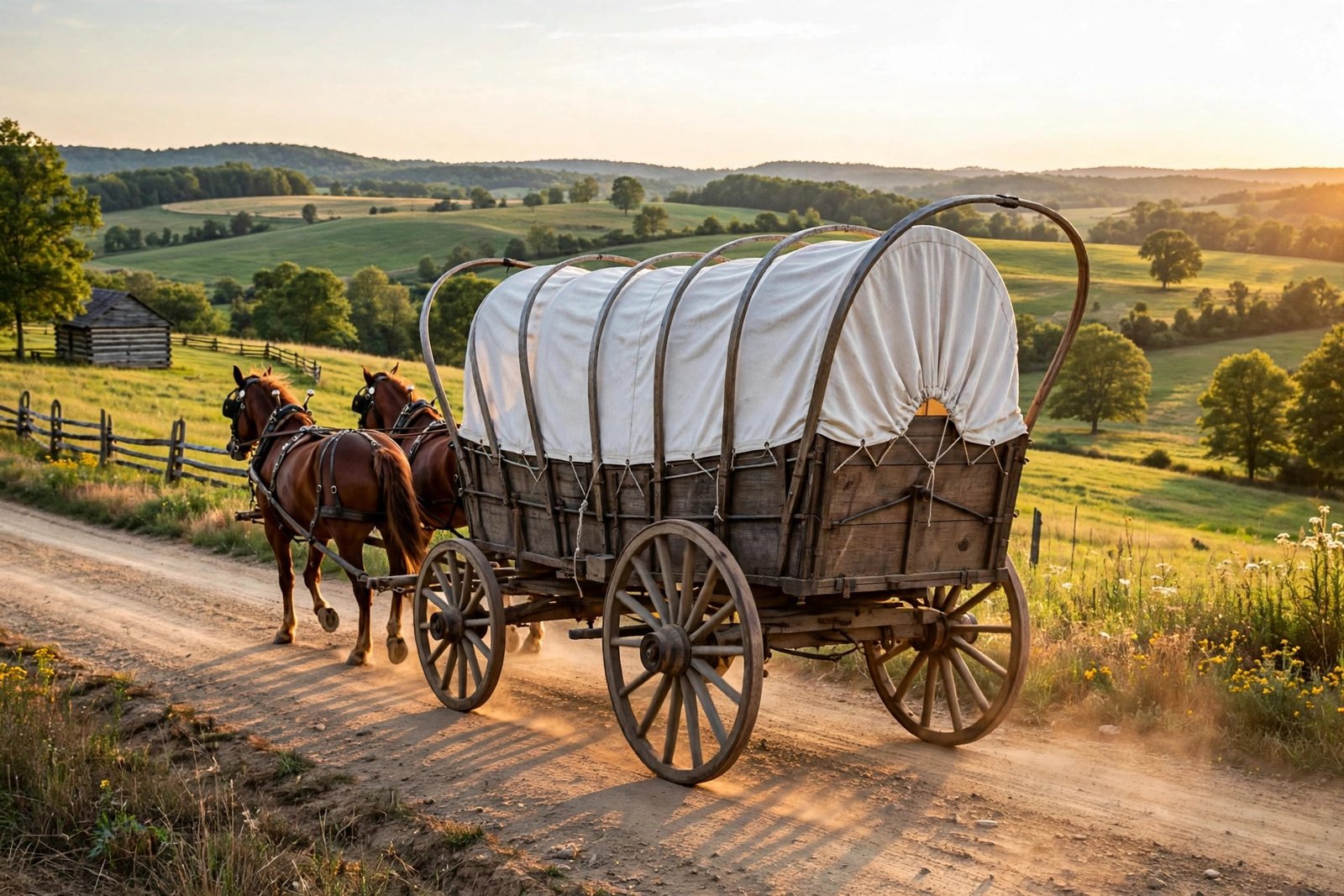
If one vehicle deserves the credit, or the blame, for American right-hand traffic, it is the Conestoga wagon. Introduced around 1750 in the vicinity of Lancaster, Pennsylvania, the Conestoga was the heavy freight truck of its day. It was a big, broad-wheeled wagon with a distinctive curved floor and a white canvas cover, built to haul enormous loads of grain, flour, and goods between the Pennsylvania frontier and the port of Philadelphia. Pulled by teams of four, six, or even eight horses, it became the main land transport vehicle for goods and people in the region, and its design shaped American driving for generations.
Here is the key detail: the Conestoga wagon had no driver’s seat at the front. Instead, the driver either rode postilion-style on the left rear horse, known as the wheel horse, or sat on a wooden plank called a “lazy board” that stuck out from the left side of the wagon. Sometimes the driver simply walked along the road on the left side of the horses. In every case, the driver was positioned on the left, holding the reins or jerk line with the left hand and the long black-snake whip with the right, while the brake lever was mounted on the wagon’s left side.
From that position on the left, keeping the wagon on the right side of the road made perfect sense. It gave the driver the clearest view of the road ahead and the best angle to judge the gap when passing an oncoming wagon. Passing on the right meant both drivers could watch the clearance on their left, where their wheels might clip. Australian historian M. G. Lay, who studied the history of the world’s roads, agreed with Rose that the Conestoga wagon provided a major impetus for right-hand driving in the United States.
As the Tennessee State Museum explains, the wagon’s drivers sat on the left so they could reach the brake lever and see traffic coming on the opposite side of the road, and historians believe this is one of the reasons North Americans drive on the right-hand side today. The Conestoga remained the main source of long-distance transport for decades, until steam railroads began to take over in the 1850s, but by then the habit was set for good.
From Custom to Law: Pennsylvania in 1792, New York in 1804
Habits are one thing; laws are another. For all the talk of wagons and whip hands, no formal rule of the road was adopted by the new country or by any state until 1792. That year, Pennsylvania adopted legislation to establish a turnpike from Lancaster to Philadelphia, and the charter legislation provided that travel would be on the right-hand side of the turnpike. It was the first formal keep-right rule in American history, and it was no coincidence that it came from the home of the Conestoga wagon.
New York followed in 1804, becoming the first state to prescribe right-hand travel on all public highways, not just a single turnpike. Other states followed suit over the coming decades, and by the time of the Civil War, right-hand travel was followed in every state. The custom had become the law of the land.
Roadside ditches helped push the process along. As traffic grew, the ditches that lined American roads encouraged drivers of light horse-drawn vehicles to both drive on the right and sit on the right side of their rig, so they could make sure their buggy or wagon did not slide into a ditch. In the late nineteenth century, that tendency grew even stronger, until the pattern we recognize today was firmly in place.
Why Britain Kept Left
To understand why America went right, it helps to understand why Britain stayed left. The most common explanation reaches back to medieval times, when travelers on horseback kept to the left so that their dominant right hand, usually holding a sword, was free to defend against an oncoming stranger. In an age when highway robbery was a real danger, passing on the left meant your weapon was between you and the other rider.
Historians do not fully agree on a single origin for the British custom, and the sword theory is a popular explanation rather than a proven fact. What is certain is that Britain formalized keep-left in law in the 1800s, and the practice then spread across the British Empire, carried by colonial administrators, soldiers, and settlers to India, Australia, New Zealand, South Africa, and dozens of other territories. The full history of the split shows how the two traditions grew apart long before cars existed.
Across the Channel, meanwhile, a different story was unfolding. In France, the Revolution upended old customs, and right-hand travel became associated with the new order. Under Napoleon, right-hand traffic spread across much of continental Europe as French armies and administrators redrew the map. The result was a continent divided: Britain and its empire on the left, much of the rest of Europe on the right. Canada, caught between British rule and American influence, was split for a time, with some provinces driving on the left and others on the right, before the whole country moved to the right in the 1920s.
The Model T and the Modern American Driver’s Seat
When automobiles began appearing in the 1890s, inventors thought of them as motorized wagons. Many early cars had the steering mechanism, a rudder or tiller rather than a wheel, in the center, where the side of the road did not make any difference. When the steering wheel arrived in 1898, a central position was no longer technically possible, and car makers usually copied existing practice by placing the driver on the curbside. That meant most American cars produced before 1910 were made with right-side driver seating, even though they were intended for right-side driving.
Henry Ford changed that. The 1908 Model T was the first of Ford’s cars to feature a left-side driving position, and the reasoning was practical: with the driver on the left, passengers could step out onto the curb on the right, away from traffic, and the driver had a better view of oncoming vehicles when passing. The Model T became so popular that by 1915, the rest of the automakers had followed Ford’s lead, and the left-side driver’s seat became the American standard.
Think about how strange that transition must have felt. For generations, American wagon drivers had sat on the right or ridden the left horse while keeping their vehicle to the right. Now, for the first time, the driver sat on the left side of the vehicle while the vehicle itself stayed on the right. It was a new arrangement, but it made perfect sense for a world of paved roads, passing lanes, and curbside parking. The history of the switch shows how a single popular car can reshape a habit that took a century to build.
Who Still Drives on the Left Today
Today, roughly 75 countries and territories drive on the left, home to about a third of the world’s population. The list includes the United Kingdom, Ireland, Cyprus, and Malta in Europe; India, Pakistan, Bangladesh, Japan, Thailand, Malaysia, Indonesia, and Singapore in Asia; South Africa, Kenya, and much of southern and eastern Africa; and Australia, New Zealand, and many Pacific island nations. Nearly all of them have historical ties to Britain. The main exceptions are Japan, Indonesia, Thailand, and Suriname, which kept left for their own historical reasons.
Japan’s case is especially interesting. The country was never part of the British Empire, yet it drives on the left, a custom often traced to samurai tradition, in which warriors passed on the left to keep their sword arms free, and later reinforced when British engineers helped build Japan’s first railway in the 19th century. Japan formally established left-hand road traffic in 1924. A complete list of left-driving countries shows just how far the British custom traveled.
Everywhere else, the map tells the story of empire and influence. The British exported keep-left around the world; the French and the Americans exported keep-right. Sweden was the last European holdout to switch, moving from left to right in a single carefully planned day, September 3, 1967, an operation known as Dagen H. The rest of the world, including the United States, Canada, China, continental Europe, and Latin America, drives on the right.
So the next time you merge onto an American highway, remember that your lane choice was made for you more than 250 years ago by a wagon driver perched on a plank on the left side of a Conestoga, whip in his right hand, watching the gap as another wagon rumbled past. The road has been paved, the horses have been replaced by horsepower, but the habit those drivers built is still carrying America forward, on the right side of the road.
Related Reading
Keep exploring American roads and the history behind them:
- Route 66 Facts: The Mother Road of the USA
- How the Interstate Highway System Built America
- American Road Trip Culture: A Complete Guide
Frequently Asked Questions
Why does America drive on the right while Britain drives on the left?
America drives on the right because of the Conestoga freight wagons of colonial Pennsylvania. Their drivers rode or sat on the left side of the wagon, so keeping to the right gave them the best view of oncoming traffic. Britain kept left for older reasons tied to horseback travel and sword use, then spread that custom across its empire.
When did driving on the right become law in the United States?
The first formal keep-right rule came in 1792, when Pennsylvania’s charter for the Lancaster-to-Philadelphia turnpike required travel on the right. New York became the first state to require right-hand travel on all public highways in 1804, and by the Civil War every state followed right-hand travel.
What was a Conestoga wagon?
The Conestoga wagon was a large, heavy freight wagon introduced around 1750 near Lancaster, Pennsylvania. Pulled by teams of four to eight horses, it hauled goods between the frontier and Philadelphia. It had no front driver’s seat; the driver rode the left rear horse or sat on a “lazy board” on the wagon’s left side.
How many countries drive on the left today?
Roughly 75 countries and territories drive on the left, including the United Kingdom, Ireland, Japan, India, Australia, and New Zealand. Together they are home to about a third of the world’s population. Most of them have historical ties to Britain, with Japan, Indonesia, and Thailand as the main exceptions.
Why do American drivers sit on the left side of the car?
American drivers sit on the left because of Henry Ford’s Model T, introduced in 1908. It was the first Ford with a left-side driving position, which let passengers step out onto the curb and gave the driver a better view when passing. The Model T was so popular that other automakers followed, and the layout became the American standard by 1915.