
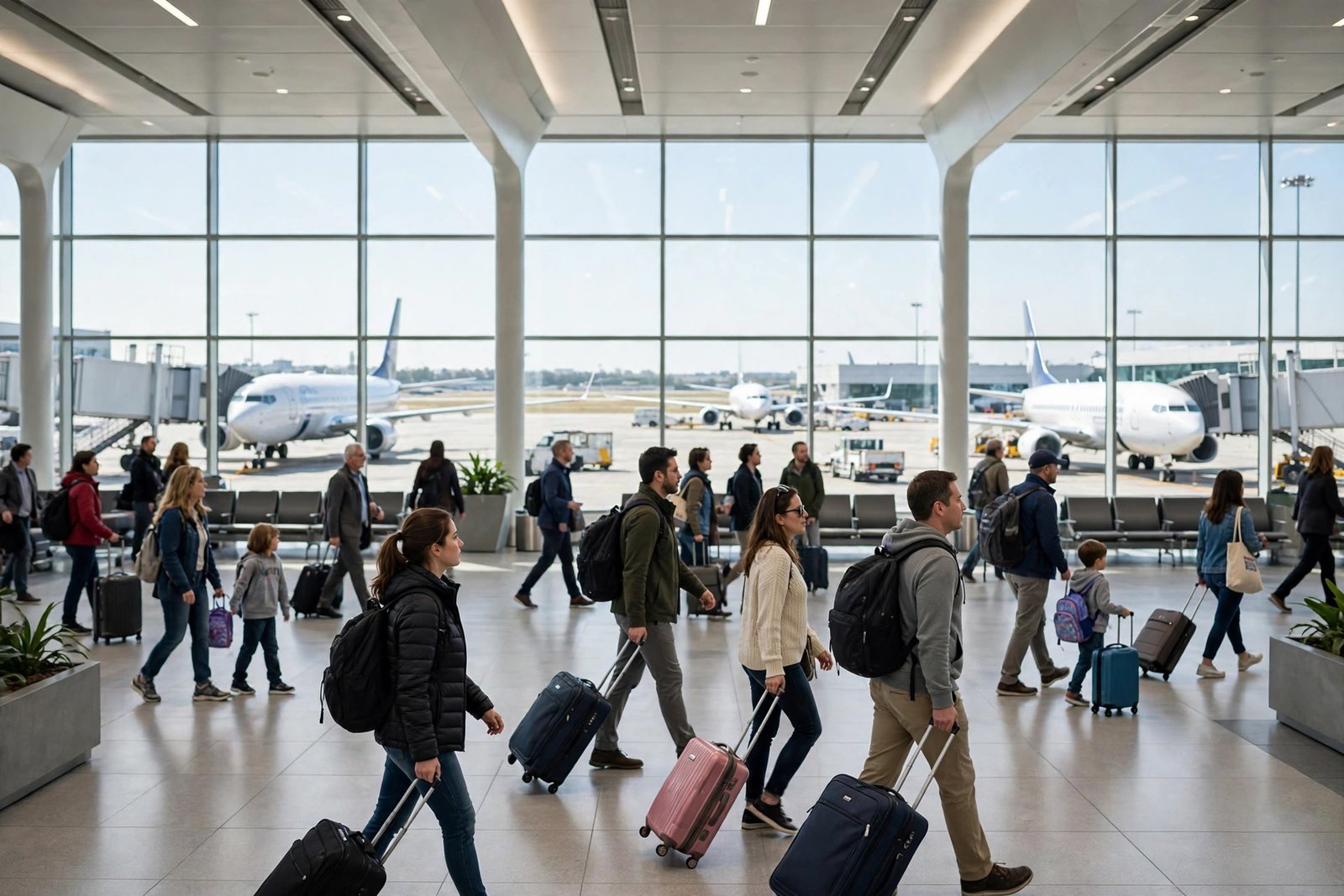
On Friday, November 13, 2026, American air travel came to a standstill in a way it had not for a generation. In the middle of a busy afternoon, the Federal Aviation Administration ordered every departing flight in the United States to stay on the ground. Planes that were already in the air were allowed to land, but nothing new took off. For more than four hours, the busiest airspace in the world went quiet, and by the time the order was lifted that evening, the disruption had rippled through every major airport in the country, stranded well over a million passengers, and forced airlines into a recovery effort that was still under way the following morning.
What happened on November 13, 2026
The Federal Aviation Administration issued a nationwide ground stop on Friday afternoon, November 13, 2026, citing what it called extraordinary circumstances and reasons for safety. The order applied to departing flights across the entire country. Aircraft already airborne were not ordered down; they continued to their destinations and landed normally. But at airports from New York to Los Angeles, from Atlanta to Seattle, departure boards turned red as flight after flight was held at the gate.
The scale of the halt was historic. According to reporting by Al Jazeera, this was the third nationwide ground stop of all departures since the September 11, 2001, attacks, and the longest since that day. The only comparable nationwide halt in between came in January 2023, when a failure in the system that sends safety alerts to pilots paused departures for about 90 minutes. Friday’s stop lasted far longer than that, running for more than four hours before the airspace was reopened.
The FAA confirmed later that evening that the ground stop had been lifted and that departures were resuming. But lifting the order did not mean an instant return to normal. Airlines had aircraft in the wrong cities and crews in the wrong places, and the process of putting the national schedule back together was expected to take days, not hours.
The timeline: from first instability to reopening
The trouble began in the afternoon, when the FAA started to detect instability in the radar and communications systems at its air route traffic control centres. Transportation Secretary Sean Duffy said the agency first identified the instability at 3:36 p.m. Eastern Time. Within minutes, the problem was serious enough that the FAA moved to protect the system, issuing the nationwide ground stop at 3:54 p.m. Eastern Time, according to Al Jazeera’s reporting.
The FAA’s own public message was blunt. In a post on X, the agency said there had been a temporary telecommunications outage and that, out of an abundance of caution, all flights had been halted. It added that every flight had been accounted for and that international flights would be handled on a case-by-case basis. That last point mattered: with more than 3,500 aircraft in the sky when the stop was issued, according to USA Today, the first priority was making sure every one of them landed safely. By 8 p.m., fewer than 400 aircraft remained airborne, a measure of how quickly the skies emptied.
For the next four hours, engineers worked to identify the fault and test the system. The FAA said it thoroughly tested its systems to confirm they were stable before lifting the nationwide stop. Airspace reopened at 8:15 p.m. Eastern Time, Secretary Duffy said, and the FAA confirmed the cancellation of the ground stop on its website shortly afterwards. Some flights were cleared even earlier: Pacific-bound and transatlantic departures were allowed to go before the nationwide clearance, according to reports from San Francisco and Boston airports.
What caused the outage
The FAA said the ground stop was caused by a telecommunications outage affecting air traffic control systems, specifically the network that links the country’s air route traffic control centres, which handle flights travelling across the country. At a press briefing after the stop was lifted, Transportation Secretary Sean Duffy gave the clearest explanation of what went wrong. Radar communications at air traffic control centres became unstable in the afternoon, he said, and the problem pointed to a fault in the FAA’s older network.
The language Duffy used was striking. “We have old switches, old routers. We use 1980s little copper lines,” he said, describing a system built on analogue technology that has been patched and extended for decades. The switches and routers on that older network, he explained, had become overloaded with data. They started to give inconsistent readings, and because controllers could not rely on the information they were seeing, the FAA shut the system down rather than risk operating on bad data.
What caused the overload itself remained unclear in the first hours, Reuters reported. A telecommunications network overseen by L3Harris Technologies appeared to be among the systems affected, The Wall Street Journal reported. L3Harris is also involved in replacing decades-old copper connections across FAA facilities with fibre, satellite and wireless links as part of a wider overhaul of the system, and the administration said on Friday that 68 percent of the FAA’s legacy copper telecommunications network had already been replaced with high-speed fibre, according to Reuters. That progress, however, did not prevent the failure on the part of the network that still runs on older equipment.
Officials were emphatic about what the outage was not. Homeland Security Secretary Markwayne Mullin told reporters outside the White House that there was no indication of a cyberattack and no evidence that the incident was a nefarious act against the United States. “This isn’t another 9/11,” Mullin said. “This is a telecommunication outage.” He also said the incident was not linked to the Microsoft outage that had affected other services. Duffy added that the outage did not involve a total loss of communications or radar capabilities, and that exceptions were made to allow critical medical evacuation flights, life-saving cargo and law enforcement flights to continue operating.
How many flights and passengers were affected
The numbers from Friday tell the story of a system-wide shock. More than 10,000 flights were delayed and around 5,000 were cancelled on the day, with some counts running higher as the evening wore on. FlightRadar24 put the figures at more than 4,700 cancellations and 10,000 delays on Friday, with another 700 flights already cancelled for Saturday. By later in the evening, the cancellation count for Friday alone had passed 6,600, according to FlightAware figures cited by The New York Times, and Al Jazeera reported that more than 8,000 flights had been cancelled nationwide as a result of the FAA-ordered stop.
The passenger impact was just as large. About 1.5 million passengers were stranded or faced travel disruption across the United States following the nationwide suspension of flight departures, according to The Associated Press, as reported by Al Jazeera. The Indian Express, citing CNN reporting, also put the figure at about 1.5 million passengers stranded. Behind that number are individual stories repeated at airport after airport: missed connections, ruined weekends, weddings and funerals missed, and business trips abandoned.
It is worth remembering what a ground stop actually does. It does not close the airspace to aircraft already flying, and it does not mean planes fall from the sky. It means no new departures.
Why this stop was different from January 2023
Friday’s halt invites comparison with the last nationwide ground stop, in January 2023, when a failure in the NOTAM system, the system that sends safety alerts to pilots, paused departures for about 90 minutes. That incident was resolved relatively quickly and was traced to a single database file that had been corrupted. The November 2026 stop was longer, broader in its cause, and more revealing about the underlying state of the system.
The comparison that officials themselves reached for was September 11, 2001. After the attacks that day, American airspace was closed to commercial flights for about two days. Friday’s stop was the longest nationwide halt since then, a fact that underlines how rare and how serious the FAA considered the situation. At the same time, officials were careful to draw the line clearly: this was a technical failure, not an attack, and the system was shut down deliberately as a safety measure, not overwhelmed by events beyond its control.
What travellers should do now
If you were caught in Friday’s disruption, or you are due to fly in the coming days, the first step is the simplest: check your flight status before leaving for the airport. Airlines were still repositioning aircraft and crews on Saturday, November 14, and delays and cancellations were continuing into the weekend. FlightAware’s live tracking pages are a useful independent check alongside your airline’s own app and website, and the FAA’s own site carries official advisories about the state of the system.
If your flight was cancelled, you are generally entitled to a refund if you choose not to travel, and airlines were offering rebooking on later flights. Keep every receipt for meals, hotels and alternative transport, because reimbursement policies vary by airline and by the reason for the disruption, and a paper trail makes any claim far easier. If you were rebooked automatically, check the new itinerary carefully: rebookings made in a hurry can route you through a different city or leave you with a connection that is too tight to make.
For those travelling in the run-up to Thanksgiving, the timing of this outage is a warning worth heeding. Build extra time into your plans, consider travelling a day earlier than you strictly need to if you can, and keep an eye on the weather as well, since winter conditions add their own delays to an already stretched system. Travellers who need a refresher on identification rules for domestic flights can find it in our guide to REAL ID, and those still planning holiday journeys should read our guide to the best and worst days for Thanksgiving travel, both linked below.
The bigger question: America’s ageing air traffic system
Friday’s outage has put the state of America’s air traffic control system back at the centre of public debate, and the debate is not new. The system that guides aircraft across the United States is one of the largest and most complex in the world, and parts of it date back decades. Controllers still work with equipment that in some places relies on copper lines installed in the 1980s, and the modernisation programme to replace those lines with fibre, satellite and wireless links is under way but incomplete.
Secretary Duffy’s remarks on Friday were unusually frank for a cabinet official in the middle of a crisis. He blamed ageing technology directly, and he described a network of old switches and routers that could be overwhelmed by the volume of data passing through them. That is not a story about a single broken component. It is a story about a system that has been asked to carry far more traffic, with far more data, than the infrastructure it was built on was designed to handle.
The modernisation effort is real. The administration said 68 percent of the FAA’s legacy copper telecommunications network has now been replaced with high-speed fibre. But the remaining share, the part that still runs on older technology, is evidently enough to bring the whole network down when it fails. That raises hard questions about priorities and pace: which parts of the system are replaced first, how quickly the work can be done, and what happens in the meantime if another part of the old network fails in the same way.
There is also a staffing dimension that cannot be ignored. Air traffic control has faced controller shortages for years, and a system that depends on human controllers working with ageing equipment is more vulnerable when something goes wrong. Friday’s controllers did their jobs: every flight was accounted for, and no one was hurt. But the episode is a reminder that safety in aviation depends on layers of protection, and when one layer fails, the others have to work harder.
For now, the immediate questions are practical ones. Will the FAA identify the precise cause of the overload? Will the fix be a repair, a replacement, or an acceleration of the modernisation programme? And will travellers see a repeat before the old network is fully retired? Those answers will come in the days and weeks ahead, as the FAA completes its investigation and reports back. What is already clear is that Friday, November 13, 2026, will be remembered as the day America’s skies went quiet, and as a warning that the system guiding them needs finishing, not just starting, its upgrade.
FAQ
What was the FAA nationwide ground stop on November 13, 2026?
It was an order from the Federal Aviation Administration halting all departing flights across the United States after a telecommunications outage affected air route traffic control centres. The stop began at 3:54 p.m. Eastern Time and was lifted at 8:15 p.m. the same evening, lasting more than four hours.
How many flights were cancelled or delayed?
More than 10,000 flights were delayed and around 5,000 were cancelled on Friday, with counts rising through the evening. FlightAware figures cited by The New York Times put Friday cancellations above 6,600 by 9:30 p.m., and about 1,500 Saturday flights had already been cancelled by then.
Was the outage caused by a cyberattack?
No. Homeland Security Secretary Markwayne Mullin said officials had found no evidence of a cyberattack and no indication that the incident was a nefarious act. Transportation Secretary Sean Duffy blamed ageing technology, saying old switches and routers became overloaded with data. Officials also said it was not linked to the Microsoft outage.
How many passengers were affected?
About 1.5 million passengers were stranded or faced travel disruption, according to The Associated Press and CNN reporting cited by the Indian Express. The disruption also affected transatlantic travel, with Europe’s EASA suspending departures to the United States from 5 p.m. to midnight Eastern Time at the FAA’s request.
Are flights back to normal now?
Departures resumed on Friday evening, but delays continued into Saturday, November 14, as airlines repositioned aircraft and crews. Travellers should check their flight status before heading to the airport and expect some residual delays while the schedule recovers.
Related reading
- REAL ID and Domestic Flights: A Traveler’s Guide
- Thanksgiving Travel 2026: Best and Worst Days Guide
- NOAA Winter Outlook 2026-2027 for the USA
Sources: Federal Aviation Administration; FlightAware; The Hindu live updates; Indian Express live updates; Indian Express explainer; Al Jazeera; USA Today.